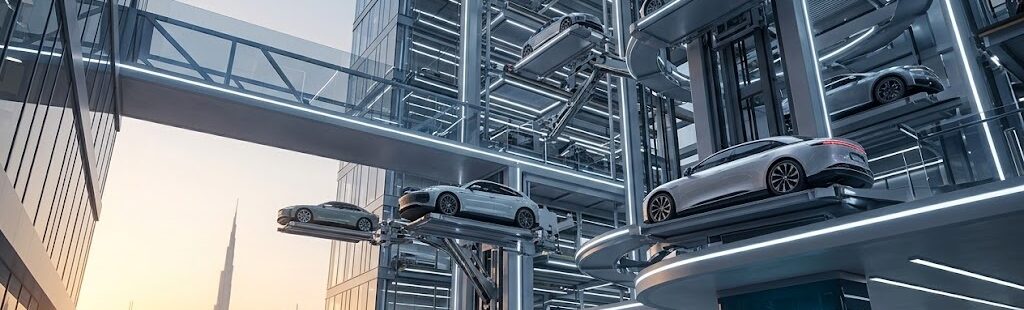



Mechanical Parking Systems in Dubai: How the City Solves Parking on the World’s Most Expensive Land
Dubai builds vertically because it has no other choice. Land in Downtown Dubai, DIFC, Business Bay, and Dubai Marina is among the most expensive in the Middle East, and every square meter a developer allocates to a flat parking ramp is a square meter that isn’t generating rental income, retail revenue, or additional saleable floor area. At the same time, Dubai’s planning authorities require every residential, commercial, and mixed-use development to meet specific parking ratios based on project type and occupancy — and meeting those ratios through conventional flat-floor parking structures can consume between 15% and 25% of a project’s total construction cost.
That single fact explains why Dubai has quietly become one of the most advanced mechanical and automated parking markets in the world, home to some of the largest robotic parking installations ever built. This guide breaks down how the technology works, what’s already been built across the city, and how developers, hoteliers, and facility owners should think about specifying the right system for a Dubai site.
Why Dubai’s Parking Problem Is an Economics Problem First
Unlike cities where parking shortages stem mainly from historic street layouts or heritage restrictions, Dubai’s challenge is almost purely economic: land value versus land consumption. A conventional ramp-style parking garage needs wide circulation lanes, ramps between levels, and significant floor-to-floor height, all of which eat into a building’s footprint and gross floor area (GFA) without generating any revenue themselves.
In the Dubai International Financial Centre (DIFC), this tension became impossible to ignore during the design of the Emirates Financial Towers. Architects needed to deliver roughly 1,200 parking spaces beneath twin towers, but a traditional ramp-style concrete garage would have consumed nearly 30% of the available land area and required a basement roughly 38 meters deep — a depth made cost-prohibitive and technically unfeasible by Dubai’s high water table and increasing soil pressure at depth. The solution was a fully automated robotic parking system that delivered the same capacity within roughly half that depth, at around 20 meters below grade, preserving gross floor area, cutting excavation costs, and solving an engineering problem that conventional construction simply could not.
This is the story behind most large-scale mechanical parking investment in Dubai: it isn’t a lifestyle upgrade, it’s a load-bearing part of the project’s financial model.
What’s Already Been Built: Dubai’s Mechanical Parking Track Record
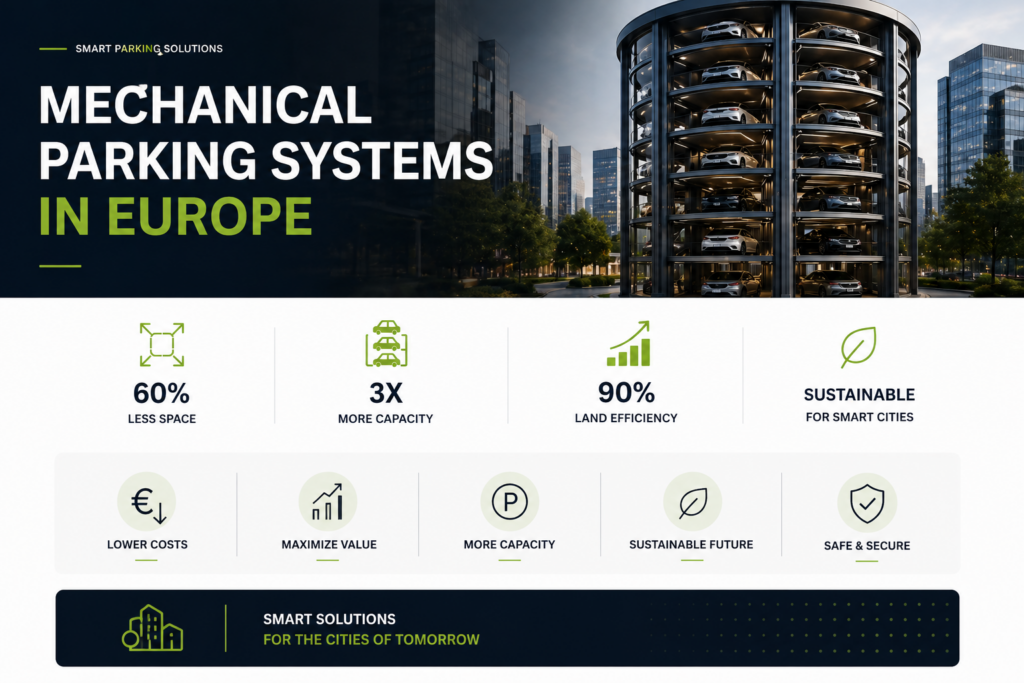
Dubai already hosts some of the most significant automated parking installations in the world. The Emirates Financial Towers in DIFC feature a fully automated robotic parking system accommodating 1,194 vehicles, making it the world’s second-largest automated parking system, integrated into the basement beneath the twin towers without disturbing the architectural vision or structural layout above it. The same manufacturer’s technology went on to power an even larger installation in Kuwait, which currently holds the Guinness World Record for the largest fully automated parking facility.
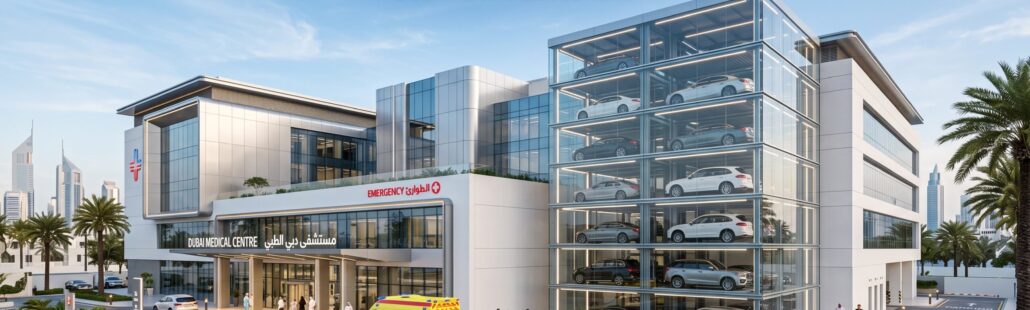
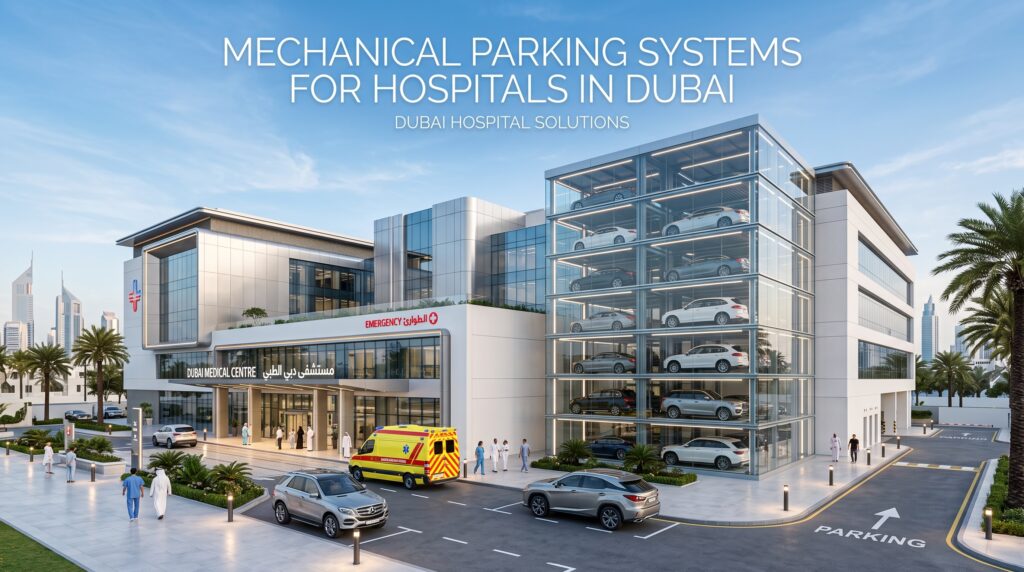
At the healthcare end of the market, Al Tadawi Hospital commissioned a fully automated car park system in 2021, installing a multi-level automated parking system across three parking levels for 143 spaces — a scale far more typical of the mid-size institutional projects most developers will actually be planning.
Locally headquartered players have also built a track record across sectors: SPS, a parking systems design and construction firm based in Dubai, lists education, hospitality, government, airports, stadiums, and office towers among its completed sectors regionally and internationally. Meanwhile, ultra-compact rotary robotic systems from providers like Park Up — which holds a record for the most compact mechanical parking footprint in the world — have targeted smaller sites such as corporate offices, government buildings, healthcare facilities, and residential complexes, upgrading a standard two-car space into a structure holding up to 12 to 16 vehicles within a footprint of just 31 to 42 square meters.
Software Is Only Half the Picture
Search “smart parking Dubai” today and most of what surfaces is about the digital layer: Dubai has rolled out AI-powered, ticketless parking using ground-level cameras and automatic number plate recognition at locations including Dubai Harbour and Dubai Mall, with fees deducted automatically through the Salik toll account via a partnership between Parkonic and Salik Company. This kind of software layer — sensors, automatic billing, mobile apps — genuinely improves how efficiently an existing parking supply is used.
But no amount of AI-powered plate recognition creates a single new parking space where none physically exists. That is the job of the mechanical and structural layer — lifts, puzzle platforms, and robotic towers — and it is precisely the layer that made a project like Emirates Financial Towers possible in the first place. The most sophisticated Dubai developments increasingly combine both: mechanical hardware that maximizes physical capacity, and digital systems layered on top to manage access, payment, and real-time availability.
What Is a Mechanical Parking System?
A mechanical parking system uses hydraulic, mechanical, or fully robotic movement to place and retrieve vehicles, rather than relying on a driver’s own maneuvering. Broadly, these fall into three categories:
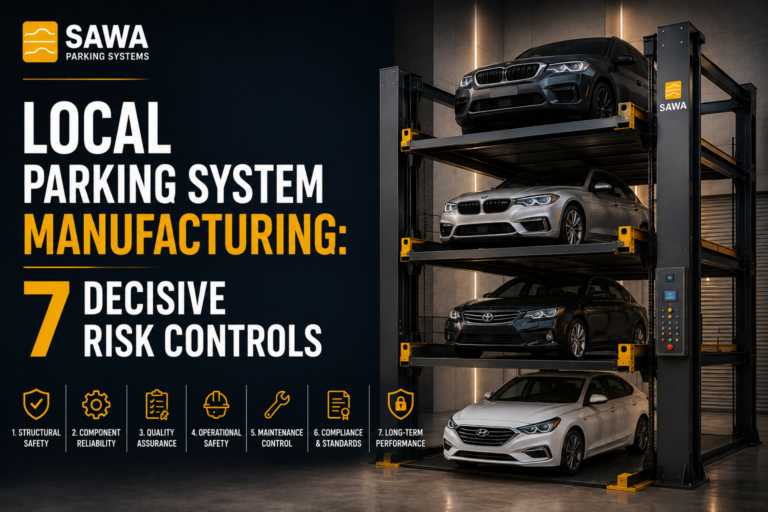
- Semi-automated systems, where the driver parks onto a platform that is then lifted or shifted mechanically to free additional space.
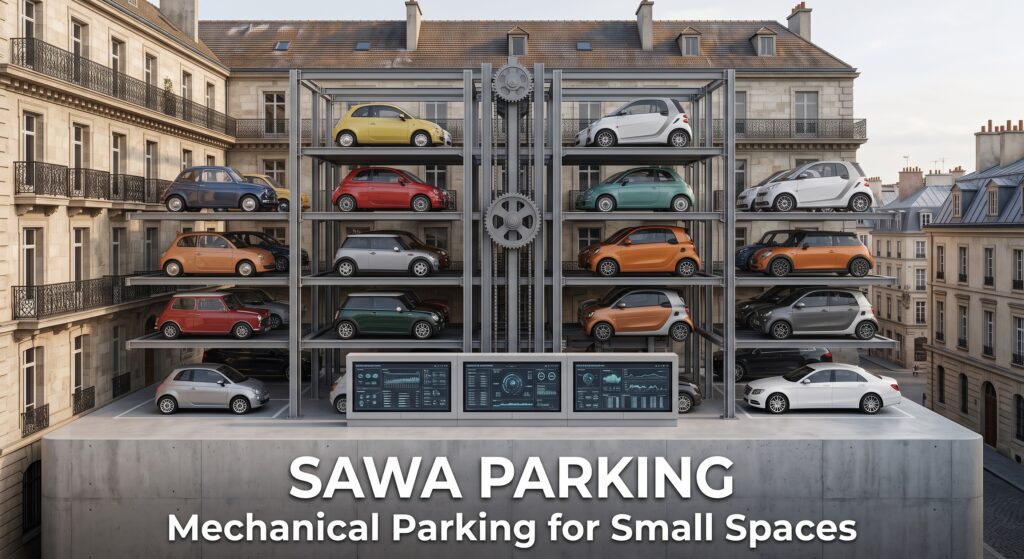
- Puzzle and shuttle systems, which move multiple vehicles both vertically and horizontally so any car can be retrieved without moving every other vehicle in a fixed sequence — arranging vehicles on motorized platforms that automatically reposition to create access pathways whenever a retrieval is requested.
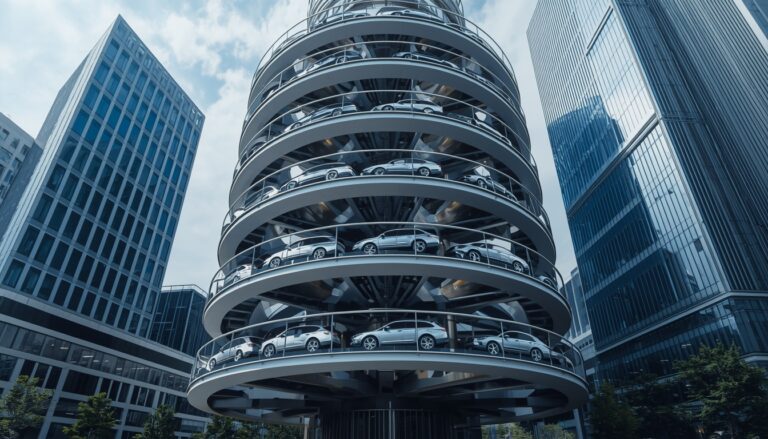
- Fully automated (robotic) tower systems, where the driver leaves the car at a transfer bay and a central lift mechanism transports it to a designated bay in a fully automated structure, achieving parking densities several times greater than a traditional garage on the same footprint.
The Types of Systems Best Suited to Dubai’s Market
Two-Post and Four-Post Lifts
The simplest, most cost-effective entry point — doubling capacity for villas, boutique commercial buildings, and small staff parking areas across communities like Jumeirah, Al Barsha, and the emerging villa developments tied to Golden Visa-driven real estate investment.
Ultra-Compact Rotary and Stacker Systems
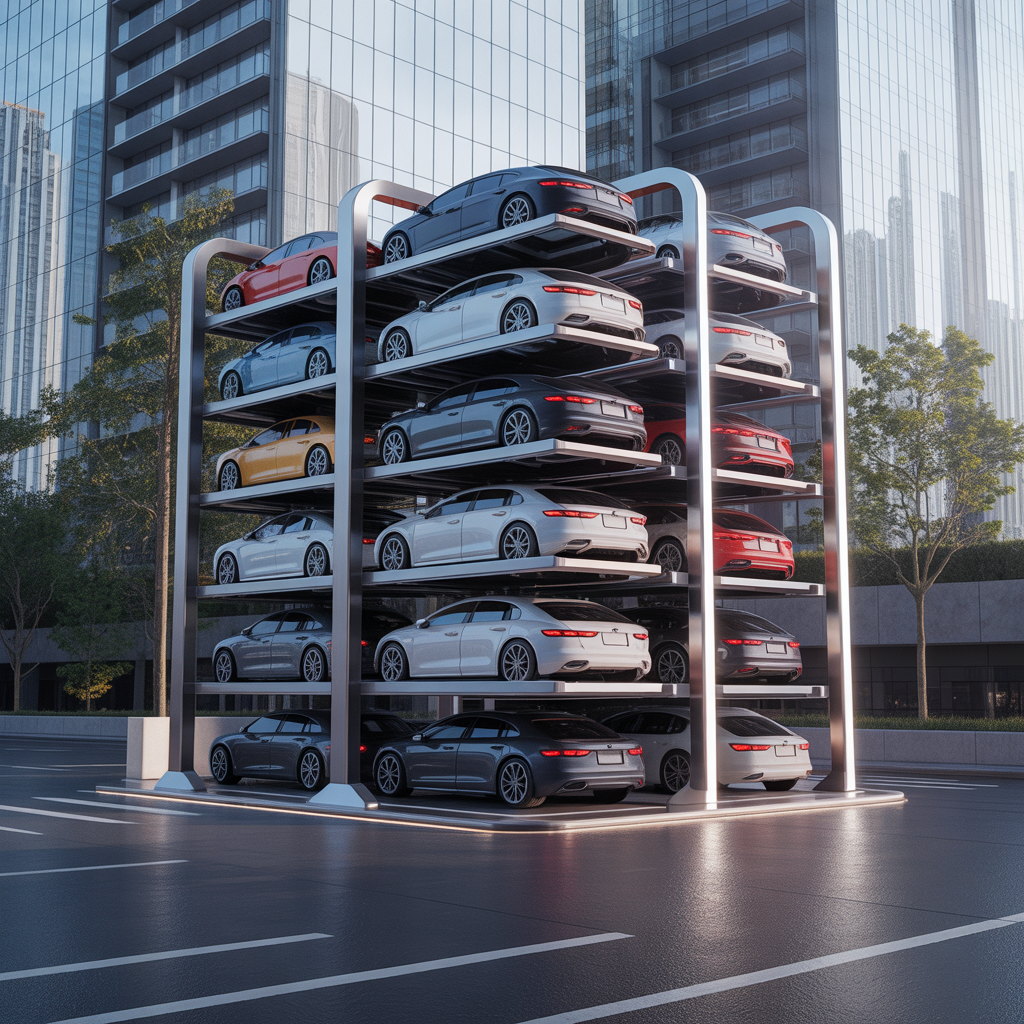
Best suited to plots where footprint is the binding constraint rather than budget — corporate offices, government buildings, clinics, and smaller residential buildings, where an ultra-compact rotary unit can multiply a standard two-car space into a structure holding well over a dozen vehicles.
Puzzle Parking Systems
A strong fit for mid-size residential towers, boutique hotels, and mixed-use developments across Business Bay and Dubai Marina, where independent vehicle retrieval matters but a full robotic tower isn’t justified by the site or budget.
Fully Automated Robotic Tower Systems
The highest-capacity format and the technology behind Dubai’s largest installations, best suited to premium high-rise developments, financial districts, and mixed-use towers where every square meter above and below ground carries significant commercial value — and where, as at DIFC, engineering constraints like high water tables or strict height limits rule out a conventional ramp-style garage entirely.
Mechanical Parking Systems for Modern Airports | Smart Parking
Where Mechanical Parking Delivers the Most Value in Dubai
Premium high-rise residential and commercial towers. In districts like DIFC, Downtown Dubai, and Business Bay, land value makes every square meter recovered from ramps and driveways directly convertible into leasable space — the exact calculation that drove the Emirates Financial Towers decision.
Hospitals and healthcare facilities. As the Al Tadawi Hospital project demonstrates, healthcare sites need secure, high-throughput parking for staff, patients, and emergency vehicles alike, without the footprint of a sprawling surface lot.
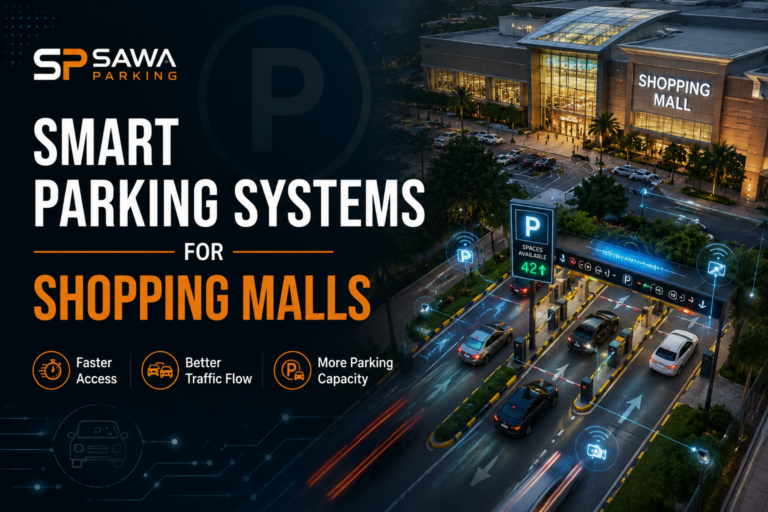
Shopping malls and retail destinations. Dubai’s malls already combine smart, ticketless entry systems with high-capacity parking structures to manage some of the highest visitor volumes of any retail destinations in the world.
Hospitality. Dubai’s hotel sector, from beachfront resorts to boutique city-center properties, increasingly treats guaranteed, secure valet-style parking as a baseline guest expectation, particularly on constrained downtown plots.
Government and institutional buildings. Automated systems are already deployed across government facilities in Dubai to combine high security with efficient space utilization.
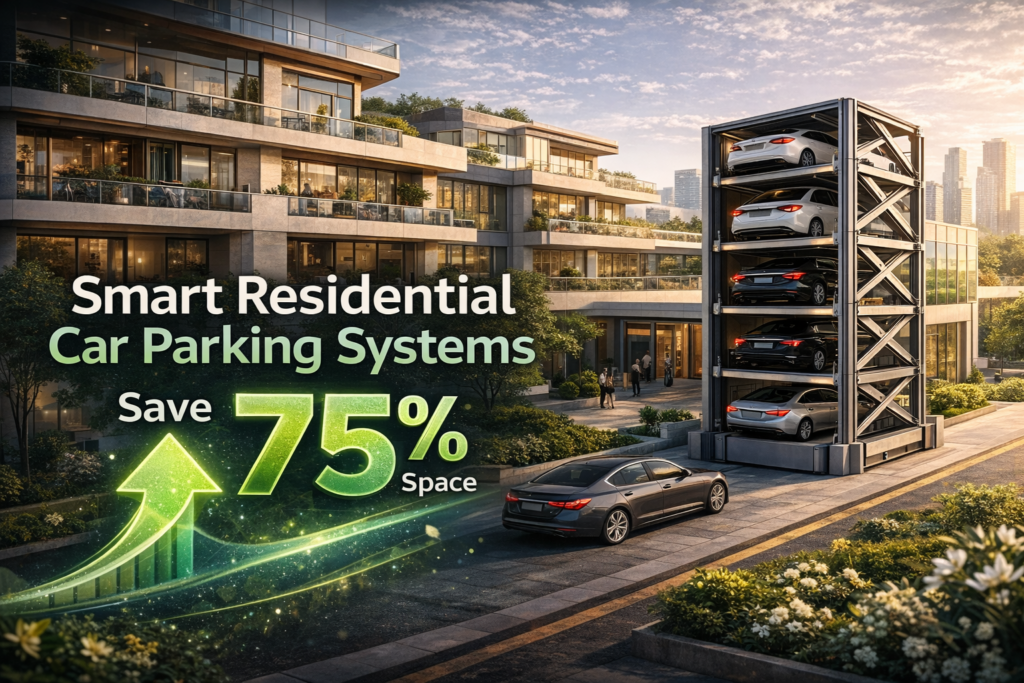
Golden Visa-driven villa and residential developments. International investment in Dubai real estate has fueled a wave of villa and boutique residential construction, where compact lift and rotary systems let smaller plots offer secure, on-site parking without sacrificing garden or living space.
Cost, ROI, and What Affects Pricing in Dubai
Cost factors for automated parking systems in Dubai include system type and complexity, number of parking spaces required, site conditions, customization requirements, integration with existing access-control or payment systems, and ongoing maintenance packages. As a general pattern:
- Two-post/four-post lifts and compact rotary units offer the fastest installation timelines — some ultra-compact systems can be installed in as little as five days post-groundwork — and the lowest cost per additional space, making them a practical entry point for villas, clinics, and small commercial buildings.
- Puzzle and mid-size stacker systems sit in the mid-range, delivering a meaningful capacity jump relative to cost for residential towers and boutique hospitality projects.
- Fully automated robotic towers require the highest upfront investment but deliver the strongest ROI on Dubai’s most expensive land, since — as the DIFC case demonstrates — they can free up 50% or more of the land area a conventional garage would have consumed, while preserving gross floor area that would otherwise have been lost to ramps and excavation depth.
Given that conventional parking can account for 15% to 25% of total project cost on constrained urban sites, developers evaluating mechanical parking should treat the comparison not as “extra cost versus no cost,” but as one construction method versus another — with the mechanical option frequently proving cheaper overall once excavation depth, GFA preservation, and construction time are all priced in.
Climate and Site Considerations Specific to Dubai
Extreme heat. Sustained summer temperatures affect hydraulic fluids, lubricants, and electronic components, making thermal tolerance and adequate ventilation or cooling provisions essential specification details for any system operating in Dubai.
Sand and dust exposure. Proximity to desert terrain means optical and laser-based vehicle detection sensors require sealed enclosures and more frequent cleaning cycles than in temperate climates.
High water table. As the DIFC project demonstrated, deep excavation for conventional underground garages becomes disproportionately expensive and technically difficult as soil pressure and water table depth increase — a site condition that specifically favors mechanical systems capable of delivering equivalent capacity at shallower depths.
Height and concourse restrictions. Many of Dubai’s most valuable districts, including DIFC, impose uniform concourse-level height requirements across neighboring buildings, meaning any parking solution must work within tightly fixed vertical constraints rather than a freely adjustable design.
Mechanical Parking Systems in Egypt | Sawa Parking
How to Choose the Right System for a Dubai Project
- Available footprint, soil conditions, and water table depth — determines whether a tower, puzzle, or simple lift system is the physically and economically viable choice.
- Applicable parking ratio requirements — confirm the exact capacity your project must legally provide under Dubai’s planning regulations for your project type and occupancy.
- Expected vehicle volume and retrieval speed needs — malls, hospitals, and government buildings need faster throughput than long-stay residential or villa parking.
- Budget and phasing — some developers start with a compact rotary or lift system for a smaller building and scale up capacity or automation level on larger phases.
- Climate-appropriate components — confirm the manufacturer specifies heat-tolerant hydraulics and sealed, dust-resistant sensor housings suited to Dubai’s environment.
- After-sales support and maintenance response times — a system is only as reliable as the servicing behind it, so confirm local support availability before committing.
What to Look for in a Mechanical Parking Manufacturer
Dubai’s market includes both software-first operators focused on ticketless access and payment, and hardware manufacturers and installers focused on the physical structure itself — and the two are not interchangeable. When evaluating a partner specifically for mechanical parking hardware, look for:
- In-house design and manufacturing capability, rather than pure resale of imported equipment, which typically translates into faster customization for irregular or constrained plots and more responsive after-sales support.
- A verifiable, large-scale track record, since Dubai’s market has already proven that these systems can perform reliably at the scale of over a thousand vehicles in a single installation.
- End-to-end turnkey service — site consultation, engineering design, manufacturing, installation, and long-term preventive maintenance under one accountable provider.
- Clear warranty terms on structural steel and mechanical components, with confirmed local spare parts availability.
- Regional climate experience, since a manufacturer accustomed only to temperate markets may not adequately account for Dubai’s heat, dust, and high-water-table site conditions.
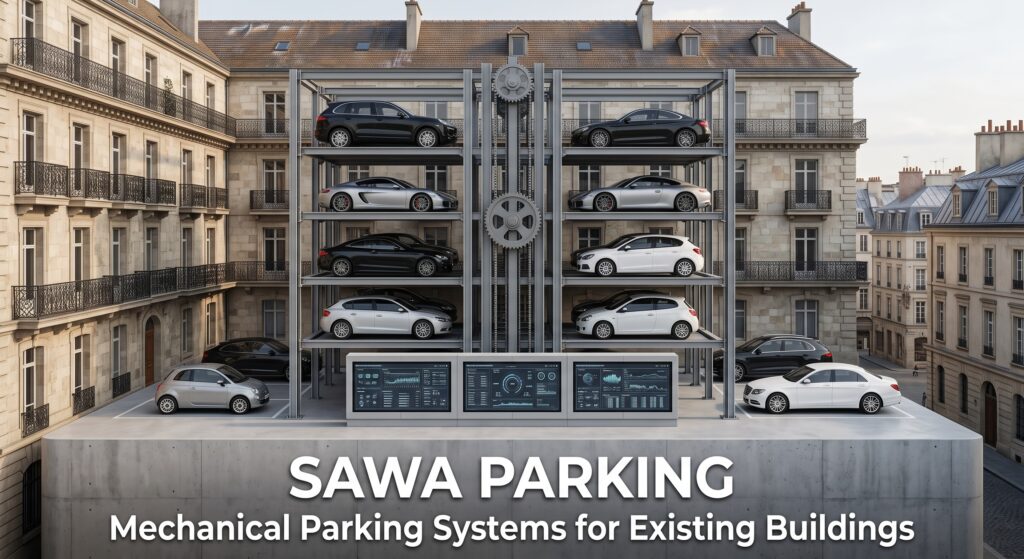
SAWA Parking was established as the first factory in Egypt, Africa, and the Middle East dedicated specifically to manufacturing mechanical and automated parking systems, and has already exported systems to Mediterranean markets including Italy and France. SAWA offers a complete turnkey process — planning and consultation, engineering design, in-house manufacturing, installation, and ongoing maintenance — giving Dubai developers, hoteliers, and facility owners a single point of accountability from the first site assessment through years of operational support. For projects ranging from a compact villa lift in a Golden Visa residential community to a mid-size puzzle system for a boutique hotel or commercial building, working with a manufacturer that controls its own production line — rather than reselling third-party hardware — typically means faster lead times, easier customization, and more responsive regional support after installation.
The Road Ahead
Dubai’s approach to parking already reflects where most global cities are heading: a physical layer of mechanical and robotic hardware that maximizes capacity on expensive, constrained land, paired with a digital layer of AI-powered access, plate recognition, and automated billing that makes using that capacity effortless. As the city’s population and vehicle ownership continue to grow, and as new districts develop under Dubai’s long-term urban planning framework, the economics that made mechanical parking essential at DIFC — high land value, height restrictions, and challenging soil conditions — will only become more common across the city’s newer developments.
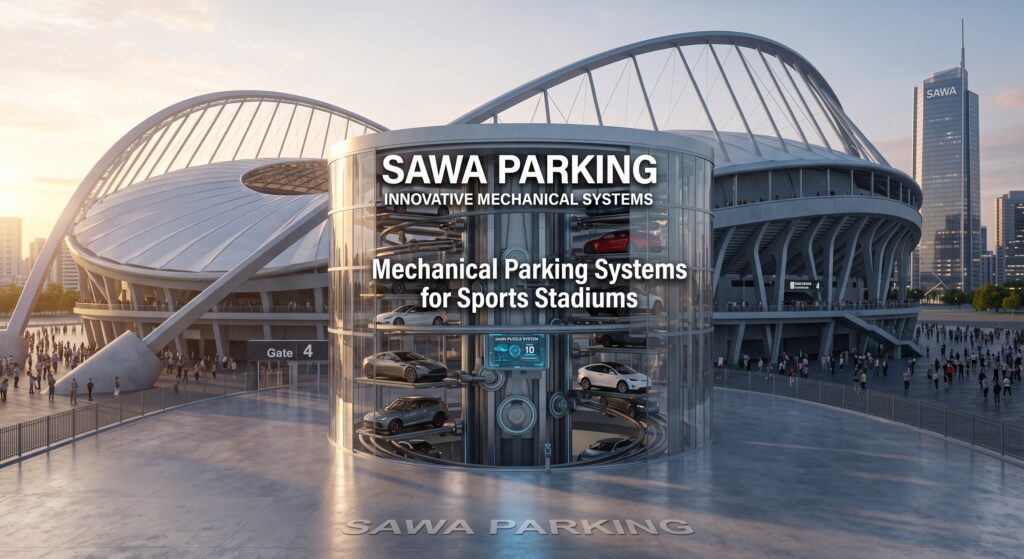
If you are planning a residential tower, hospitality project, hospital, or villa development anywhere in Dubai and want to explore which mechanical parking solution fits your site, SAWA Parking’s team can review your project details and propose a tailored parking strategy from concept through long-term maintenance.
Sources
- Robotic Parking Systems — Emirates Financial Towers, DIFC Dubai: 1,194-Space Automated Parking Case Study. https://roboticparking.com/project/emirates-financial-towers-eft-dubai-uae-1200-spaces/
- AEDLER Logistik Solutions — Al Tadawi Hospital Fully Automated Car Park System, Dubai. https://www.als.aero/fully-automated-car-park-solution.php
- KTC International — Mechanical Parking Systems in the UAE: A Guide for Urban Developers. https://ktcco.net/tec/mechanical-parking-for-urban-developments/
- JobXDubai — Dubai’s Smart Parking: Fully Automated Ticketless System Launched. https://blog.jobxdubai.com/2025/03/08/dubais-smart-parking-ticketless-automated-system-locations/
- Park Up — Rotary Robotic Parking Systems in Dubai. https://parkup.ae/