

Mechanical Parking in Saudi Arabia: How Vision 2030, NEOM, and Riyadh’s Giga-Projects Are Redefining Parking
Saudi Arabia is building faster than almost anywhere else on earth. Riyadh is racing toward Vision 2030 landmarks like Qiddiya, King Salman Park, and Expo 2030. NEOM is rising in the northwest, anchored by The Line, a 170-kilometer linear city being built explicitly around the idea of eliminating the private car altogether. And across the Kingdom, giga-projects, new residential communities, and mixed-use towers are reshaping what “urban” means in Saudi Arabia.
Underneath all of that ambition sits a very physical, very unglamorous problem: where do you actually put the cars?
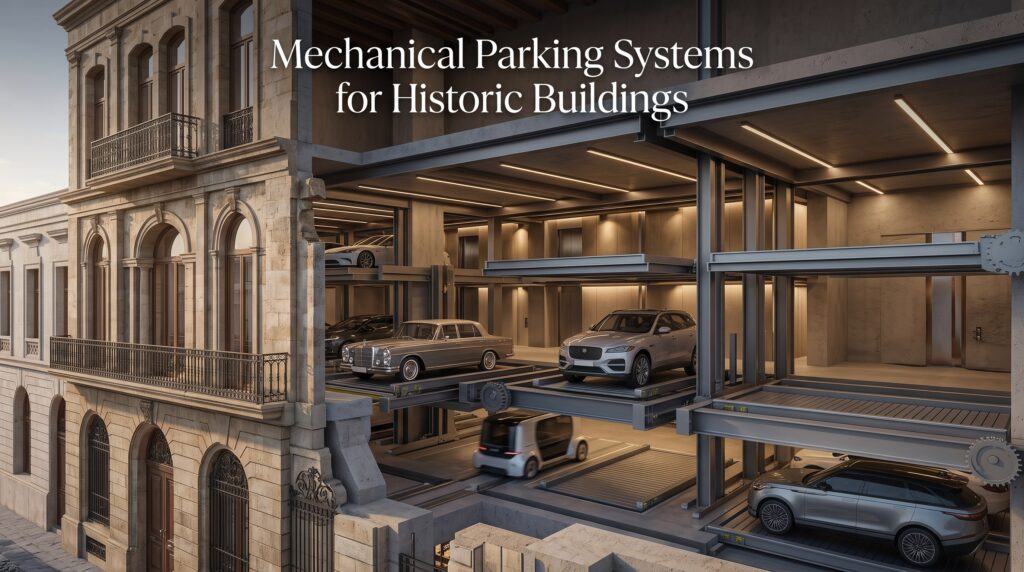
This might sound like a paradox next to a car-free city like The Line, but it is precisely because Saudi Arabia is building both extremes at once — car-free megacities and some of the densest, fastest-growing conventional cities in the region — that mechanical parking systems have become such a critical piece of infrastructure. This guide explains what mechanical parking systems are, how they fit into Saudi Arabia’s Vision 2030 landscape, what is already happening in Riyadh and NEOM, and how developers, investors, and facility owners should think about specifying the right system for their project.
The Parking Reality Behind Vision 2030
Saudi Arabia has one of the highest rates of private vehicle ownership in the Middle East, and more than 84% of the population now lives in urban areas, putting sustained pressure on parking infrastructure in Riyadh, Jeddah, Dammam, and other major cities. In a single recent year, more than 616,000 new passenger vehicles were registered in the Kingdom, adding directly to the daily competition for parking space in already dense city centers.
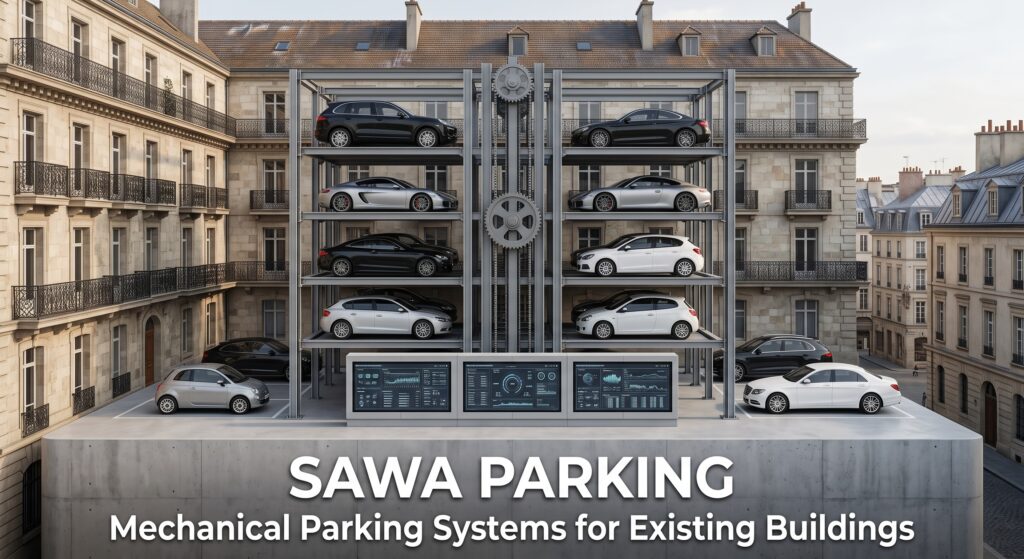
The government has responded on two fronts simultaneously. On the policy side, the Ministry of Municipal Rural Affairs and Housing introduced paid parking permit services to modernize how parking is managed and to attract private investment into the sector, and Riyadh has already rolled out a managed parking system for residential neighborhoods, starting with Al-Wurud, issuing digital permits through the Riyadh Parking app as part of a citywide expansion of paid parking zones. On the infrastructure side, Riyadh’s broader smart parking rollout is targeting tens of thousands of new managed public parking spaces in its first phase alone.
Market analysts are backing this up with serious numbers. Saudi Arabia’s automated parking system market alone is projected to grow from roughly USD 58.6 million in 2025 to more than USD 230 million by 2033, expanding at a compound annual growth rate above 19%. The broader smart parking and mobility sector is projected to expand even faster, from around SAR 8.8 billion in 2024 to more than SAR 50 billion by 2030 — an annual growth rate near 34%, driven directly by urbanization, smart city policy, and giga-projects such as Expo 2030 Riyadh, Qiddiya, and King Salman Park.
In short: the Saudi market has already recognized that parking is not a side issue in Vision 2030 — it’s core infrastructure, and it is attracting serious capital. In late 2025, Merak Capital, a Saudi investment firm backed by the Capital Market Authority, invested SAR 100 million (about USD 26.7 million) into Arsann, a Saudi smart parking operator that already runs more than 270 sites and has processed over 10 million vehicle parking sessions across the Kingdom — a clear signal of investor confidence in the sector’s growth trajectory.
Software Is Not the Whole Story: Where Mechanical Systems Fit In
Search “smart parking Saudi Arabia” or “parking systems Riyadh” today, and most of what surfaces is about the software layer of parking: ANPR-based access control, mobile app reservations, digital permits, IoT occupancy sensors, and payment automation. Companies like Arsann and Convosync have built strong positions in exactly this space, and rightly so — Saudi Arabia’s parking modernization absolutely needs better digital management.
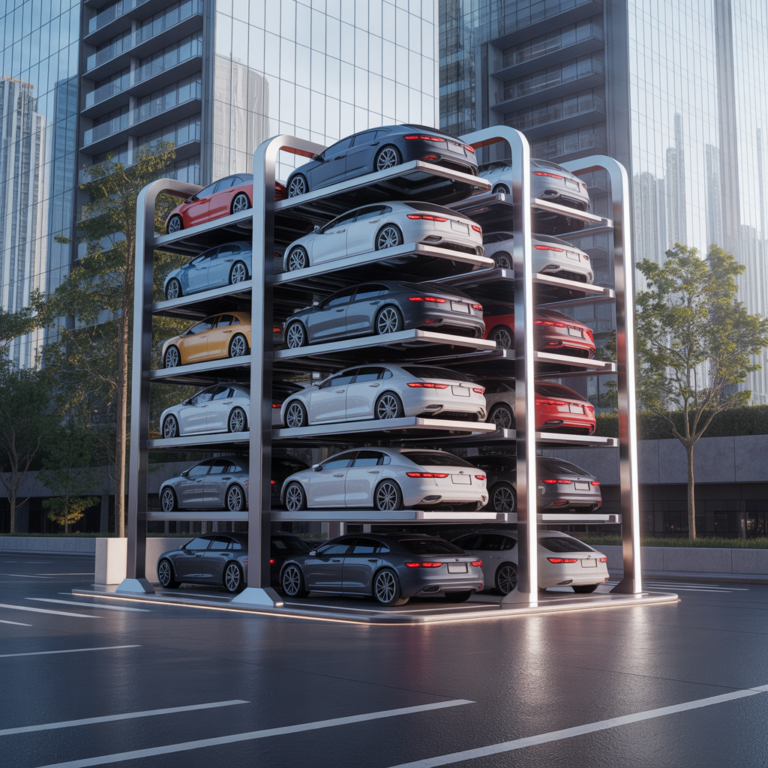
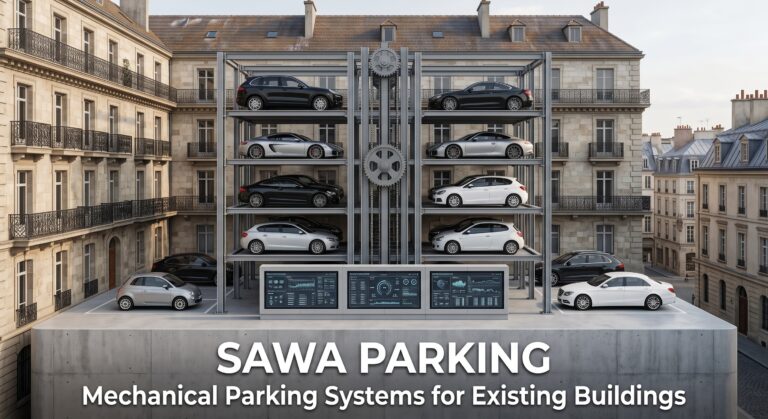
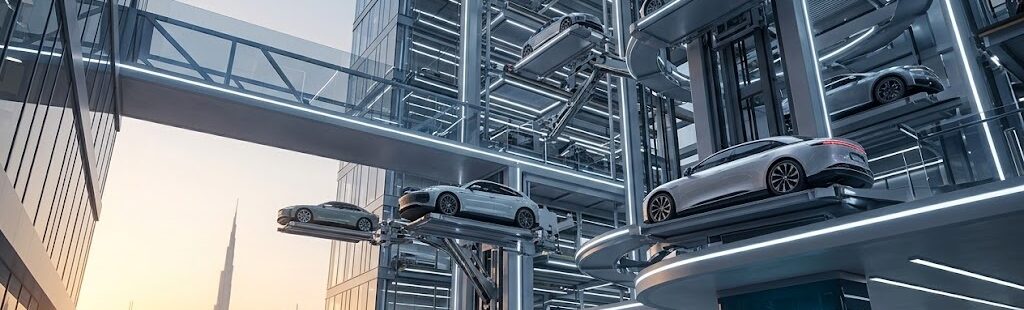
But software can only optimize the parking spaces that physically exist. It cannot conjure new capacity out of a plot of land that has already run out of room. That is the layer mechanical and automated parking systems operate on: the physical hardware — lifts, puzzle platforms, and robotic towers — that multiplies how many vehicles a given footprint can actually hold.
A handful of providers in the Kingdom, such as IHCC, have already begun combining both layers, offering semi-automatic and fully automated mechanical parking hardware alongside digital platforms for reservations, payments, and license plate recognition, specifically framing this combination as support for Vision 2030’s modernization and sustainability goals. That pairing — mechanical hardware plus digital management — is exactly where the market is heading, and it’s the gap most purely software-focused providers cannot fill on their own.
What Are Mechanical Parking Systems, Exactly?
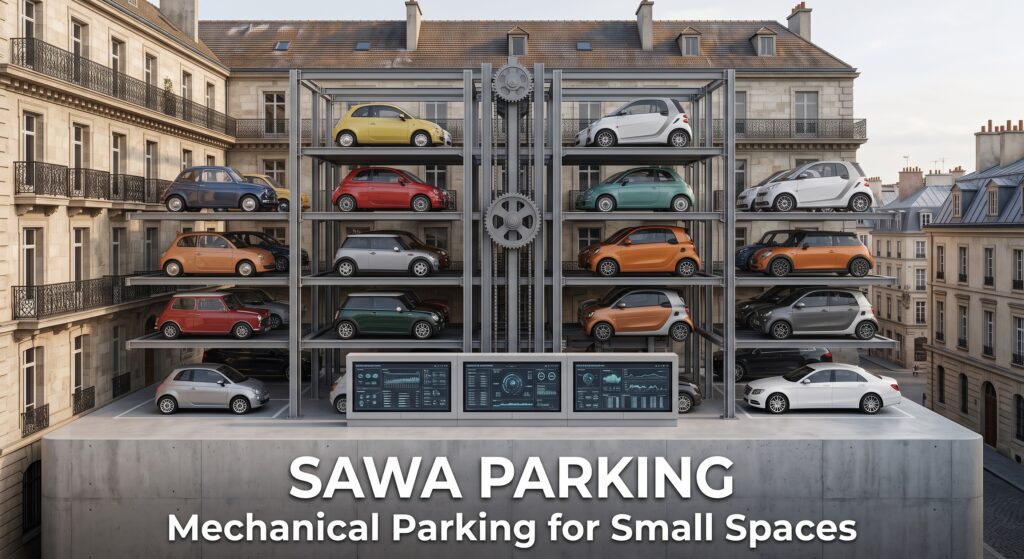
A mechanical parking system uses hydraulic, mechanical, or fully robotic movement to place and retrieve vehicles, rather than relying on the driver to maneuver into the final position themselves. These systems fall into three broad categories:
- Semi-automated systems, where the driver parks onto a platform that is then lifted or shifted mechanically to create additional space.
- Puzzle and shuttle systems, which move multiple vehicles both vertically and horizontally so that any car can be retrieved without needing to move every other vehicle in a fixed sequence.
- Fully automated (robotic) systems, where the driver leaves the vehicle at a transfer bay and a robotic shuttle or lift stores it inside a tower, rack, or underground vault, with no driver access to the storage area at all.
Types of Mechanical Parking Systems Suited to the Saudi Market
Two-Post and Four-Post Lifts
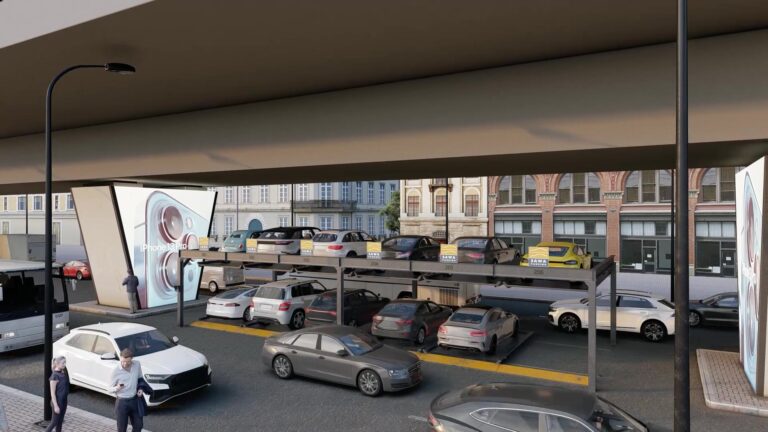
The simplest and most cost-effective entry point, doubling capacity on villas, small commercial buildings, and staff parking areas. These are quick to install and require minimal civil works, making them a practical option for smaller developments and retrofit projects across Riyadh, Jeddah, and secondary Saudi cities.
Tandem Parking Systems
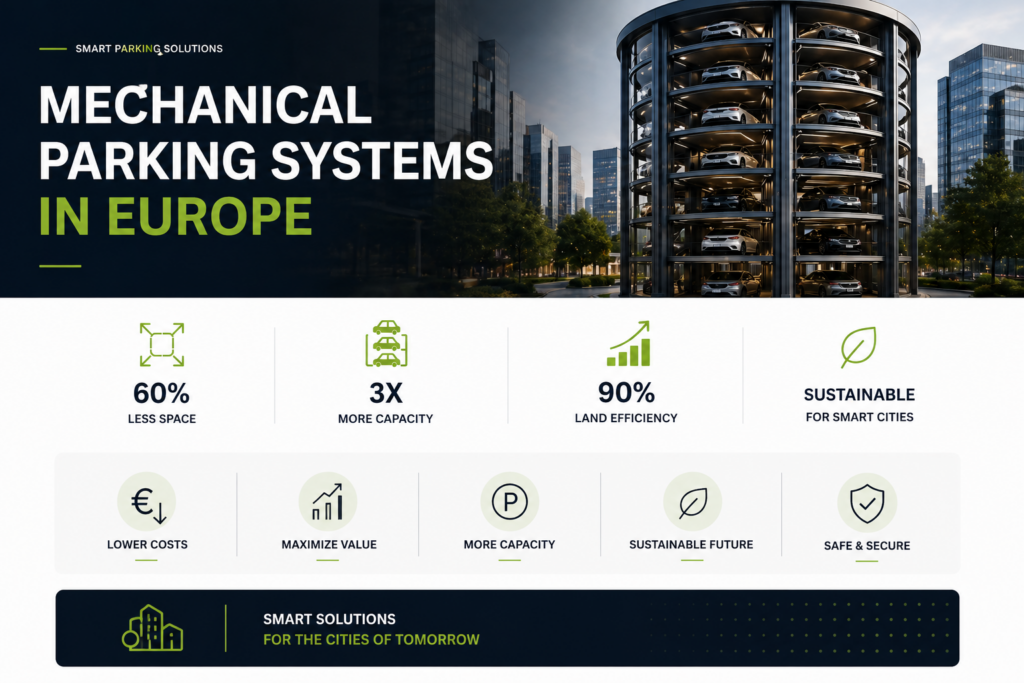
Ideal for residential compounds, staff housing, and valet-operated facilities where vehicle owners are known and turnover is predictable. Tandem systems park cars in sequence, front-to-back or stacked, offering strong capacity gains at moderate cost.
Puzzle Parking Systems
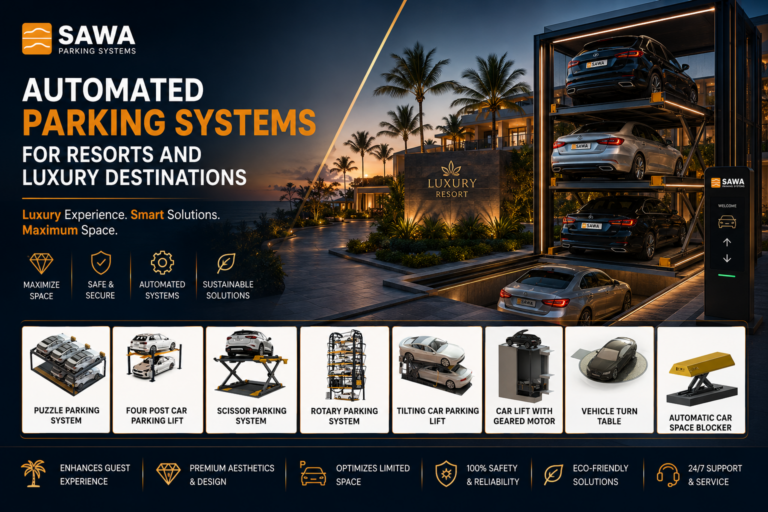
A strong fit for mid-size residential towers, office parks, and hospitality properties, puzzle systems allow independent retrieval of any vehicle by shifting a grid of platforms, balancing flexibility with efficient use of vertical and horizontal space.
Fully Automated Towers
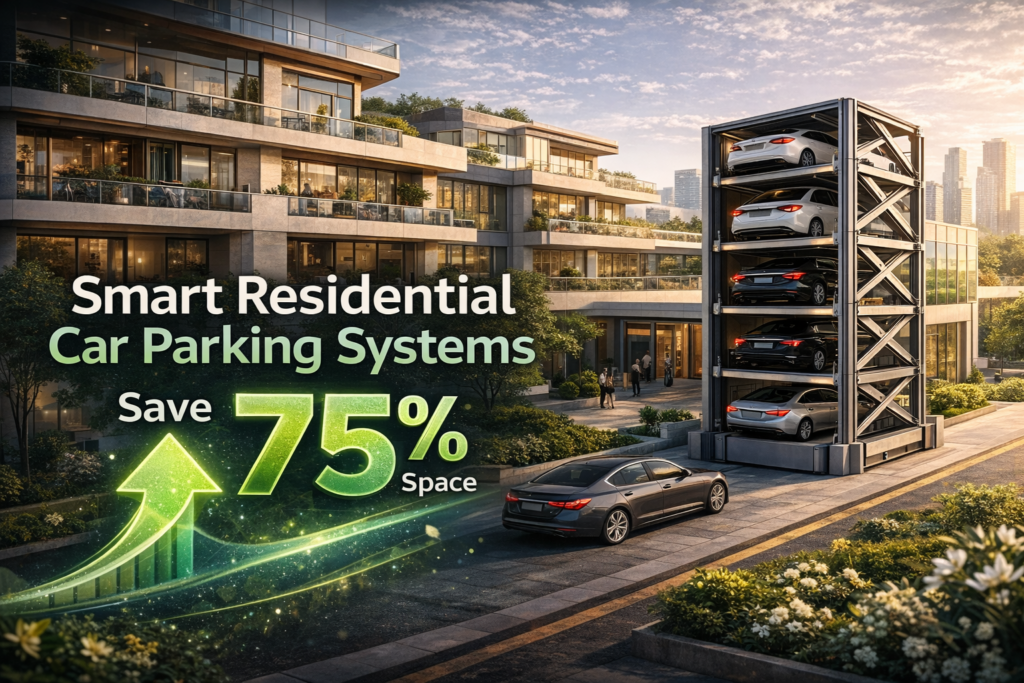
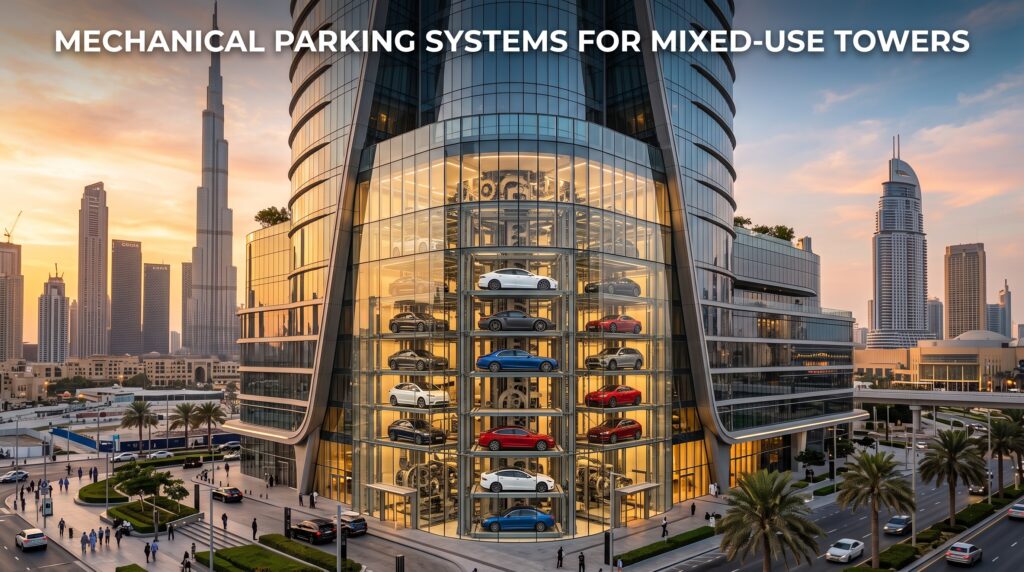
The highest-capacity format, and increasingly relevant for Saudi Arabia’s densest urban plots — high-rise residential and mixed-use towers in Riyadh, luxury hospitality developments along the Red Sea coast, and giga-project districts where every square meter above ground is reserved for revenue-generating space rather than ramps and driveways. Vehicles are typically retrieved within one to three minutes via a keypad, card, or mobile app, with drivers never entering the storage structure.
Car Elevators and Turntables
Frequently deployed alongside puzzle or tandem systems to solve maneuvering constraints — rotating a vehicle for forward exit onto a narrow street, or transporting cars vertically between underground levels and street level in constrained urban plots.
The NEOM and The Line Paradox: Why a Car-Free City Still Needs Parking Engineering
The Line is designed from the ground up as a zero-car environment: no roads, no parking structures, no gas stations, with residents relying instead on a six-tier mobility system built around high-speed rail, general mass transit, and rapid vertical transport nodes placed every 1.5 to 2 kilometers. NEOM’s Chief Development Officer Denis Hickey has described the ambition plainly, noting that residents will be able to step outside and reach schools, workspaces, and hospitals without ever needing a car.
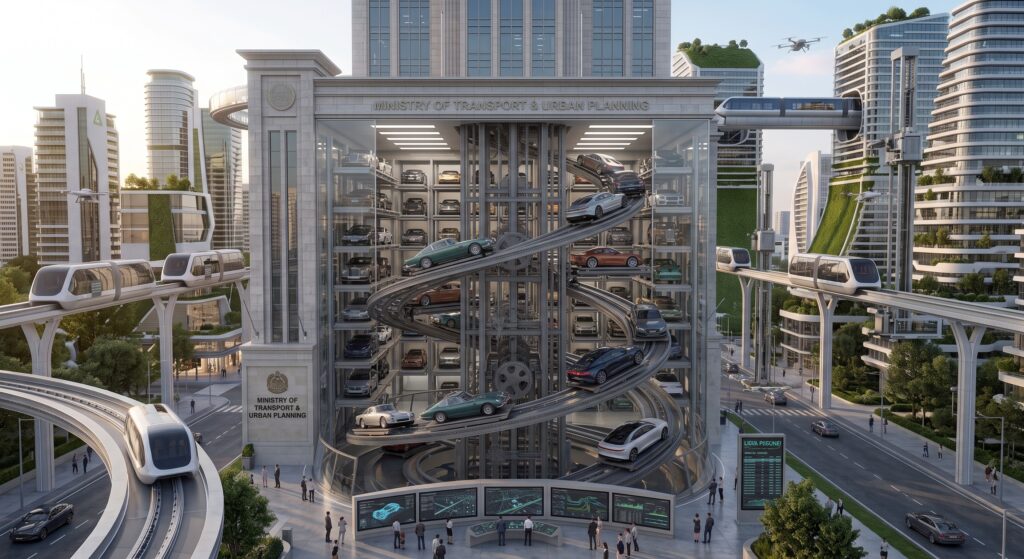
That vision, however, doesn’t eliminate the need for vehicle storage from the wider NEOM region — it relocates it. Construction fleets, logistics and freight vehicles, visitor and staff transport, and the connector infrastructure linking The Line to Oxagon and NEOM International Airport all still require efficient, space-conscious parking and vehicle staging solutions, just positioned at the perimeter and transit nodes rather than embedded inside the linear city itself. For a development explicitly designed to protect 95% of its land for nature, every vehicle storage facility built at these peripheral hubs has the same incentive as any other space-constrained Saudi project: maximize capacity, minimize footprint. That is precisely the value proposition of mechanical and automated parking technology, applied at the access points and support zones of even the most car-free megaprojects in the Kingdom.
Meanwhile, Riyadh’s own giga-projects — Qiddiya’s entertainment and sports districts, King Salman Park’s mixed-use developments, Expo 2030 Riyadh’s exhibition grounds, and large-scale residential communities such as ROSHN — are being built as more conventional, car-oriented urban environments, and are exactly the kind of large-footprint, high-traffic sites where mechanical parking systems deliver their strongest returns.
Why Developers and Investors Are Turning to Mechanical Parking
Higher land value and yield. Every square meter recovered from a flat surface lot or a wide vehicle ramp can be converted into leasable retail space, additional residential units, or hospitality amenities — assets that generate revenue instead of sitting idle as circulation space.
Compliance with tightening parking ratio requirements. As Saudi municipalities modernize regulatory frameworks around parking — covering everything from access control to enforcement — projects on constrained urban plots increasingly need mechanical solutions to meet required capacity without redesigning the entire building envelope.
Alignment with sustainability goals. Vision 2030 explicitly ties smart parking and mobility infrastructure to national sustainability targets, and mechanical parking systems that use hybrid hydraulic-electric drives and efficient ventilation directly reduce the idling, circling, and search-traffic that contribute to urban air pollution.
Security and asset protection. Fully automated towers remove public and driver access to the storage area entirely, significantly reducing the exposure of vehicles to theft, vandalism, and collision compared with an open surface lot — a meaningful consideration for luxury residential towers and high-value hospitality projects.
Faster, more predictable retrieval. Automated systems typically return a vehicle within one to three minutes, a meaningful improvement over the time drivers often spend circling large surface lots at malls, hospitals, and stadiums during peak hours.
EV-readiness. With Vision 2030’s sustainability push accelerating electric vehicle adoption, integrating EV charging directly into lift and tower parking bays at the design stage is far more cost-effective than retrofitting it later — something forward-looking Saudi developments are already beginning to specify.
Where Mechanical Parking Delivers the Most Value in Saudi Arabia
Residential towers in Riyadh and Jeddah. Rising land costs in central districts make ground-floor retail and additional residential floors far more valuable than surface parking, pushing developers toward puzzle and tower systems that meet capacity requirements without sacrificing marketable space.
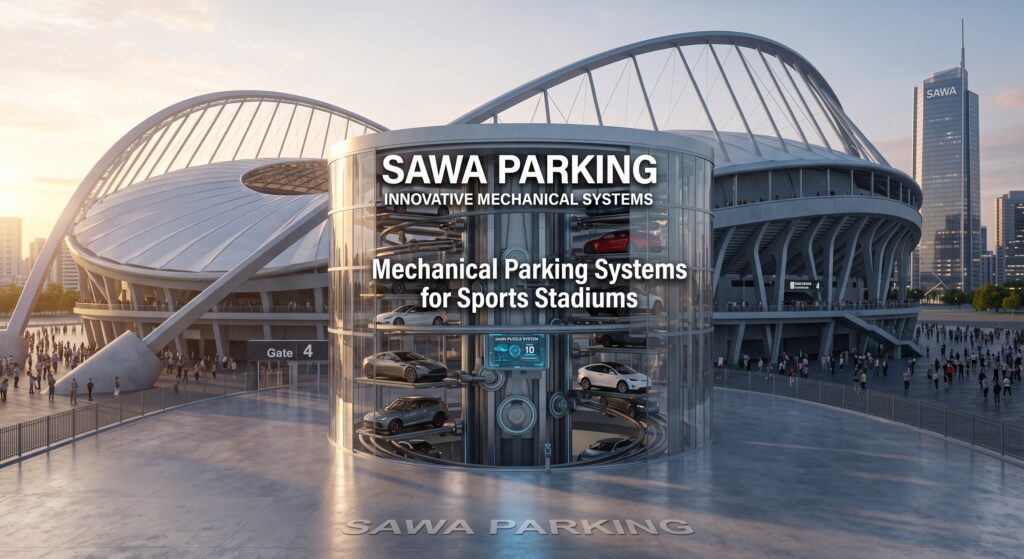
Giga-project entertainment and sports districts. Sites like Qiddiya expect massive visitor influxes during peak events, where high-throughput mechanical systems reduce entrance queues and internal traffic far more effectively than expanding surface lots ever could.
Hospitality along the Red Sea coast and in Makkah and Madinah. Hotels serving both leisure tourism and religious pilgrimage face extreme peaks in vehicle volume during Hajj and Umrah seasons, making compact, high-capacity automated parking an efficient way to manage demand spikes without permanently oversized surface lots sitting empty the rest of the year.
Shopping malls and mixed-use retail. High footfall destinations across the Kingdom benefit directly from increased bay counts within the same footprint, reducing the congestion and circling that frustrate shoppers during peak hours.
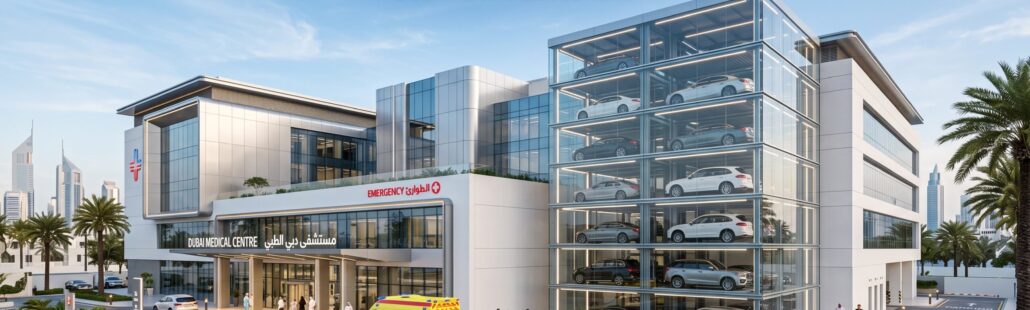
Hospitals and institutional facilities. Predictable, secure parking is essential for staff and visitors, and mechanical systems allow institutions on constrained urban plots to expand capacity without expanding the building’s physical footprint.
Support and logistics zones around car-free megaprojects. As outlined above, even car-free environments like The Line generate demand for efficient, space-optimized vehicle storage at their access points and connector hubs.
Cost, ROI, and What Affects Pricing in the Saudi Market
Pricing for mechanical parking systems in Saudi Arabia depends on system type, vehicle capacity, site conditions, and the degree of custom engineering required for irregular plots:
- Two-post and four-post lifts offer the lowest cost per additional space and the fastest installation timeline — a practical entry point for smaller projects or a pilot phase before scaling up.
- Tandem and puzzle systems sit in the mid-range, delivering a meaningful jump in capacity and flexibility relative to cost.
- Fully automated towers require the highest upfront investment but typically deliver the strongest long-term ROI on expensive urban land, since they recover the greatest amount of square footage for alternative revenue-generating use — a calculation that matters enormously given Saudi Arabia’s construction boom and rising urban land values.
Ongoing preventive maintenance should also be budgeted into any project, since hydraulic components, sensors, and control software require regular servicing to maintain reliability across a system’s typical 15-to-25-year lifespan.
Automatic Parking in Saudi Arabia: Complete Guide
Climate and Site Considerations Specific to Saudi Arabia
Saudi Arabia’s extreme heat, frequent dust and sandstorms, and coastal humidity in cities like Jeddah and along the Red Sea create specific engineering requirements that a generic, imported parking system may not be designed to handle:
- Extreme heat affects lubricants, hydraulic fluids, and electronic components, requiring systems specified with appropriate thermal tolerances and cooling or ventilation provisions.
- Dust and sand exposure, especially in inland and desert-adjacent sites, can degrade sensor accuracy and requires more frequent cleaning of optical or laser-based vehicle detection systems, along with sealed enclosures for sensitive components.
- Coastal humidity and salt air in Jeddah and Red Sea developments accelerate corrosion on untreated steel, making galvanized or specially coated structural components and sealed electrical housings essential specification details.
- Site and foundation conditions vary significantly between Riyadh’s plateau terrain, Jeddah’s coastal plains, and NEOM’s mountain and desert landscape, meaning every installation should begin with a proper site survey rather than a generic foundation design.
How to Choose the Right System for a Saudi Project
- Available footprint and ceiling height — determines whether a tower, puzzle, or simple lift system is physically feasible on the plot.
- Expected vehicle volume and peak demand — giga-project entertainment districts and pilgrimage-season hospitality sites need very different throughput than a residential tower.
- Retrieval speed requirements — malls, hospitals, and event venues need faster retrieval than long-stay residential parking.
- Budget and phasing — some developers start with a simpler lift or tandem system and expand capacity as demand grows.
- Local regulatory and parking ratio requirements — confirm the exact capacity your project must legally provide under evolving municipal regulations.
- Climate-appropriate materials and components — confirm the manufacturer specifies corrosion-resistant and heat/dust-tolerant components suited to your specific site conditions.
- After-sales support and maintenance response times — a system is only as reliable as the servicing behind it, so confirm local or regional support availability before committing.
What to Look for in a Mechanical Parking Manufacturer
The Saudi market includes both software-first operators and hardware manufacturers, and the two are not interchangeable. When evaluating a partner specifically for mechanical parking hardware, look for:
- In-house design and manufacturing, rather than pure resale of imported equipment, which typically means faster customization and more responsive after-sales support for the region.
- A verifiable track record of completed projects across comparable climates and site conditions, not just marketing renders.
- End-to-end turnkey service — site consultation, engineering design, manufacturing, installation, and long-term preventive maintenance under one accountable provider.
- Clear warranty terms on structural steel and mechanical components, with confirmed spare parts availability.
- MENA regional experience, since a manufacturer accustomed to European or Asian climates may not account for Saudi heat, dust, and coastal salt exposure appropriately.
SAWA Parking was established as the first factory in Egypt, Africa, and the Middle East dedicated specifically to the manufacturing of mechanical and automated parking systems, and has since exported systems as far as Italy and France. SAWA offers a complete turnkey process — planning and consultation, engineering design, in-house manufacturing, installation, and ongoing maintenance — giving Saudi developers, giga-project contractors, and hospitality operators a single point of accountability from the first site assessment through years of operational support. For projects across Riyadh, Jeddah, and the giga-project corridors of Vision 2030, working with a manufacturer that controls its own production line — rather than reselling third-party hardware — typically means faster lead times, easier customization for irregular or challenging plots, and more responsive regional support after installation.
Mechanical Parking Systems in Egypt | Sawa Parking
The Road Ahead
Saudi Arabia’s parking sector is moving in two directions at once, and both create demand for mechanical parking expertise. On one side, conventional cities like Riyadh and Jeddah are digitizing and expanding parking capacity to keep pace with urban growth and rising vehicle ownership. On the other, radical projects like The Line are attempting to eliminate the private car altogether, which paradoxically concentrates demand for highly efficient, space-optimized vehicle storage at the access points, logistics hubs, and connector zones that keep a car-free city supplied and staffed.
In both scenarios, the winners will be the developers and operators who pair the right mechanical hardware with the right digital management layer, rather than treating either one as sufficient on its own.
If you are planning a development anywhere in the Kingdom — from a residential tower in Riyadh to a hospitality project on the Red Sea coast or a support facility within a NEOM-adjacent zone — and want to explore which mechanical parking solution fits your site, SAWA Parking’s team can review your project details and propose a tailored parking strategy from concept through long-term maintenance.
Sources:
- Grand View Research (Horizon Databook) — Saudi Arabia Automated Parking System Market Size & Outlook, 2033. https://www.grandviewresearch.com/horizon/outlook/automated-parking-system-market/saudi-arabia
- Merak Capital — Arsann: Powering the Future of Smart Parking in Saudi Arabia. https://merak.capital/arsann-powering-the-future-of-smart-parking-in-saudi-arabia/
- Futurism (Vocal Media) — Saudi Arabia Smart Parking Systems Market: Smart Cities, IoT Integration & Growth Outlook. https://vocal.media/futurism/saudi-arabia-smart-parking-systems-market-smart-cities-io-t-integration-and-growth-outlook
- Arabian Business — NEOM Chief Reveals First Details of Car-Free Vertical City THE LINE. https://www.arabianbusiness.com/industries/construction/neom-chief-reveals-first-details-of-car-free-vertical-city-the-line-report
- NEOM — THE LINE: A Revolution in Urban Living. https://neom.com/en-us/regions/theline