


Mechanical Parking Systems for Historic Buildings : The architectural heritage of humanity is not merely a collection of old structures; it is the physical manifestation of our shared cultural identity, craftsmanship, and historical narrative. However, as cities modernize, the ancient cores of global capitals—studded with medieval palaces, renaissance churches, and 19th-century civic buildings—face an existential threat. To survive economically in the 21st century, these historic structures must be repurposed. A 16th-century palace must become a luxury boutique hotel; a 19th-century post office must become a modern corporate headquarters. Yet, this adaptive reuse demands a modern amenity that directly contradicts the spatial reality of the past: parking.
Introducing traditional concrete ramp parking into a historic district is an act of architectural vandalism. It requires demolishing irreplaceable contextual fabric, digging deep trenches through archaeologically sensitive soil, and imposing massive, visually intrusive concrete structures that destroy the historic streetscape. The clash between the heavy, vibrating physics of the automobile and the fragile, static nature of ancient masonry is absolute. To bridge this profound divide, heritage conservationists and specialized real estate developers are turning to mechanical parking systems for historic buildings. This highly specialized discipline of spatial engineering allows us to satisfy modern commercial demands while strictly adhering to the rigorous international charters of preservation. To navigate the extreme engineering constraints of heritage sites, architects rely on the bespoke, stealth solutions provided by industry leaders like Sawa Parking.
The Imperative of Heritage Conservation and Mechanical Parking Systems for Historic Buildings
The preservation of historic buildings is governed by stringent international doctrines, most notably the Venice Charter and the guidelines set forth by UNESCO and ICOMOS. These doctrines dictate that any intervention on a historic structure must be reversible, must not alter the architectural character of the site, and must avoid destroying the spatial context in which the building sits.
The Visual and Contextual Destruction of Ramps
If a developer attempts to add a traditional parking garage to a historic building, they immediately violate these core tenets. Traditional parking requires wide entrance and exit lanes, which necessitates demolishing the ground-floor historic façade. Furthermore, the sheer mass of a multi-story concrete parking structure looming over a 300-year-old building completely destroys the historic skyline and the human scale of the neighborhood.
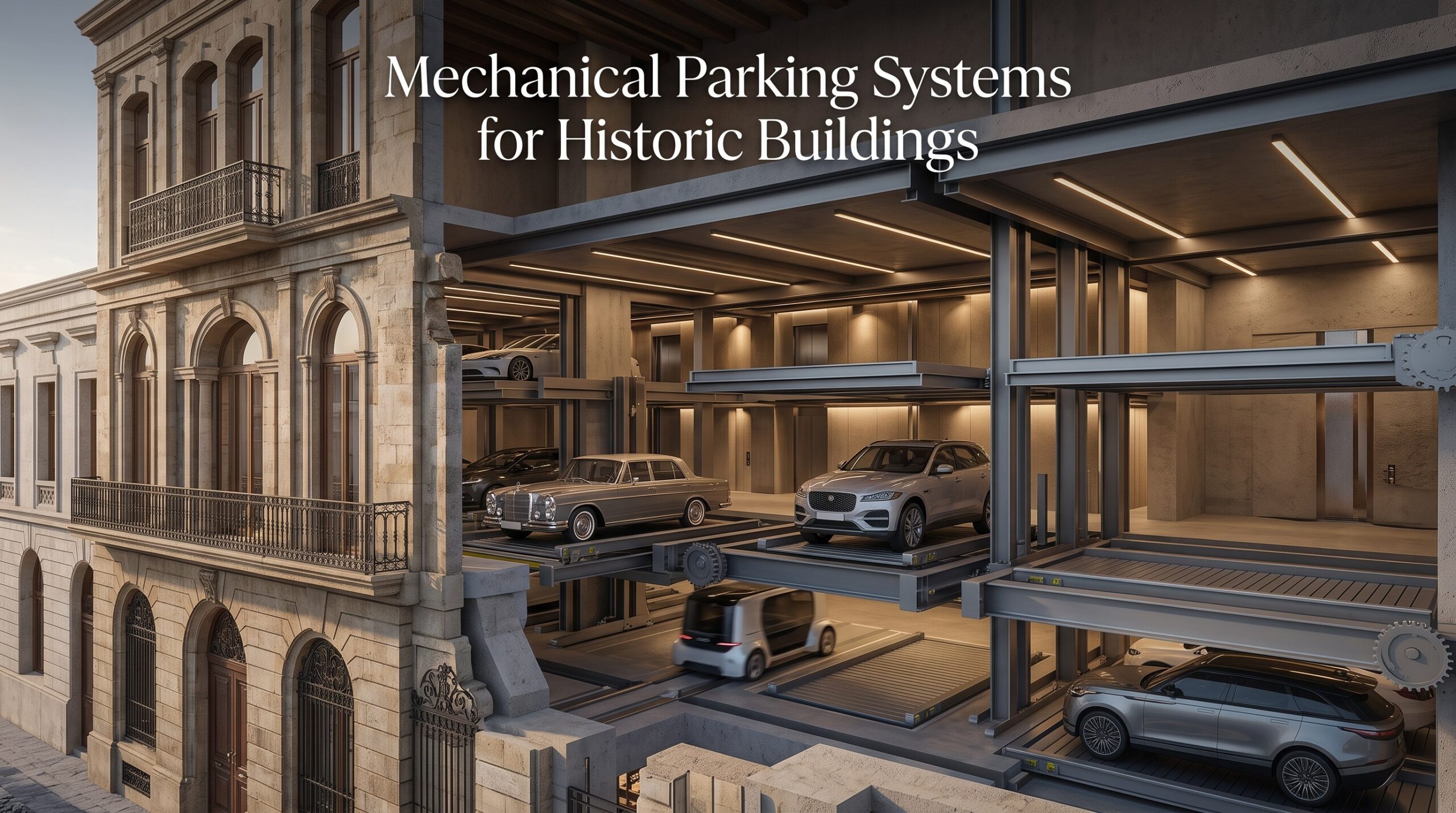
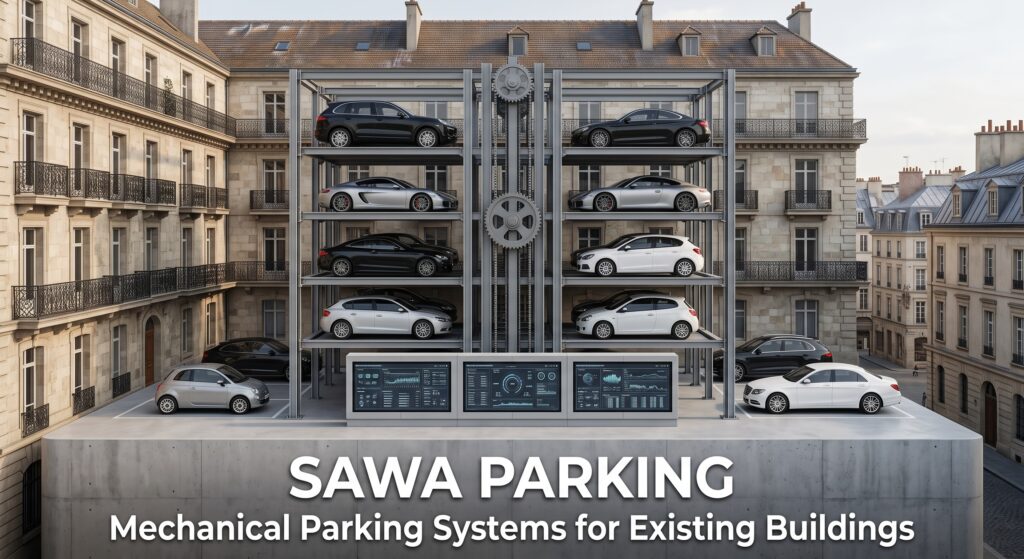
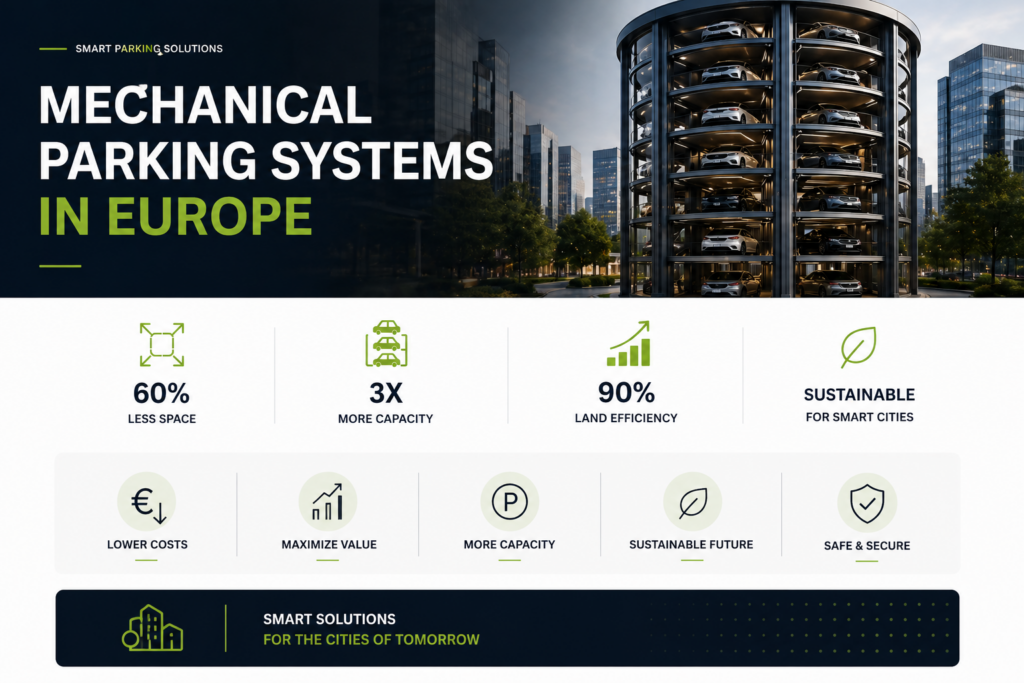
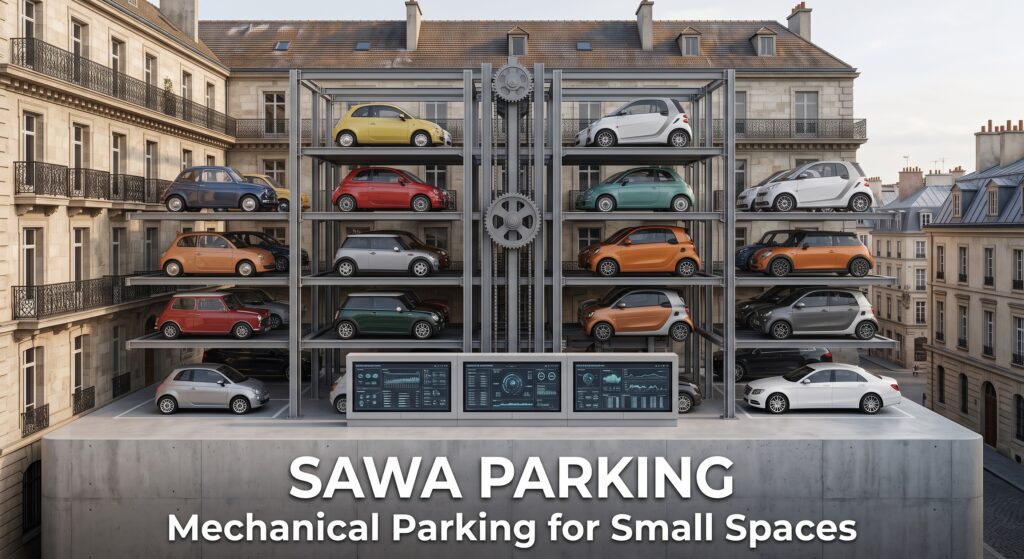
Mechanical parking systems for historic buildings offer an invisible solution. Because the machinery is internal and vertical, the entire high-capacity parking function can be hidden entirely within an existing interior courtyard, a disused light well, or a shallow subterranean space. There is no need to widen the historic doors or alter the street-level façade. The only visible street-level intervention is a beautifully designed, discreet transfer cabin that can be architecturally tailored to match the historic aesthetic of the building. As demonstrated in numerous sensitive heritage global project portfolios, this “stealth” approach allows developers to inject modern capacity into protected sites without triggering the wrath of local heritage conservation boards.
Geotechnical Nightmares: Soil Mechanics and Mechanical Parking Systems for Historic Buildings
The soil upon which historic cities are built is often highly unstable. Ancient builders did not have access to modern geotechnical engineering; they built on whatever ground was available, often relying on shallow foundations, wooden piles driven into soft riverbanks, or unrefined rubble. Introducing heavy, modern loads into this environment requires extreme caution.

The Danger of Deep Excavation
To achieve the required parking capacity using traditional ramps, a developer must excavate deep basements—often going 10 to 15 meters below the existing grade. In a historic city center, this deep excavation is incredibly dangerous. It can undermine the shallow foundations of the historic building itself, cause structural settling that cracks ancient frescoes and plasterwork, and worst of all, dewater the surrounding soil. Pumping groundwater during excavation can cause neighboring historic buildings to subside and collapse, leading to catastrophic, irreversible loss of heritage.
Mechanical parking systems for historic buildings radically reduce geotechnical risks. By eliminating wide driving lanes and ramps, an automated system can achieve the exact same parking capacity in a basement that is only 4 to 6 meters deep. This shallow-depth excavation keeps the construction zone well above the sensitive historical soil layers and the wooden pilings of neighboring structures. If an area is highly sensitive, the system can even be installed entirely above ground within a retrofitted interior space, requiring zero excavation whatsoever. To achieve this crucial shallow-depth footprint, conservation architects can select from a highly specialized range of advanced parking products, specifically ultra-compact puzzle or tower systems engineered for zero-impact installations.

Vibration Isolation in Mechanical Parking Systems for Historic Buildings
Beyond the geotechnical risks, there is the severe threat of mechanical vibration. Historic buildings are composed of brittle materials—lime mortar, degraded brickwork, fragile plaster, and timber—that are highly susceptible to vibrational fatigue.
The Resonance of Traditional Parking
A traditional parking garage is a resonant chamber. The continuous sound of internal combustion engines idling, tires squealing on concrete ramps, and cars driving over expansion joints creates low-frequency vibrations. These vibrations travel through the concrete slab and resonate with the natural frequency of the ancient walls, causing progressive structural damage, the crumbling of historic plaster, and the detachment of architectural ornamentation.
Mechanical parking systems for historic buildings are engineered as vibration-free environments. Because cars are turned off upon entry and moved solely by electric motors, there are no engine vibrations. More importantly, the heavy-duty machinery—the motors, chain drives, and lifting mechanisms—is completely decoupled from the historic structure using state-of-the-art anti-vibration isolation technology. The machinery is mounted on massive, highly damped rubber and spring isolators that absorb the dynamic loads of moving vehicles, ensuring that zero kinetic energy is transferred to the fragile historic walls. The rigorous manufacturing processes behind these heritage-grade systems ensure that the anti-vibration components are precision-calibrated to protect the most sensitive archaeological environments.
The Visual Impact and Stealth Design of Mechanical Parking Systems for Historic Buildings
Heritage boards around the world (such as English Heritage in the UK, or the Ministry of Culture in Italy) will not approve an installation that looks “industrial” or “modern” in a historic context. The integration must be seamless and reversible.
Camouflaging the Transfer Cabin
The only visible element of mechanical parking systems for historic buildings is the ground-level transfer cabin where the user drops off their vehicle. This cabin cannot look like a metal box. It must be designed to “disappear” into the historic fabric. Skilled architects design these cabins using reclaimed historic stone, custom wrought ironwork, or traditional brick bonds that perfectly match the existing street-level façade. The automated sliding doors can be designed to look like traditional wooden carriage doors. When not in use, the cabin can be entirely hidden from public view. Managing this highly sensitive architectural negotiation requires comprehensive end-to-end parking services to ensure the design perfectly satisfies the most stringent heritage board aesthetic requirements.
Avoiding Archaeological Interference
In many historic cities, the soil itself is an archaeological layer cake. Digging a massive, wide traditional basement requires heavy earthmoving equipment that destroys this undisturbed archaeological strata forever. Because automated parking requires a much smaller, more targeted footprint, the excavation can be carried out manually or with micro-machinery under the strict supervision of an on-site archaeologist. If an artifact is discovered during the shallow dig, the modular nature of the automated parking system allows the foundation plan to be easily shifted or modified to protect the find without halting the entire parking project. Urban planners and heritage advocates looking to understand how to balance modern infrastructural needs with archaeological preservation can find valuable strategic frameworks by exploring a specialized parking technology blog.
Funding Restoration Through Mechanical Parking Systems for Historic Buildings
The restoration of a truly historic building—repointing stone, conserving wood, and restoring frescoes—is astronomically expensive. To justify this CapEx, the building must generate significant revenue. However, without modern parking, the building cannot attract premium corporate or luxury hospitality tenants.
The Economic Engine of Modernization
Mechanical parking systems for historic buildings provide the economic engine that funds heritage conservation. By slipping a high-capacity, invisible parking system into an unused interior courtyard, the developer transforms a structurally obsolete historic property into a Class A commercial or hospitality asset. The revenue generated by the newly modernized building can then be ring-fenced to pay for the ongoing, multi-decade restoration of the historic fabric. It is a brilliant symbiotic relationship: modern technology provides the spatial efficiency required to generate capital, and that capital is immediately reinvested to preserve the ancient structure for future generations.
Conclusion
We have a profound moral and cultural obligation to preserve the architectural heritage of our cities. However, we cannot freeze these buildings in time and expect them to survive economically in a modern metropolis. The heavy, destructive physics of traditional automobile storage is fundamentally incompatible with the fragile geotechnics, sensitive materials, and strict aesthetic guidelines of historic preservation. Mechanical parking systems for historic buildings resolve this impossible equation. They provide the high-density vehicular storage required for modern economic viability, while operating with zero visual impact, zero deep-excavation risks, and zero destructive vibrations. They allow us to hide the noisy, heavy reality of the 21st century behind the beautiful, ancient walls of the past, ensuring these treasures remain financially viable and structurally sound for centuries to come. To explore how these bespoke, heritage-sensitive systems can be integrated into your conservation project, we encourage you to contact our team for an architectural feasibility study. Discover how Sawa Parking is engineering the future of historic preservation.
References & Authoritative Industry Sources
-
UNESCO World Heritage Centre – Historic Urban Landscapes – Guidelines for the management of historic cities, emphasizing the preservation of spatial context, visual integrity, and the prohibition of intrusive modern infrastructural interventions. 🔗 https://whc.unesco.org/en/historic-cities/
-
ICOMOS (International Council on Monuments and Sites) – Structural Restoration and Vibration – Charters and guidelines regarding the physical fragility of historic structures, the risks of structural fatigue, and the necessity of vibration isolation in proximity to ancient masonry. 🔗 https://www.icomos.org/en/charters-texts/
-
English Heritage – Archaeology and Development – Standards for mitigating the impact of deep excavations on buried archaeological strata in sensitive urban brownfield and historic sites. 🔗 https://historicengland.org.uk/advice/caring-for-historic-places/development/
-
Association for Preservation Technology International (APT) – Adaptive Reuse – Financial modeling, funding mechanisms, and the economic repositioning of heritage assets through modern infrastructural upgrades that do not compromise their architectural character. 🔗 [https://www.apti.org/what-is-apt/apts-approach/adaptive-reuse/]