


Mechanical Parking Systems in Greece: Solving the Parking Puzzle of Athens, Santorini, and the Historic Cities
Greece has one of the most unusual parking problems in Europe, because it isn’t really one problem — it’s two, pulling in opposite directions. In Athens and Thessaloniki, dense modern development, narrow pre-war street grids, and rising vehicle ownership have created the same land-scarcity pressure found in any growing European capital. On the islands and in Greece’s historic towns, the pressure is different: centuries-old buildings, protected archaeological ground, and a tourism industry that brings in far more visitors each summer than the local infrastructure was ever built to hold.
Santorini’s mayor has been explicit about it, describing traffic congestion and the chronic lack of parking space as one of the clearest, most immediate consequences of the island’s overtourism problem, alongside efforts to build new car parks and bypass roads to relieve the pressure. The same tension plays out, in different forms, in Mykonos, Rhodes’ Old Town, Nafplio, Chania, and dozens of other destinations where the built environment predates the automobile by hundreds or thousands of years.
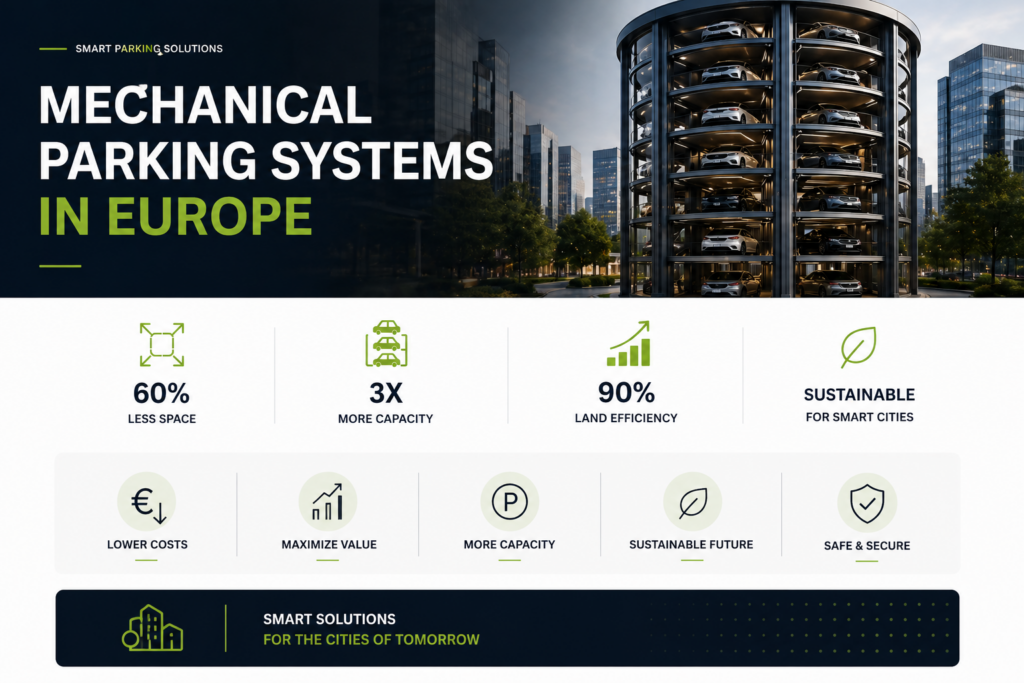
This is exactly where mechanical and automated parking systems earn their place — not as a generic technology upgrade, but as one of the few practical ways to add real parking capacity in places where digging a conventional underground garage is either physically impossible, archaeologically restricted, or economically unjustifiable. This guide walks through how the technology works, what’s already happening in the Greek market, and how developers, hoteliers, and municipalities should think about specifying the right system for a Greek site.
Why Greece’s Parking Problem Is Genuinely Different
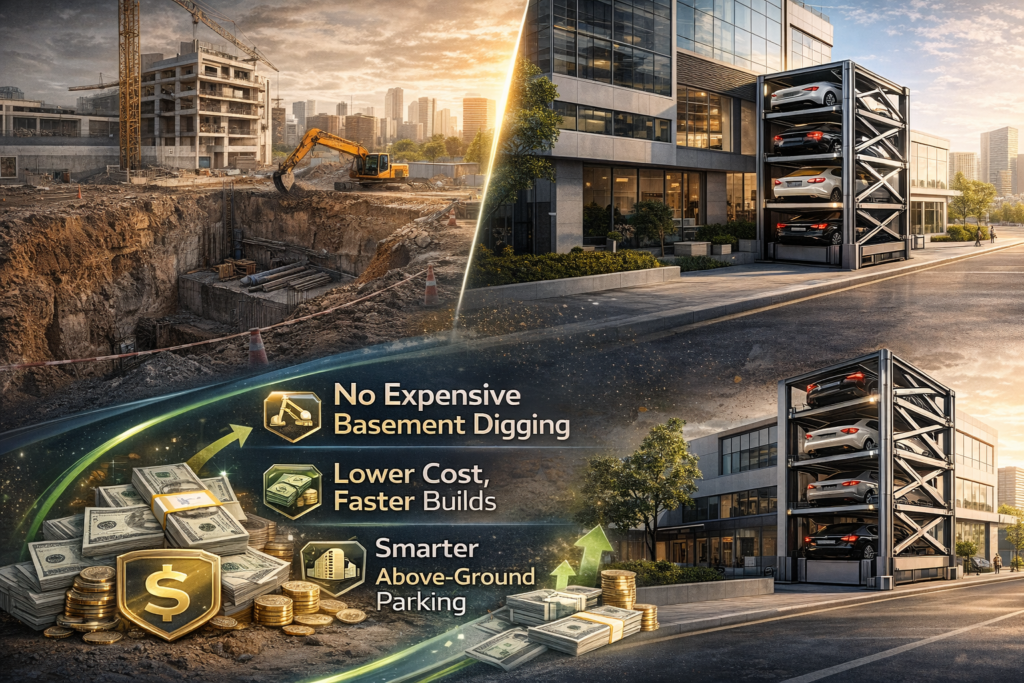
Archaeological and heritage restrictions. Greece is unique in Europe for how often a construction project — especially in central Athens, Thessaloniki, and virtually any historic town — can trigger a mandatory archaeological survey before excavation is even allowed to proceed. Deep underground parking garages, the default solution in most European cities, are frequently impossible or prohibitively expensive to build in these zones, because any significant excavation risks disturbing protected antiquities. Mechanical parking systems that operate largely above ground, with a shallow or minimal foundation footprint, sidestep this constraint entirely, offering real capacity gains without the excavation risk that stops conventional underground garages before they start.

Overtourism and extreme seasonality. Santorini’s own municipal research has estimated the island can sustainably absorb a certain daily volume of visitors during peak season, yet real tourist flows have repeatedly overwhelmed that capacity, with congested, overcrowded streets making international headlines. Parking demand on islands like Santorini and Mykonos swings dramatically between a quiet winter and an overwhelmed August, making space efficiency during the few peak months of the year an economic necessity rather than a luxury.
Physically narrow, ungridded streets. Much of the appeal of Fira, Oia, Nafplio’s old town, and the historic core of Rhodes comes from cobbled, pedestrian-scaled streets that were never designed for vehicles at all — visitors are routinely warned that some village lanes are barely wide enough for a single small car, let alone two-way traffic or roadside parking. Any parking solution here has to work within an extremely constrained footprint, often carved out of a small plot at the edge of a village rather than within it.
Rising urban density in Athens and Thessaloniki. Away from the islands, Greece’s two largest cities face the more familiar European story: shrinking available land, rising property values, and modern buildings competing for space with historic districts that limit how aggressively new construction can expand. Athens’ municipal authorities have already begun piloting smart parking sensor technology in the city center, part of a broader recognition that both the physical supply and digital management of parking need modernizing simultaneously.
A booming real estate and hospitality sector. Greece’s real estate market, driven partly by tourism growth and partly by international investment through programs like the Golden Visa, has fueled a wave of new hotel, villa, and mixed-use development, particularly in Athens, the islands, and coastal regions — all of which need to offer secure, space-efficient parking to justify premium pricing without sacrificing valuable land to a flat surface lot.
The Greek Mechanical Parking Market Today
Greece already has an established, competitive mechanical and automated parking sector. SCAN Information Systems positions itself as the country’s largest automated parking provider, with more than 100 completed projects ranging from small installations to multi-storey facilities inside some of Greece’s biggest shopping malls, including Golden Hall, The Mall Athens, Thessaloniki Airport, the Thessaloniki International Fair, and the Stavros Niarchos Foundation Cultural Center. Ergomatic has built its reputation partly on the Mediterranean Cosmos Shopping Mall in Thessaloniki, supporting a parking management system covering roughly 3,200 spaces — one of the largest single installations in the country. Smart Park operates in Greece as the exclusive sales partner for KLAUS Multiparking, a major international manufacturer of mechanical parking systems, bringing German engineering to the Greek market through a local representation model.
This tells us two important things about the competitive landscape. First, demand for large-scale automated parking in malls, airports, and cultural venues is already well established and well served in major cities. Second, most of the visible Greek market activity — including well-known players like Cityzen’s app-based parking or Central Parking System Athens’s facility management services — sits on the software and operations side, or represents foreign manufacturers through a local sales and installation partnership rather than in-house manufacturing. That leaves a meaningful gap for smaller-footprint, boutique-scale, and island-specific mechanical parking projects — exactly the segment that historic towns, boutique hotels, and villa developments actually need, and that large mall-scale integrators are not typically built to serve efficiently.
What Is a Mechanical Parking System?
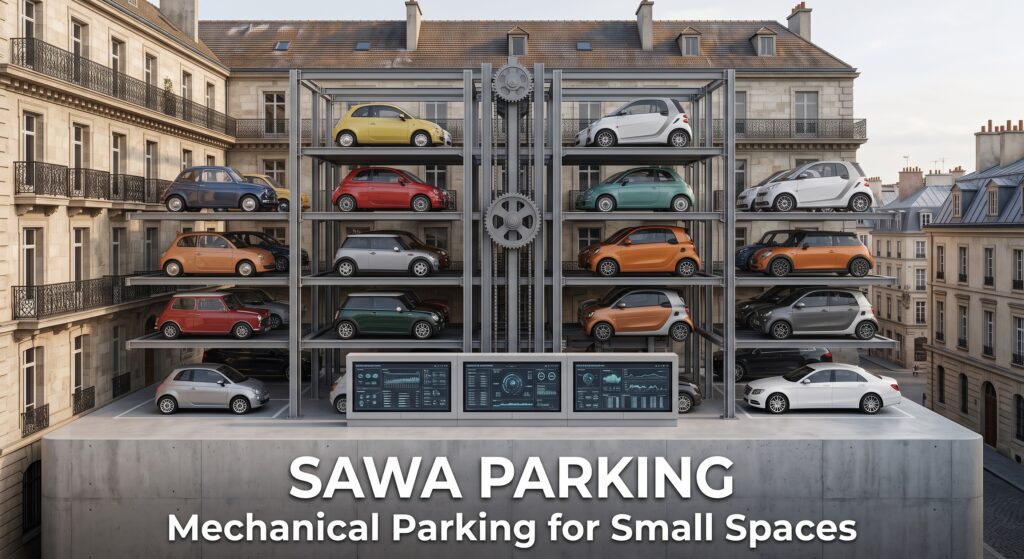
A mechanical parking system uses hydraulic, mechanical, or fully robotic movement to place and retrieve vehicles, instead of relying on the driver’s own maneuvering into a final position. The main categories are:
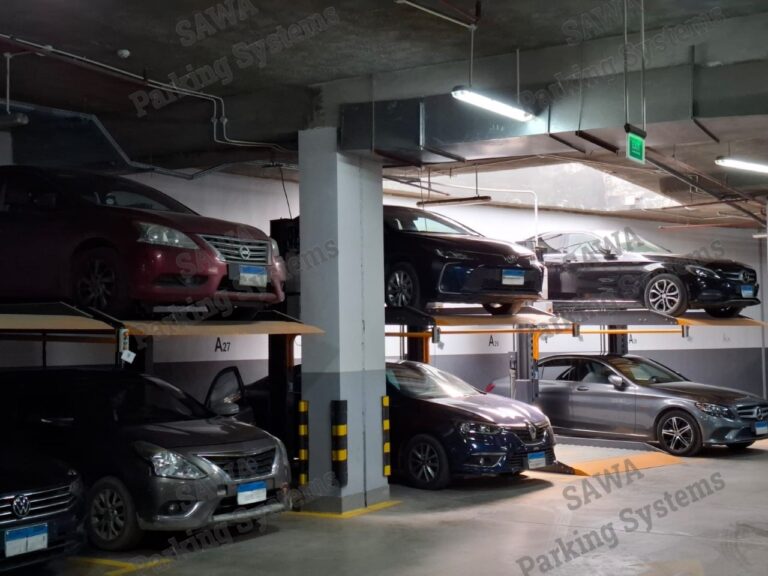
- Semi-automated systems, where the driver parks onto a platform that a hydraulic or mechanical mechanism then lifts or shifts to free additional space.
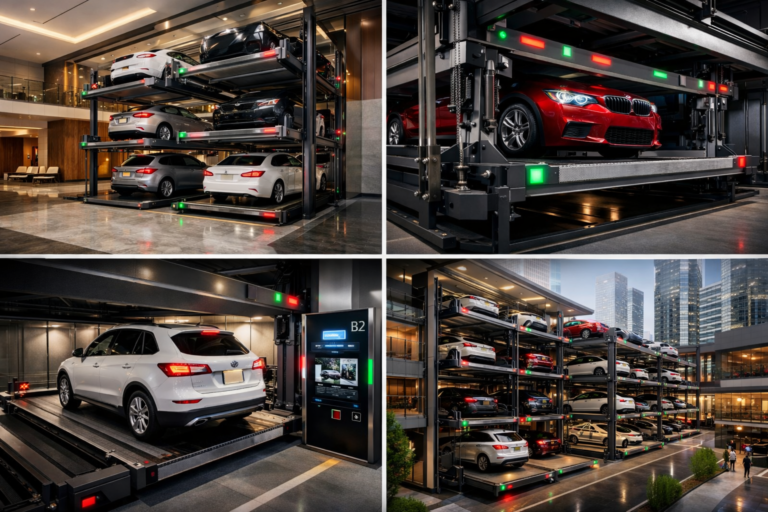
- Puzzle and shuttle systems, which move several vehicles both vertically and horizontally so any car can be retrieved without moving every other vehicle in sequence.
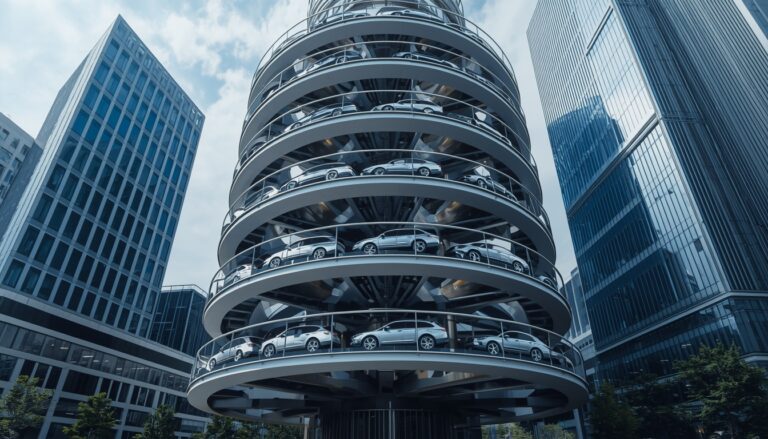
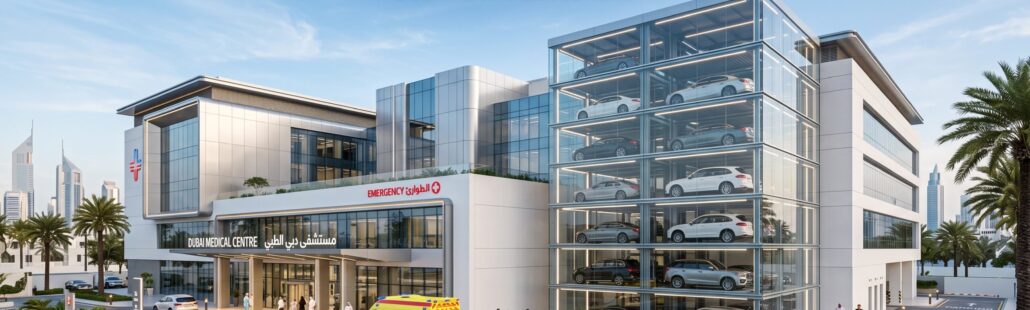
- Fully automated (robotic) systems, where the driver leaves the car at a transfer bay and a robotic shuttle stores it inside a tower or rack, with no further driver or public access to the storage area.
The Types of Systems Best Suited to Greek Sites
Two-Post and Four-Post Lifts
The simplest, most cost-effective option, doubling capacity for villas, boutique hotels, and small commercial buildings without heavy civil works — a natural fit for the small, irregular plots common on the islands and in historic town peripheries.
Tandem Parking Systems
Well suited to villa complexes, staff parking, and valet-operated boutique hotels where vehicle owners are known and turnover is predictable — common scenarios across the Cyclades and Ionian islands.
Puzzle Parking Systems
A strong fit for mid-size hotels, residential buildings, and mixed-use developments in Athens and Thessaloniki, where independent retrieval matters but a full robotic tower isn’t justified by the site or budget.
Fully Automated Towers
The highest-capacity format, best suited to Athens and Thessaloniki’s densest urban plots — office towers, large residential developments, and shopping centers — where every square meter above ground is reserved for revenue-generating space rather than ramps.
Compact, Shallow-Footprint Systems for Historic and Archaeologically Sensitive Sites
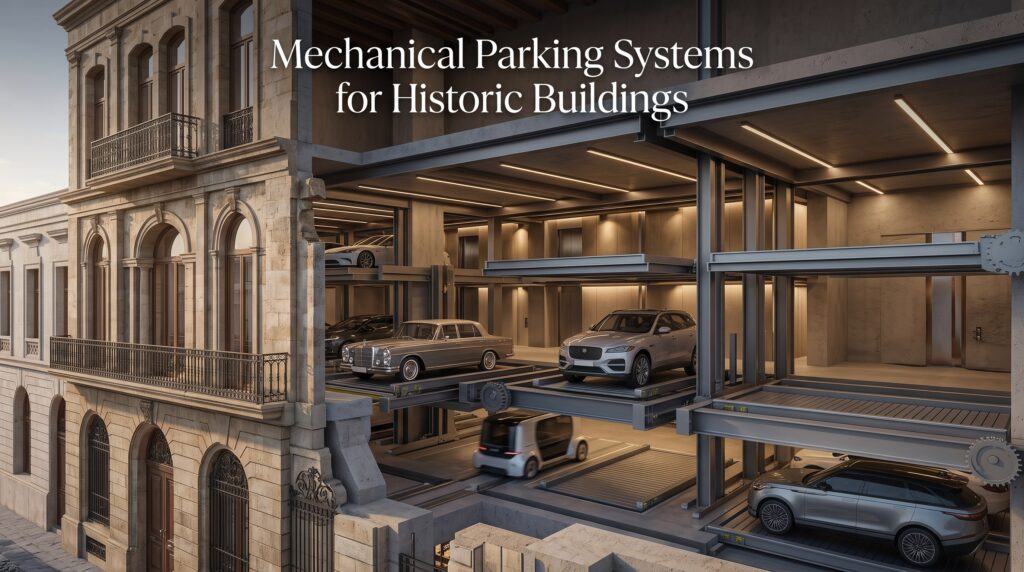
This is where Greece’s market genuinely diverges from most of Europe. On sites where deep excavation is restricted or economically unfeasible due to archaeological survey requirements, above-ground stacker and lift systems with minimal foundation depth allow property owners to add capacity without triggering the excavation risk that stops conventional underground garages before construction even begins.
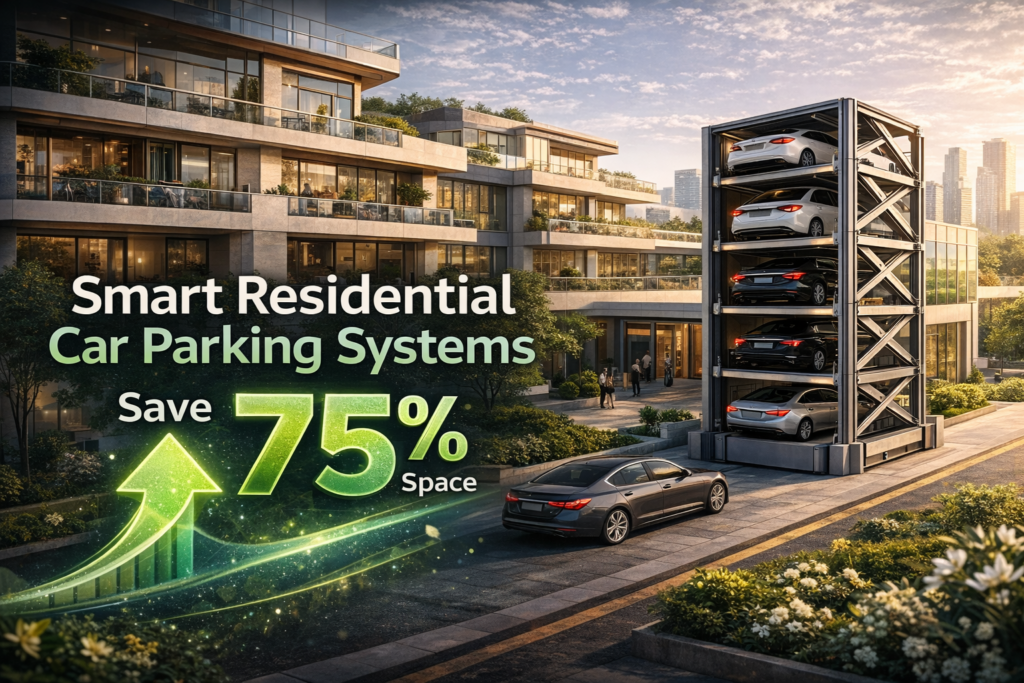
Where Mechanical Parking Delivers the Most Value in Greece
Boutique hotels on Santorini, Mykonos, and the Cyclades. Guests increasingly expect secure, on-site parking, but plots are small, streets are narrow, and heritage regulations often prohibit expanding a building’s footprint. Compact lift and puzzle systems let hospitality operators offer this amenity within an existing courtyard or small adjacent plot.
Historic town centers (Nafplio, Rhodes Old Town, Chania, Monemvasia). Municipalities and private developers alike face the same challenge: how to add parking capacity near a historic core without an excavation permit process that can stall or block a project entirely. Shallow-footprint mechanical systems offer a practical way to add capacity at the edges of these districts.
Athens and Thessaloniki residential towers and mixed-use developments. Rising land values make ground-floor retail and additional residential floors far more valuable than a flat surface lot, pushing developers toward puzzle and tower systems that meet capacity needs without sacrificing marketable space — the same logic that has already driven SCAN and Ergomatic’s large mall-scale installations.
Shopping malls, cultural venues, and airports. Greece’s largest automated parking installations already exist in this segment, and continued visitor growth at venues like Thessaloniki Airport and major Athens malls will keep driving demand for higher-capacity systems.
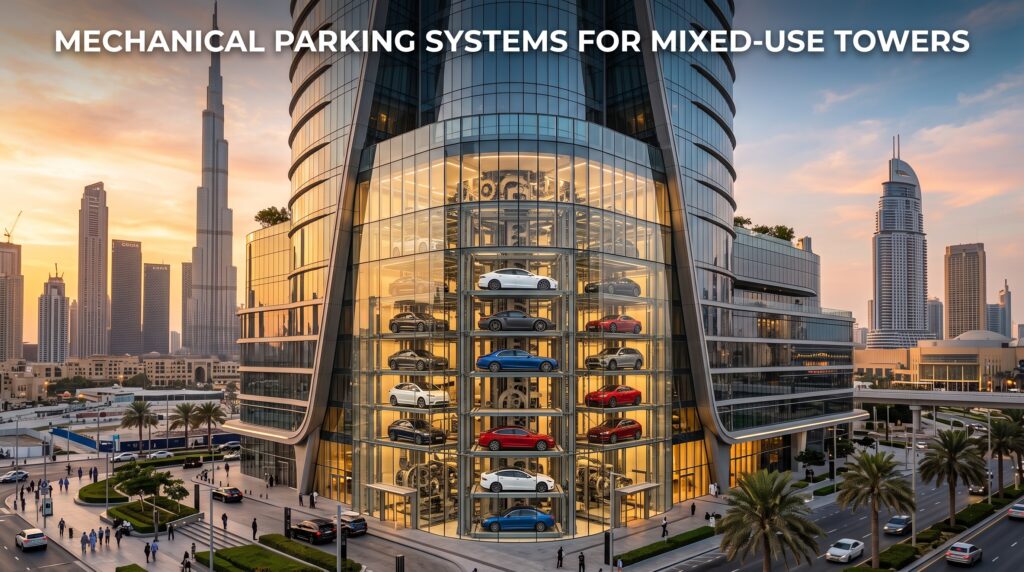
Golden Visa and luxury villa developments. International investment in Greek residential property has fueled a wave of villa and small residential complex construction, particularly on the islands and along the coast, where secure, space-efficient parking is increasingly expected as a standard amenity rather than an afterthought.
Marinas and yacht-adjacent developments. Greece’s extensive coastline and marina culture create demand for compact vehicle storage solutions at waterfront developments where land is at its most expensive and most constrained.
Cost, ROI, and What Affects Pricing in Greece
Pricing for mechanical parking systems in Greece depends on system type, vehicle capacity, and site-specific factors:
- Two-post and four-post lifts offer the lowest cost per additional space and the fastest installation timeline, well suited to boutique hospitality and villa projects on the islands.
- Tandem and puzzle systems sit in the mid-range, delivering a meaningful capacity increase relative to cost, and are the most common format in Greece’s larger mall and residential installations.
- Fully automated towers carry the highest upfront investment but typically deliver the strongest long-term ROI on expensive urban land in Athens and Thessaloniki, since they recover the most square footage for alternative revenue-generating use.
For historic-district and archaeologically sensitive sites, the calculation shifts: the relevant comparison often isn’t between a mechanical system and a cheaper flat lot, but between a mechanical system and no additional parking capacity at all, since deep excavation may not be a viable option regardless of budget. In these cases, even a modest lift or stacker system can represent the only realistic way to add capacity.
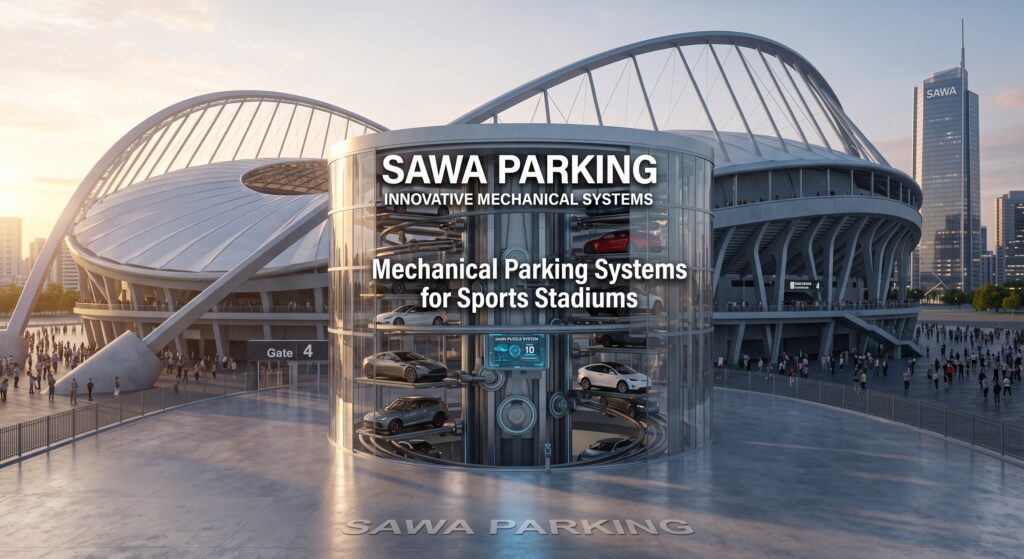
Ongoing preventive maintenance should be budgeted into any project, since hydraulic components, sensors, and control software require regular servicing to maintain reliability across a system’s typical 15-to-25-year lifespan — a particularly important consideration for coastal and island installations exposed to salt air.
Climate, Seismic, and Site Considerations Specific to Greece
Seismic activity. Greece is one of the most seismically active countries in Europe, and any mechanical or automated parking structure needs to be engineered and certified to relevant seismic design standards, with structural steel and anchoring systems rated for regional earthquake risk — a specification detail that matters far more here than in most other Mediterranean markets.
Coastal salt air and humidity. Island and coastal installations face accelerated corrosion risk on untreated steel, making galvanized or specially coated structural components and sealed electrical housings essential, particularly for systems installed near the waterfront on islands like Santorini, Mykonos, and Rhodes.
Summer heat and dust. Extended high temperatures during peak tourist season can affect hydraulic fluids, lubricants, and electronic components, requiring systems specified with appropriate thermal tolerances.
Archaeological survey requirements. As outlined above, any project in central Athens, Thessaloniki, or a historic town center should assume the possibility of a mandatory archaeological assessment before excavation, making shallow-footprint or above-ground system designs a practical risk-mitigation strategy from the outset.
Foundation and terrain variability. Greece’s terrain ranges from the volcanic caldera cliffs of Santorini to the flat urban plains of Athens, meaning every installation should begin with a proper site and soil survey rather than a standardized foundation design.
How to Choose the Right System for a Greek Project
- Available footprint and heritage/archaeological status of the site — determines whether excavation is even a viable option, or whether a shallow-footprint system is required by default.
- Seasonal demand patterns — island and tourism-driven sites need to plan for extreme peak-season volume rather than average annual demand.
- Expected vehicle volume and retrieval speed needs — malls, airports, and event venues need faster throughput than long-stay residential or villa parking.
- Budget and phasing — some developers start with a simpler lift or tandem system for a boutique property and expand later as demand grows.
- Seismic and coastal exposure — confirm the manufacturer specifies components rated for Greece’s earthquake risk and, where relevant, salt-air corrosion resistance.
- Local regulatory and heritage compliance requirements — confirm the system design accounts for any municipal or archaeological authority approval process specific to the site.
- After-sales support and maintenance response times, particularly important for island locations where response logistics are more complex than in Athens or Thessaloniki.
What to Look for in a Mechanical Parking Manufacturer
Much of the visible Greek market — SCAN, Ergomatic, and Smart Park among them — has built strong positions representing or installing internationally manufactured systems, particularly for large mall and commercial-scale projects. For boutique hospitality, villa developments, and historic-site projects, look for a partner that offers:
- In-house design and manufacturing, allowing faster customization for the small, irregular plots typical of island and historic-town sites, rather than a standardized product line built primarily for large commercial installations.
- A verifiable track record across comparable Mediterranean climates, including coastal corrosion resistance and seismic-appropriate engineering.
- End-to-end turnkey service — site consultation, engineering design, manufacturing, installation, and long-term preventive maintenance under one accountable provider, which matters even more on islands where coordinating multiple contractors is logistically harder.
- Clear warranty terms on structural steel and mechanical components, with confirmed spare parts availability for remote or seasonal locations.
SAWA Parking was established as the first factory in Egypt, Africa, and the Middle East dedicated specifically to manufacturing mechanical and automated parking systems, and has already exported systems to Mediterranean markets including Italy and France. SAWA offers a complete turnkey process — planning and consultation, engineering design, in-house manufacturing, installation, and ongoing maintenance — giving Greek developers, hoteliers, and municipalities a single point of accountability from the first site visit through years of operation. For boutique hospitality projects on the islands, historic-district developments in Athens or Thessaloniki, or villa complexes built for the Golden Visa market, working with a manufacturer that controls its own production line — rather than reselling third-party systems — typically means faster lead times, easier customization for irregular or heritage-constrained plots, and more responsive support for locations off the mainland.
The Road Ahead
Greece’s parking challenge is unlikely to ease on its own. Tourism numbers continue to grow, Athens and Thessaloniki keep densifying, and heritage protections around the country’s archaeological and historic sites are, if anything, tightening rather than loosening. At the same time, the country’s largest cities are already investing in the digital side of parking management, from Athens’ smart sensor pilots to app-based payment platforms — a signal that the market is maturing on both the software and hardware fronts simultaneously.
The developers, hoteliers, and municipalities who get ahead of this will be the ones who treat mechanical parking not as an afterthought bolted onto a finished design, but as a core planning decision made early — especially on sites where archaeological restrictions, narrow streets, or extreme seasonal demand rule out a conventional parking solution entirely.
If you are planning a hotel, villa complex, residential building, or municipal project anywhere in Greece — from central Athens to the smallest Cycladic village — and want to explore which mechanical parking solution fits your site, SAWA Parking’s team can review your project details and propose a tailored parking strategy from concept through long-term maintenance.
Sources:
- GreekReporter — Santorini Mayor Sets Out Strategy to Tackle Overtourism. https://greekreporter.com/2024/08/22/santorini-overtourism-control/
- SCAN Information Systems — SCANparking: Automated Parking Facilities in Greece. https://www.scan.gr/en/solutions/scanparking
- Ergomatic Ltd. — Automatic Parking Systems in Greece. https://www.ergomatic.gr/en/products/parking-systems
- Smart Park (KLAUS Multiparking Greece) — Premium Car Parking Systems. https://www.multiparking.com.cy/smartparkgr
- Parking.net — Athens Trials Real-Time Bay Sensor Parking Solution. https://www.parking.net/parking-news/smart-parking-ltd/athens-real-time-bay-sensor-parking