


- August 2, 2026
Over the past two decades, Turkey has experienced a massive transformation in its higher education sector. The country has aggressively expanded its university network, evolving from a handful of elite public institutions in major cities to a vast ecosystem of over 200 universities, including massive foundation (private) universities and specialized technical institutes. Istanbul, in particular, has become a regional hub for higher education, attracting tens of thousands of domestic and international students. However, this rapid academic expansion has collided with a harsh urban reality: the catastrophic geography and infrastructure of Turkish megacities.
Istanbul is a city defined by water and hills. Spread across two continents, divided by the Bosphorus strait, and characterized by steep, historic topography, finding flat, buildable land is an astronomical challenge. When a new university campus is planned in areas like Sariyer, Beykoz, or the rapidly developing Asian side, the architectural focus is rightfully placed on laboratories, libraries, lecture halls, and student housing. Yet, a critical logistical flaw often undermines these academic utopias: the assumption that thousands of students, faculty, and administrative staff will arrive on foot or via an underdeveloped public transit system. The reality is a daily tidal wave of private vehicles that creates gridlock, consumes valuable campus land, and generates immense frustration. This is precisely why mechanical parking systems for universities have become an essential component of modern Turkish campus planning. Engineering innovators like Sawa Parking are providing the spatial technologies required to solve this higher education puzzle.
The Urban Geography Challenge and Mechanical Parking Systems for Universities
To understand the urgency of automated parking in Turkish academia, one must analyze the spatial economics of a modern university campus. A mid-to-large-sized Turkish private university might have 10,000 to 15,000 students and staff. Even if only 20% of this population commutes by car, the campus must accommodate 2,000 to 3,000 vehicles daily.
In a traditional planning model, accommodating 3,000 cars requires building massive surface lots or sprawling multi-level concrete ramp garages. In Istanbul’s expensive and geographically constrained real estate market, this is a disastrous use of space. A conventional parking space—including driving lanes, turning radii, pedestrian walkways, and structural supports—consumes approximately 30 to 35 square meters of footprint. Therefore, a 3,000-car traditional facility swallows over 90,000 square meters (roughly 9 hectares) of land.

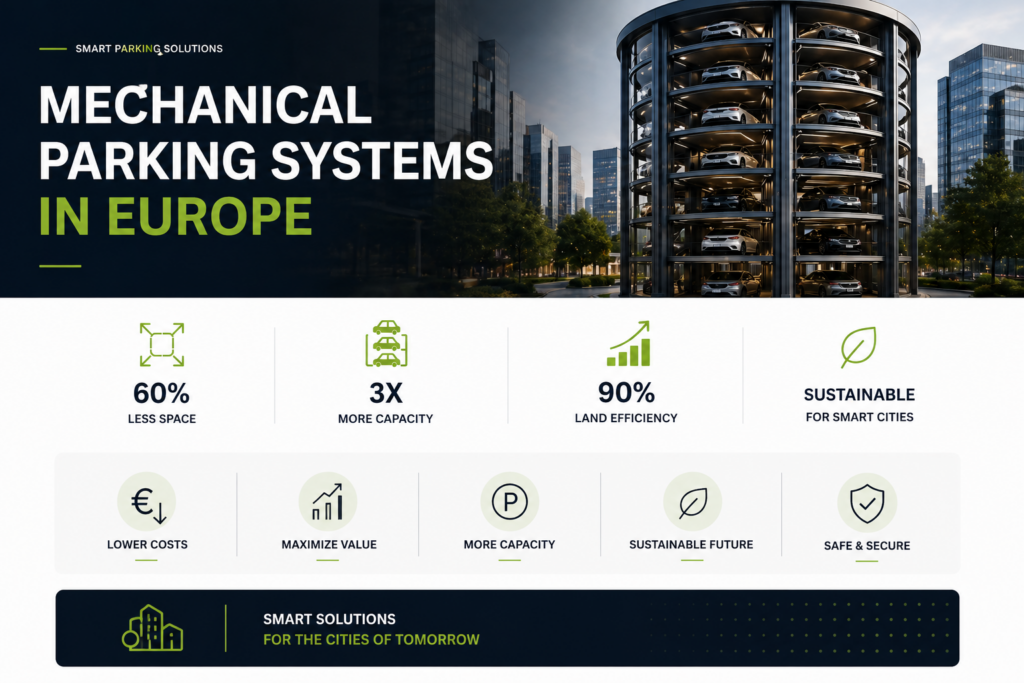
Mechanical parking systems for universities completely disrupt this mathematical paradigm. By utilizing automated pallets, lifts, or robotic platforms, human drivers and their vehicles are separated. The system eliminates the need for driving lanes, pedestrian stairs, and turning circles, reducing the spatial requirement per vehicle to as little as 15 square meters. For a Turkish university developer, this represents a 50% to 60% reduction in the parking footprint. This spatial efficiency allows academic institutions to reclaim tens of thousands of square meters of valuable land, repurposing it for high-priority academic facilities like research centers, athletic complexes, or additional faculty offices. Campus architects can select from a wide variety of advanced parking products to perfectly match the specific topographical constraints of their Turkish site.
The Academic Traffic Rhythm: Why Mechanical Parking Systems for Universities Excel
A university campus does not generate steady, predictable traffic like a shopping mall or an office building. It operates on a highly rigid, pulsating schedule dictated by lecture timetables. This creates extreme, localized traffic surges that traditional parking infrastructure is fundamentally ill-equipped to handle.
The Morning Rush and the Bell-Curve Bottleneck
At 8:30 AM, Monday through Thursday, a Turkish university experiences a massive influx of vehicles as students and faculty rush to make 9:00 AM classes. In a traditional parking garage, this causes gridlock at the entrance barriers, traffic jams on the internal ramps, and a frantic, dangerous competition for the remaining empty spots. Students end up parking illegally on grass medians or sidewalks. This chaos induces high levels of cortisol before the academic day even begins, negatively impacting cognitive function and learning readiness.
Mechanical parking systems for universities are engineered to absorb these shockwaves. The entry process is exponentially faster. Students pull into a ground-level transfer cabin, exit their vehicle in under 60 seconds, and walk directly to their lecture halls. The automated machinery stores the cars simultaneously in the background. Because retrieval is also rapid—often under three minutes—the chaotic 5:00 PM exodus is similarly smoothed out. Implementing these systems requires comprehensive end-to-end parking services to ensure the technology is perfectly synchronized with the university’s academic calendar and bell schedules.
Protecting Pedestrian Safety on Campus
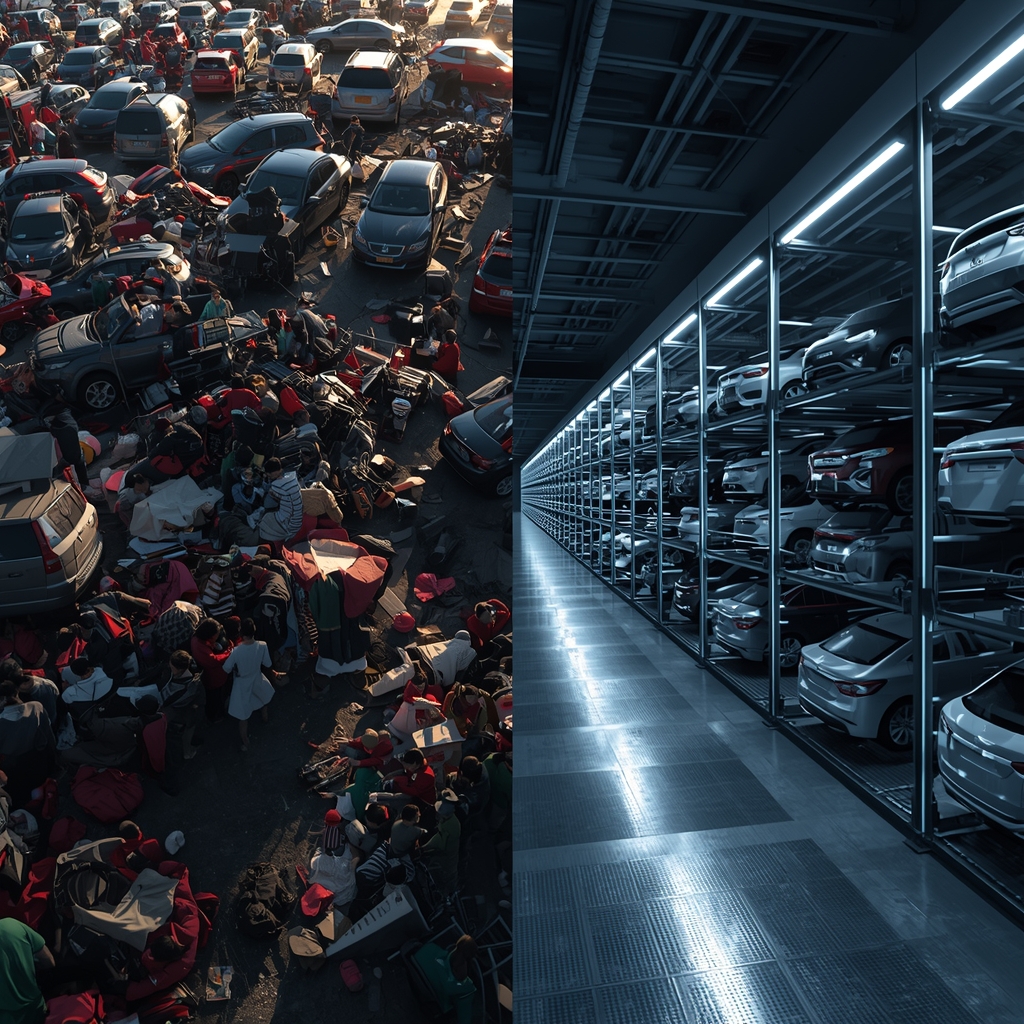
A traditional campus parking garage forces pedestrians (students walking to class) and vehicles (cars circling for spots) to share the same chaotic environment. This leads to a high frequency of minor accidents, “near-misses,” and severe pedestrian anxiety, particularly during the dark winter months in northern Turkey. Automated parking creates a strictly segregated environment. The parking grid is a human-free vault. Students walk exclusively on safe, vehicle-free promenades from the transfer cabins to the academic buildings.
Engineering Reliability for the Academic Semester
The academic calendar in Turkey is unforgiving. A university operates in intense bursts: a rigorous 14-week fall semester, a 14-week spring semester, and intensive summer schools. There is no “off-season” where a parking system can be taken offline for weeks of maintenance. The machinery must operate with absolute, fail-safe reliability.
High-Speed Puzzle and Tower Systems
For the dense, scheduled traffic of a university, specific automated technologies excel. Puzzle parking systems are highly effective for medium-to-large capacities. They use moving pallets to shift cars vertically and horizontally, allowing a single access aisle to serve dozens of parking spaces. Tower parking systems are ideal for universities with limited ground footprint but the ability to build upward. They act as high-speed elevators for cars, retrieving vehicles in under two minutes, which is crucial for a student running between back-to-back classes across a sprawling campus.
The Importance of Precision Manufacturing
The continuous, high-stress duty cycle of an academic semester demands components of the highest quality. The steel pallets, heavy-duty motors, and safety sensors must withstand thousands of cycles daily without failure. The rigorous manufacturing processes behind these automated systems ensure strict quality control, precision welding, and advanced load testing. This guarantees that the machinery will not suffer from mechanical fatigue during critical exam weeks or the first week of the fall semester when traffic is at its absolute peak.
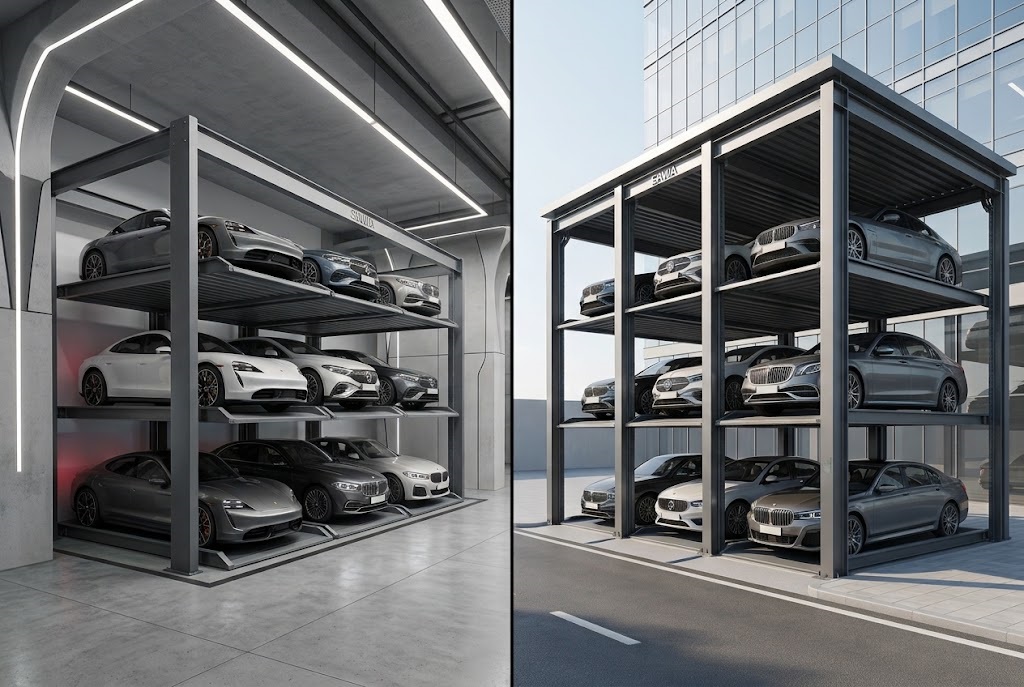
Security, Weather Protection, and Mechanical Parking Systems for Universities
Students in Turkey often invest heavily in their vehicles, and the safety of these assets is a major concern on campus. Traditional open-air lots leave cars exposed to the harsh elements—blistering summer sun that degrades interiors, heavy winter rains, and the infamous Istanbul snowstorms that can paralyze surface-level logistics. Furthermore, traditional lots are vulnerable to vandalism, theft of exterior mirrors, and minor collisions.
Mechanical parking systems for universities transform vehicle storage into a highly secure, climate-protected vault. Because the public is entirely excluded from the parking grid, the risk of vandalism, theft, and accidental damage is reduced to near zero. Vehicles are stored in a clean, dry, enclosed environment, protecting the university’s reputation and saving students from the financial distress of vehicle damage. The global project portfolios of automated parking providers feature numerous educational institutions where this transition to high-security storage has drastically reduced campus security complaints.
Sustainability and Green Campus Initiatives in Turkey
Turkish universities are increasingly aligning their operations with global sustainability goals, driven by international ranking systems like THE (Times Higher Education) Impact Rankings, which heavily weight institutional environmental performance. Traditional parking is a significant liability in this regard.
Eliminating the Circling Emissions
In a traditional campus lot, students routinely spend 10 to 15 minutes idling their engines, circling the aisles looking for a spot. This releases unnecessary particulate matter and greenhouse gases into the campus atmosphere. Mechanical parking systems for universities eliminate this “cruising for parking” phenomenon entirely. The car is turned off the moment it enters the transfer cabin.
Drastic Energy Reduction
Lighting and ventilating a massive, multi-story concrete ramp garage 24/7 requires an enormous amount of electricity. Because automated parking grids are human-free, they do not require continuous lighting or ventilation. Lights and exhaust fans only activate momentarily when a vehicle is being moved. This reduction in electrical consumption significantly lowers the university’s carbon footprint and drastically reduces utility costs, freeing up budgetary resources for academic programs. University administrators looking to integrate these sustainable infrastructure solutions can find valuable strategic insights by exploring a specialized parking technology blog.
Conclusion
The rapid expansion of Turkish higher education cannot be sustained using 20th-century urban planning models. As cities like Istanbul, Ankara, and Izmir become increasingly dense and congested, universities can no longer afford to sacrifice precious academic land for sprawling, inefficient concrete parking ramps. Mechanical parking systems for universities provide the definitive solution to this modern crisis. They maximize land utilization, neutralize the chaotic traffic surges of the academic schedule, protect student vehicles, and dramatically lower the environmental impact of the campus. By investing in automated parking infrastructure, Turkish universities are not just solving a logistical problem; they are optimizing their spatial assets to focus entirely on their core mission: education and research. To discover how these advanced systems can be integrated into your campus master plan, we encourage you to contact our team for a specialized consultation.
References & Scientific Sources
- Journal of Transport Geography – Spatial allocation and land-use optimization in higher education campuses: The impact of automated vehicular storage systems. (Provides the academic foundation for calculating spatial footprint reductions and the opportunity cost of land used for traditional parking versus academic facilities).
- Transportation Research Part F: Traffic Psychology and Behaviour – Commuting stress, cognitive performance, and the impact of pre-class parking friction on university student populations. (Validates the psychological argument regarding how traditional parking chaos negatively affects student readiness and academic performance).
- Sustainable Cities and Society – Evaluating the carbon footprint reduction of automated parking infrastructure in dense urban educational institutions. (Supports the environmental sustainability claims, specifically regarding the elimination of idling emissions and the reduction in ventilation/lighting energy consumption).
- Accident Analysis & Prevention – Pedestrian-vehicle conflict analysis in traditional campus parking structures versus segregated automated parking environments. (Validates the safety and security benefits of excluding human traffic from the parking grid to protect university students and staff).