


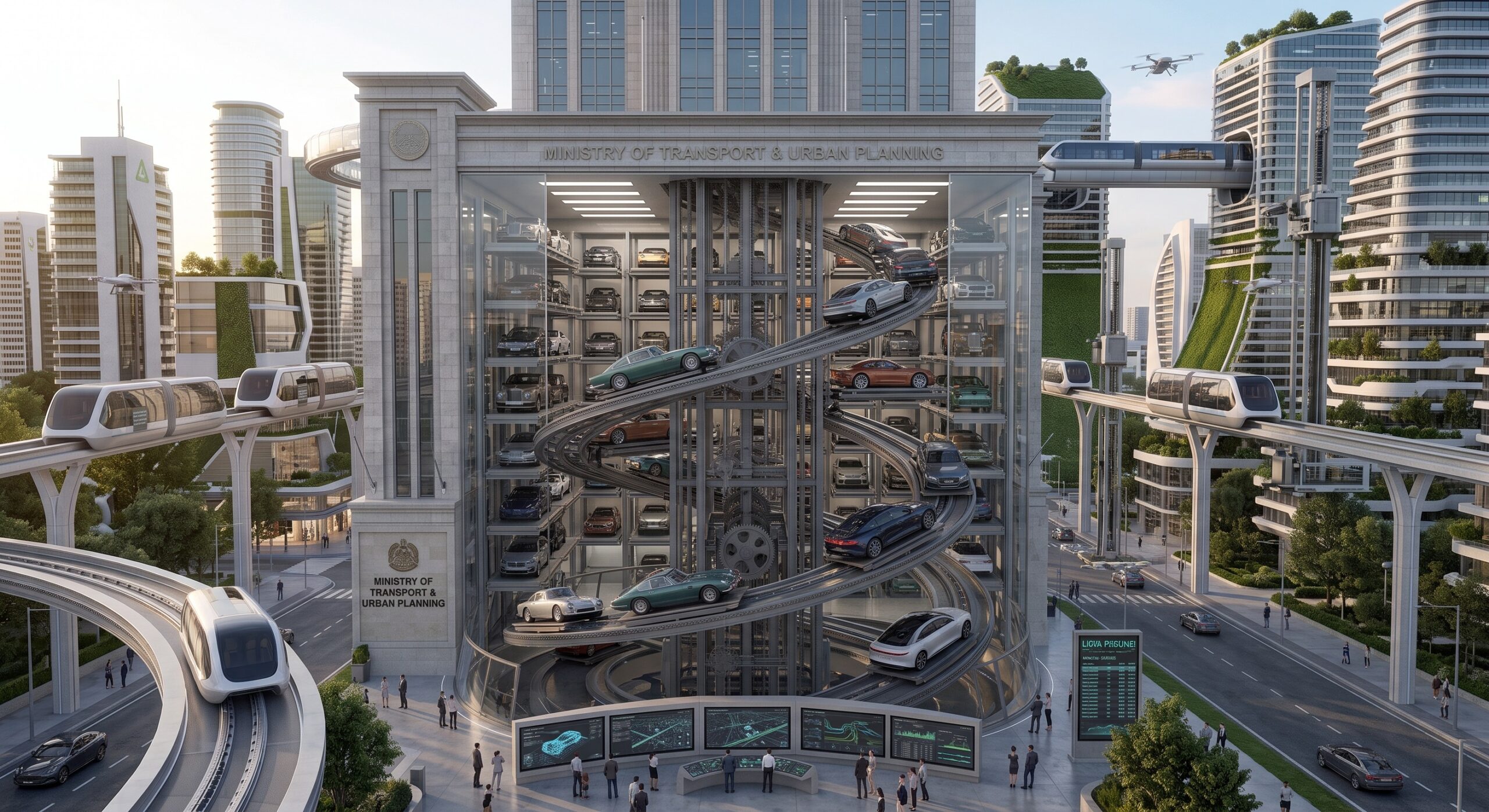
Mechanical Parking Systems for Government Buildings: The Ultimate Security & Space Guide
The architecture of modern governance has undergone a radical and necessary transformation over the past three decades. In an era defined by evolving global security threats, the traditional concept of a government building as an open, accessible civic temple has been permanently altered. Today, embassies, ministries, judicial courts, and municipal headquarters in major capital cities must function as highly secure fortresses that simultaneously remain accessible to the public they serve. This paradoxical mandate—openness versus absolute security—creates profound logistical nightmares for urban planners and state architects.
Nowhere is this paradox more visible and more dangerous than in the parking infrastructure. Traditional underground parking ramps and surface lots attached to government buildings represent the single most vulnerable point in a facility’s security perimeter. They allow unidentified, unscreened vehicles to penetrate deep into the physical footprint of the building, bringing with them the existential threat of Vehicle-Borne Improvised Explosive Devices (VBIEDs). To mitigate this catastrophic risk while simultaneously solving the severe spatial constraints of dense capital cities, state planners are increasingly mandating mechanical parking systems for government buildings. This transition represents a critical evolution in protective architecture. Industry leaders in automated spatial engineering, such as Sawa Parking, are at the forefront of designing the high-reliability, secure infrastructure required to protect modern state assets.

The Urban Land Crisis and Mechanical Parking Systems for Government Buildings
Government buildings are historically located in the dense, historic cores of capital cities—areas like Capitol Hill in Washington D.C., Whitehall in London, or the diplomatic districts of Riyadh and Abu Dhabi. In these prime geopolitical zones, land is virtually priceless, and the geometric constraints of existing streets make expansion nearly impossible.
When a government agency needs to expand its operations, it faces a harsh mathematical reality. Traditional parking requires approximately 30 to 35 square meters of structural footprint per vehicle, factoring in wide driving lanes, oversized turning radii for armored state vehicles, pedestrian escape routes, and heavy structural ventilation shafts. For a large ministry employing 2,000 civil servants, traditional parking could consume over 60,000 square feet of highly valuable urban real estate.
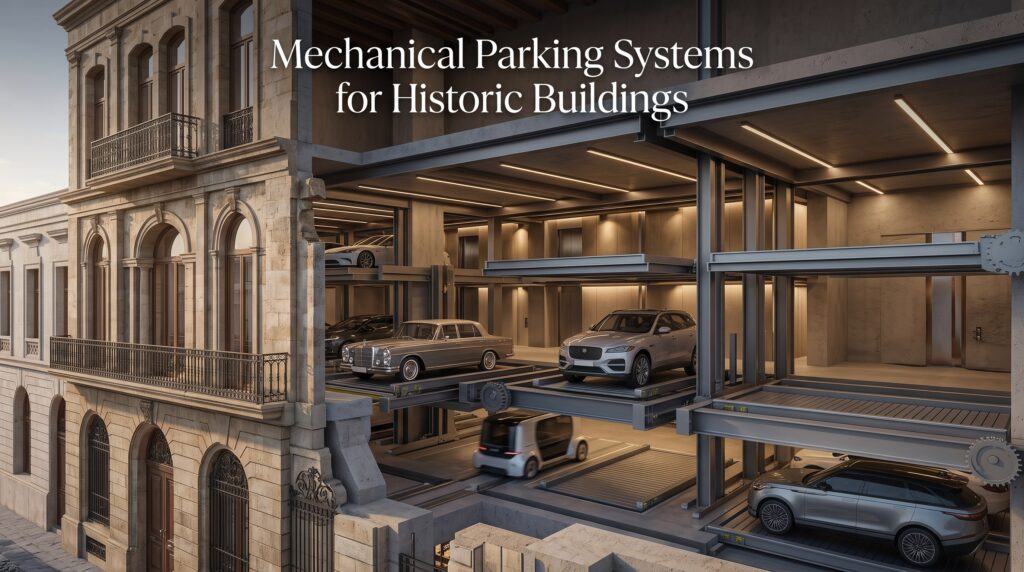
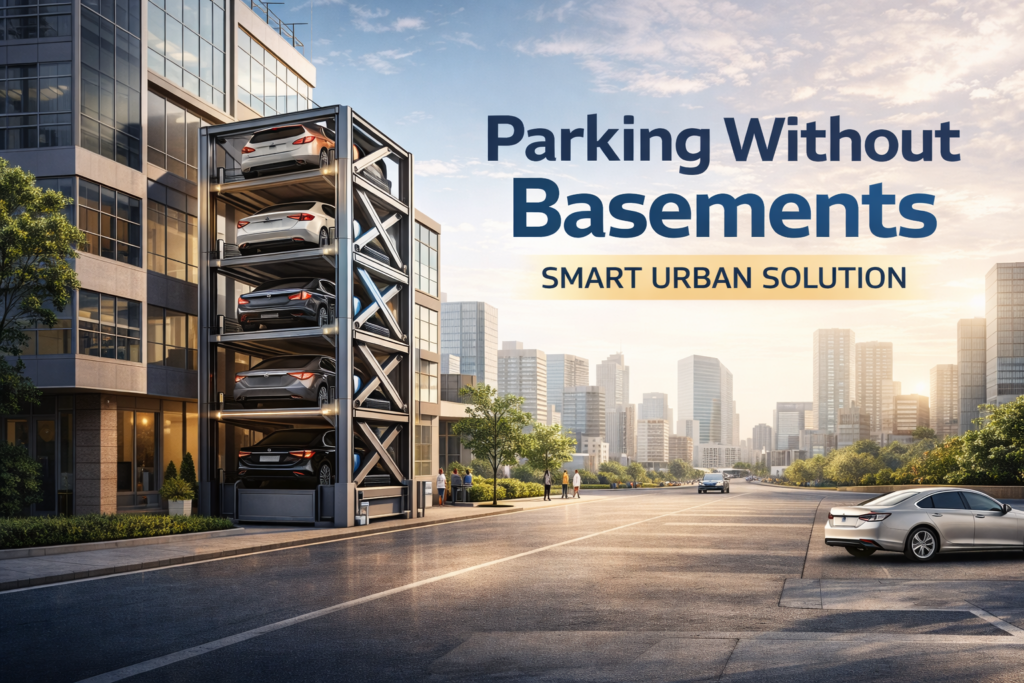
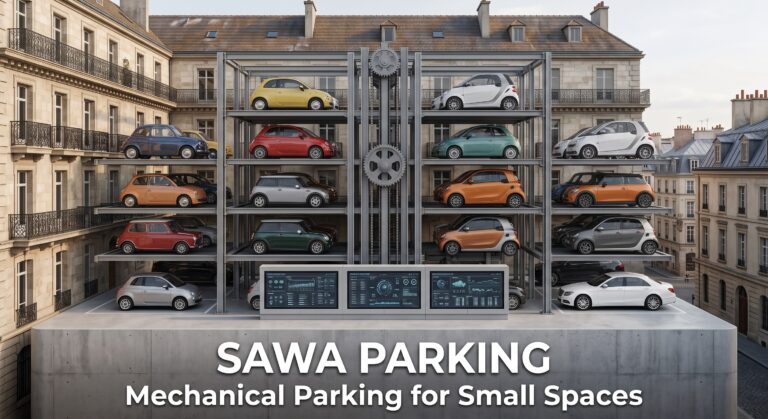
Mechanical parking systems for government buildings completely disrupt this inefficient spatial paradigm. By utilizing automated pallets, lifts, or robotic platforms, the human driver is removed from the parking equation. The system eliminates the need for driving lanes, turning circles, and pedestrian walkways within the structure, compressing the spatial requirement to as little as 15 to 18 square meters per vehicle. For government developers, this represents a 50% to 60% reduction in the parking footprint. This massive spatial efficiency allows planners to either avoid costly deep excavations in complex urban geology or reclaim the saved subterranean volume to expand secure office space, intelligence briefing rooms, or critical IT infrastructure. To achieve this level of spatial compression, government architects can select from a highly specialized range of advanced parking products tailored to handle unique state vehicle dimensions.
Elevating Physical Security with Mechanical Parking Systems for Government Buildings
In the realm of state architecture, security is not a feature; it is the foundational requirement. The primary reason government agencies worldwide are migrating to automated parking is the unparalleled enhancement of physical security protocols.
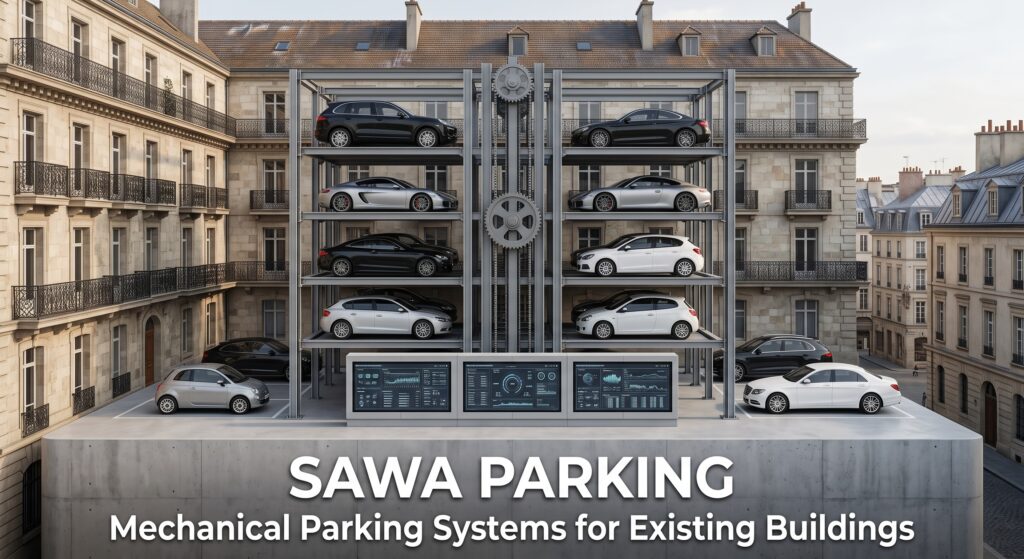
Eliminating the VBIED Threat
The greatest threat to a modern government building is a car bomb. In a traditional parking garage, a terrorist can drive a vehicle laden with explosives directly into the lower levels of the building, potentially collapsing the entire structural foundation. Even with advanced screening technologies like X-ray scanners and undercarriage inspections at the garage entrance, the mere presence of a vehicle inside the perimeter is a severe liability.
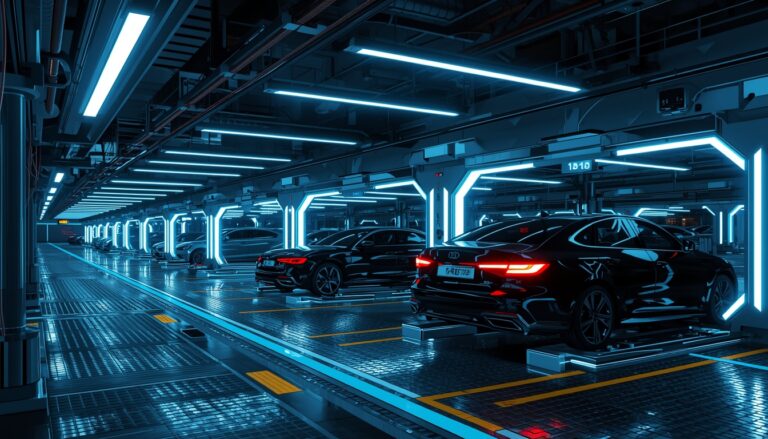
Mechanical parking systems for government buildings architect a fundamentally different security paradigm. The system acts as a physical filter. An armored diplomatic vehicle or a staff car pulls into a heavily secured, blast-resistant ground-level transfer cabin located outside the main secure perimeter of the building. The driver and passengers exit the vehicle. The car is then whisked away by machinery into a dense, human-free storage vault.
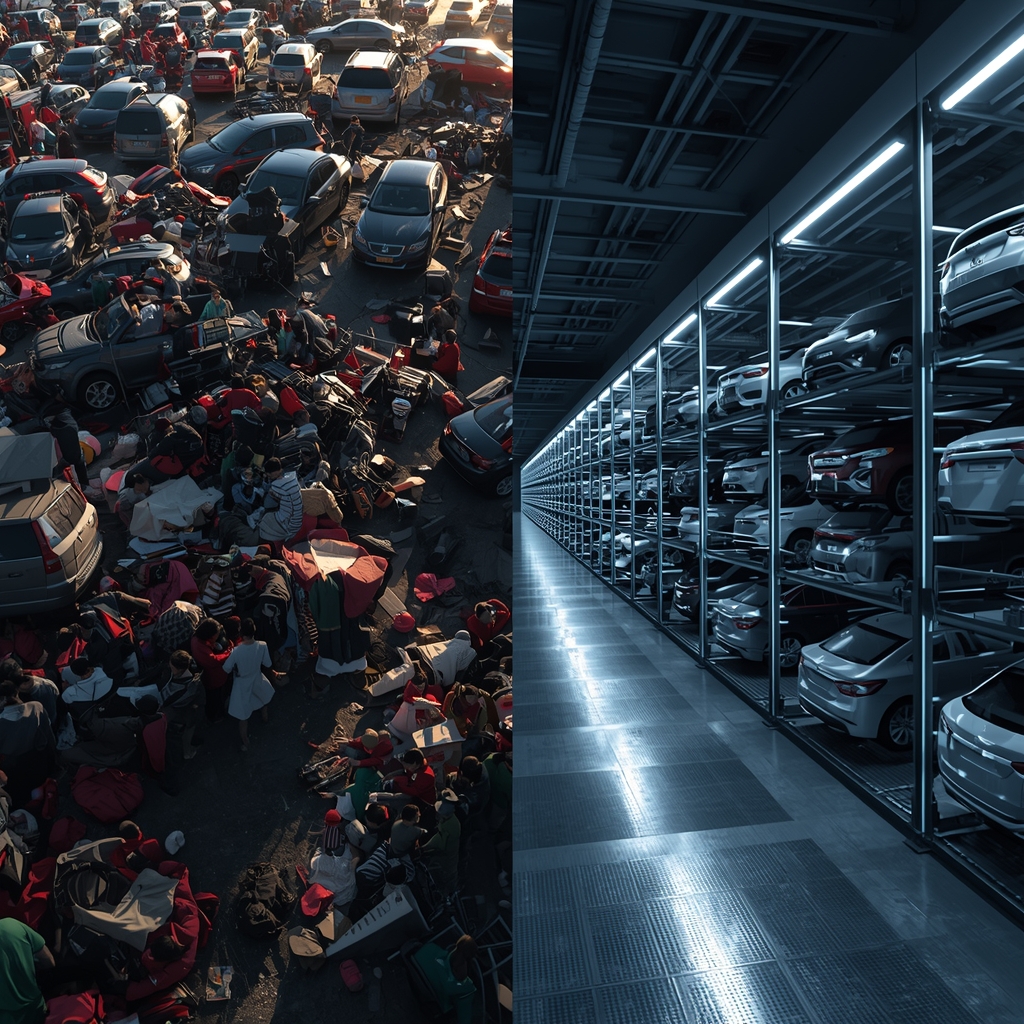
Because the public and the building’s occupants are strictly excluded from the parking grid, the vault can be designed as a hardened, reinforced concrete bunker, physically isolated from the main building’s structural core. If a vehicle somehow contains an explosive device, the blast is contained entirely within the isolated parking vault, leaving the government facility above completely unharmed.
VIP Discreet Arrivals and Anti-Surveillance
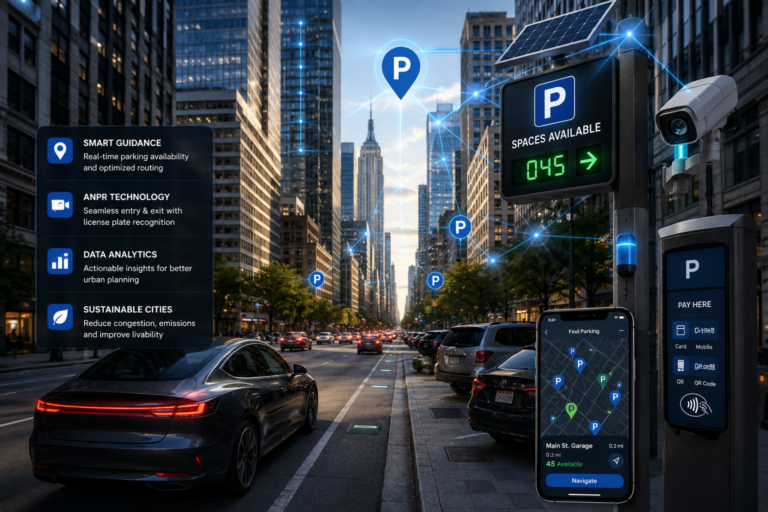
Government buildings host high-ranking officials, foreign diplomats, and protected witnesses. Traditional parking forces these VIPs to navigate public ramps, exposing them to surveillance, paparazzi, or potential physical attack. Automated parking ensures absolute discretion. A diplomat’s vehicle enters a private, secure transfer cabin. They step directly into a private elevator or a secure internal corridor. The automated system stores the vehicle in an inaccessible vault, eliminating the risk of tampering, tracking devices being planted on the vehicle, or vandalism. The integration of this level of security requires comprehensive end-to-end parking services to ensure the machinery’s software integrates seamlessly with the building’s biometric access controls and CCTV command centers.
The Engineering Behind Mechanical Parking Systems for Government Buildings
The operational tempo of a government facility is unique. It must operate with absolute reliability during standard working hours, but it must also be capable of surviving extreme events, including power grid failures, cyber-attacks, or physical bombings. Therefore, the technology utilized must be engineered to military-grade specifications.
Redundancy and Fail-Safe Operations
A government ministry cannot afford to have its parking system go offline, trapping officials or delaying emergency response teams. Therefore, mechanical parking systems for government buildings are designed with massive systemic redundancy. This includes dual power feeds from independent city grids, massive Uninterruptible Power Supplies (UPS) that can run the system for hours during a blackout, and backup diesel generators.
Mechanically, if a primary lift motor fails, secondary motors automatically engage. If a sensor malfunctions, the system defaults to a safe state, locking the vehicles in place until manual override protocols are initiated by security personnel. The engineering complexity of these fail-safes is immense, which is why they must be developed under strict quality controls.
Precision Manufacturing for State Infrastructure
The continuous, high-stress duty cycle of a state facility demands components of the absolute highest caliber. The heavy-duty steel pallets, high-torque motors, and redundant safety sensors must withstand continuous use without mechanical fatigue. The precision manufacturing processes behind these government-grade automated systems ensure strict adherence to international structural steel codes (such as AISC or Eurocode), utilizing non-destructive testing (NDT) on every critical weld. This guarantees that the machinery will not suffer from structural failure during a national emergency or a high-security event.
Blast Resistance and Structural Engineering in Mechanical Parking Systems for Government Buildings
When designing automated parking for state facilities, the structural engineering goes far beyond merely holding up the weight of cars. The transfer cabins and the outer shell of the parking vault must be designed to withstand explosive blasts.
Hardened Transfer Cabins
The ground-level cabins where vehicles are dropped off can be engineered as “blast chambers.” They are constructed with reinforced concrete walls, steel blast doors, and specialized venting mechanisms designed to direct the force of an explosion upward and outward, away from the main government building and populated pedestrian zones. If a threat is detected in the cabin, security personnel can lock down the blast doors, evacuating the area while containing the device.
Structural Isolation
By utilizing automated systems, civil engineers can physically decouple the parking structure from the main government building. Traditional parking ramps are structurally integrated into the building’s foundation. An automated vault can be built as a separate, standalone structure buried adjacent to the facility, connected only by a subterranean pedestrian tunnel. This ensures that even if the parking vault is compromised, the structural integrity of the primary government building remains intact. As documented in highly secure global project portfolios, this architectural separation is now a gold standard in modern embassy and ministry construction.
Economic Optimization Through Mechanical Parking Systems for Government Buildings
While security is the primary driver, the economic argument for automated parking in the public sector is incredibly compelling, especially when considering the responsible use of taxpayer funds.
Reducing Excavation and Construction Costs
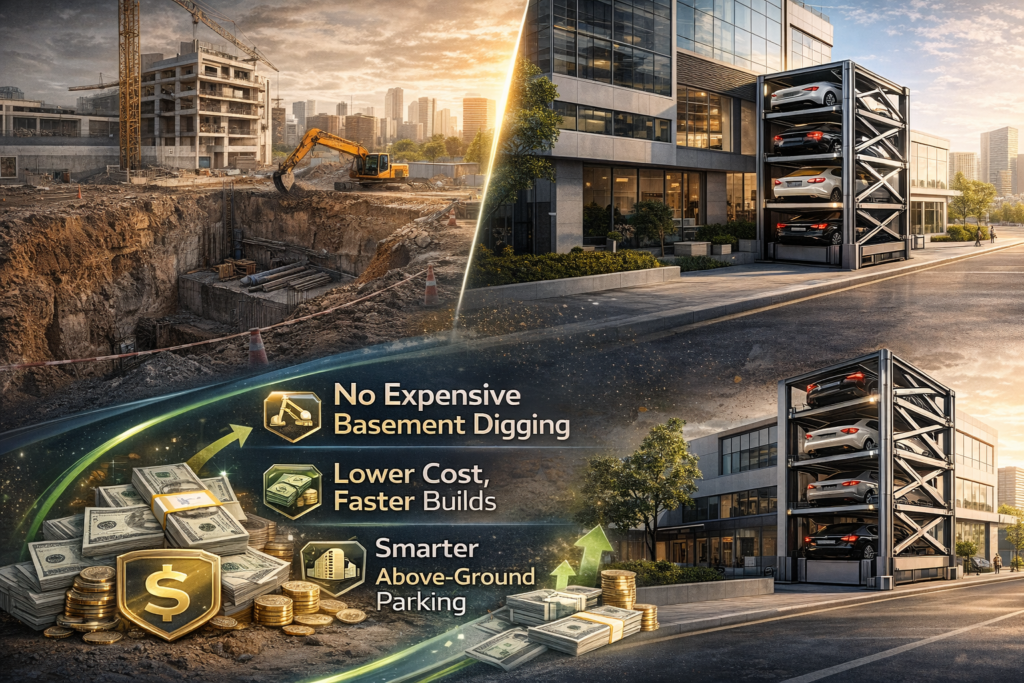
Digging a deep, multi-level traditional parking basement beneath a historic government building or in a dense urban center is an engineering nightmare. It requires complex shoring walls, dewatering systems to handle groundwater, and meticulous monitoring to prevent subsidence damage to adjacent historic structures. These underground construction costs can run into tens of millions of dollars. Because mechanical parking systems for government buildings require significantly less depth to achieve the same vehicle capacity, they can drastically reduce the complexity and cost of the excavation phase, saving the government massive amounts of capital.
Lowering Operational Overhead
Traditional government parking garages require a small army of contract security guards to patrol the aisles, monitor for suspicious behavior, and manage traffic. They also require 24/7 high-intensity lighting and massive mechanical ventilation fans to extract vehicle exhaust. Automated parking eliminates the human element from the garage, drastically reducing security personnel costs. Furthermore, because the vault is unlit and unventilated until a car is moving, the electrical utility costs are reduced by up to 70%, representing massive long-term savings for the public purse. Government facility managers looking to justify these capital expenditures through operational savings can find valuable strategic frameworks by exploring a specialized parking technology blog.
Sustainability Mandates for Mechanical Parking Systems for Government Buildings
Governments are increasingly bound by strict environmental mandates. In the United States, federal buildings must adhere to Guiding Principles for Sustainable Federal Buildings. In the European Union, public buildings must meet stringent energy efficiency directives. Traditional parking is a massive barrier to achieving these green building certifications.
Eradicating Idling Emissions
In a traditional government parking facility, hundreds of staff members and visiting citizens routinely idle their engines for 10 to 15 minutes while navigating ramps and searching for spots. This concentrated idling releases nitrogen oxides (NOx) and particulate matter directly into the air intakes of the government building, severely degrading indoor air quality. Mechanical parking systems for government buildings eliminate this phenomenon. The vehicle is turned off the moment it enters the transfer cabin, resulting in zero tailpipe emissions inside the structure.
Drastic Energy Reduction
Lighting and ventilating a massive, multi-story concrete ramp garage 24/7 requires an enormous amount of electricity—often generated by fossil fuels. Because automated parking grids are strictly human-free, they do not require continuous lighting or ventilation. Lights and exhaust fans only activate momentarily when a vehicle is being moved. This massive reduction in electrical consumption helps government buildings easily achieve LEED (Leadership in Energy and Environmental Design) or BREEAM (Building Research Establishment Environmental Assessment Method) certification, allowing the state to lead by example in the fight against climate change.
Conclusion
The architectural landscape of modern governance requires a delicate balance between democratic accessibility and absolute physical security. Traditional parking paradigms fundamentally fail this test, acting as chaotic, expensive, and highly vulnerable weak points in the protective perimeter of state facilities. Mechanical parking systems for government buildings provide the definitive, engineered solution to this 21st-century crisis. By physically separating the driver from the vehicle, automated parking eliminates the catastrophic threat of vehicle-borne explosives, ensures the absolute discretion of VIP arrivals, and transforms the parking garage into a hardened, isolated security vault. Furthermore, it maximizes the utilization of highly constrained urban land, drastically reduces the operational burden on the public purse, and ensures strict compliance with aggressive environmental sustainability mandates. For state architects and security directors, investing in automated parking infrastructure is not merely a logistical upgrade; it is a fundamental imperative of national security and responsible public administration. To explore how these highly secure, state-of-the-art systems can be integrated into your government facility’s master plan, we encourage you to contact our team for a classified-level engineering consultation.
References & Authoritative Industry Sources
-
FEMA (Federal Emergency Management Agency) – Physical Security & Blast Mitigation – Reference Manual to Mitigate Potential Terrorist Attacks Against Buildings. (This official government source validates the article’s claims regarding VBIED threats, the necessity of establishing physical standoff distances, and the structural benefits of isolating hardened parking vaults from primary government facilities). 🔗 https://www.fema.gov/emergency-managers/risk-management/reference-manual-mitigate-potential-terrorist-attacks-against-buildings
-
U.S. Green Building Council (USGBC) – LEED Certification Standards – Guidelines for Sustainable Building Design and Parking Structures. (This authoritative source supports the article’s sustainability section, detailing how eliminating vehicle idling, reducing the structural footprint, and minimizing continuous ventilation and lighting in automated parking directly contribute to LEED and BREEAM green building certifications). 🔗 https://www.usgbc.org/leed
-
ASCE (American Society of Civil Engineers) – Structural Engineering Library – Standards for Load-Bearing Capacities and Urban Excavation. (This premier engineering institution’s database validates the article’s technical claims regarding the heavy-duty structural requirements, steel fabrication codes, and the complex geotechnical challenges of deep excavations in dense capital cities versus shallow-footprint automated systems). 🔗 https://ascelibrary.org/
-
Urban Land Institute (ULI) – Urban Planning & Space Optimization – Research on High-Density Land Use and the Evolving Role of Parking. (This global real estate and urban planning authority provides the economic frameworks that back up the article’s arguments regarding the high opportunity cost of land in capital cities and the lifecycle cost savings (LCCA) of reclaiming subterranean space for high-yield government use rather than traditional parking ramps). 🔗 https://uli.org/research/