

Mechanical Parking Systems in Riyadh: How the Capital’s Vertical City Ambitions Are Reshaping Parking
Riyadh is growing faster than almost any other capital city in the world. The Saudi capital is now home to roughly 7 million residents, with projections putting that figure closer to 8.3 million within a decade, and for most of its modern history that growth has been absorbed the same way most car-dependent Gulf cities absorb it: wider roads, more surface lots, and a skyline that spreads outward rather than up.
That era is visibly ending. King Abdullah Financial District (KAFD) — a 1.6-square-kilometer, 59-tower vertical city inside Riyadh designed by 25 of the world’s top architectural firms — is being built explicitly around the idea of a “10-minute city,” with a masterplan that includes more than 62,000 parking spaces across its towers and a driverless metro station, designed by Zaha Hadid Architects, anchoring the entire district. At the same time, Riyadh Municipality has rolled out its own “Riyadh Parking” initiative to digitally manage more than 164,000 existing parking spaces across the city’s residential and commercial streets. Two very different parts of Riyadh’s parking puzzle — brand-new vertical density and legacy street-level congestion — are being solved in parallel, and both point to the same underlying need: mechanical and automated parking systems that can deliver real capacity on land that is becoming more valuable and more contested every year.
This guide explains how mechanical parking systems work, what Riyadh has already built, and how developers, facility owners, and municipal planners should think about specifying the right system for a Riyadh site.
Why Riyadh’s Parking Challenge Is Its Own Story
Explosive population growth. Riyadh’s population growth rate is among the highest of any capital city in the region, driven by Vision 2030’s economic diversification push and its designation as the Kingdom’s primary business and administrative hub. Every new resident, and every new company relocating to the capital, adds directly to demand for parking capacity that the city’s traditional car-dependent layout was never designed to absorb at this pace.
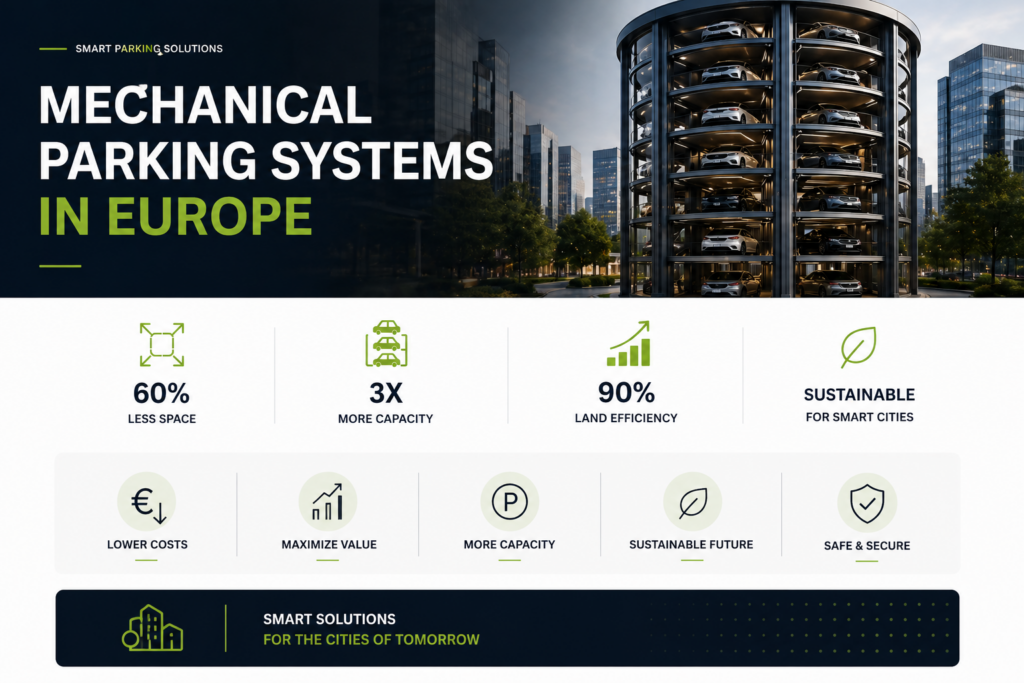
A car-dependent legacy the city is actively trying to reverse. Riyadh has long been characterized by heavy private vehicle use, and the city’s sprawling, traffic-choked road network has been a defining feature of daily life for residents. The launch of the Riyadh Metro — an 85-station, driverless rapid transit network spanning roughly 176 kilometers, billed as the longest fully automated metro system in the world — represents a deliberate strategic shift away from that legacy, and it changes the parking equation in an important way: metro stations become new nodes of parking demand for park-and-ride commuters, while some central districts see reduced pressure for street-level parking as more residents shift to transit.
Land value concentrated in a handful of transformative districts. KAFD alone represents a masterplan of more than 3,000,000 square meters of built space and 62,000 parking spaces across a district built specifically to be the Kingdom’s financial and business hub. In a district competing to attract the same tier of global tenants as Dubai’s DIFC or London’s Canary Wharf, every square meter has to earn its place — and a flat surface parking lot inside a 1.6-square-kilometer vertical city built around 10-minute walkability is one of the least efficient uses of that land imaginable.
Extreme climate and air quality pressures. Riyadh sits in a dust storm–prone desert region, and its air quality challenges are compounded by high private vehicle usage, relatively low fuel costs, and industrial activity — a combination that makes reducing unnecessary vehicle idling and circling (the kind that happens when drivers search for a parking spot) a genuine public health consideration, not just a convenience issue.
A municipal push to formalize and digitize parking. Riyadh’s own “Riyadh Parking” project, launched in phases starting in 2024, is already managing more than 24,000 paid commercial spaces and over 140,000 free residential spaces across a dozen key districts, using solar-powered payment machines, smart guidance signage, and a mobile app linked to the national Nafath identity platform. This tells us clearly that Riyadh’s municipal authorities are treating parking as core infrastructure worth serious investment — creating a receptive policy environment for private developers and facility owners to invest in complementary physical capacity as well.
KAFD: Riyadh’s Flagship Case Study in Vertical Parking
King Abdullah Financial District deserves special attention because it is, in effect, a live experiment in what parking looks like when an entire district is designed around density rather than around the car.
The masterplan calls for roughly 62,000 parking spaces to serve a district that includes Grade A office towers, luxury residences, retail, and hospitality across 59 (reported by some sources as up to 95) towers built on just 1.6 square kilometers of land. In late 2023, KAFD’s development company opened the first phase of dedicated tenant parking and shuttle facilities — more than 4,000 shaded spaces across two phases, paired with a free internal bus service connecting parking areas to the Financial Plaza, specifically designed to reduce parking pressure spilling into surrounding residential neighborhoods.
The district’s approach to mobility goes further still: the KAFD Metro Station, a six-platform, four-level interchange connecting three metro lines and a six-station monorail, was purpose-built to reduce the number of car journeys into the district altogether, with park-and-ride facilities integrated directly into the transit hub design.
What makes KAFD instructive for any other Riyadh developer isn’t just its scale — it’s the underlying logic. A masterplan built around a “10-minute city” concept cannot afford long, sprawling surface parking between buildings without undermining the entire pedestrian-first design premise. The only way to deliver 62,000 parking spaces inside a walkable, vertically dense district is to build much of that capacity into or beneath the towers themselves, using structured and mechanical parking formats rather than the flat, land-hungry lots that define older parts of the city.
Two Layers, One Strategy: Smart Parking Management vs. Mechanical Capacity
Riyadh’s own “Riyadh Parking” municipal initiative, and private providers like Parkomax (deployed through local partner Stebilex Systems across Riyadh, Jeddah, and Dammam), represent the software and management layer of the city’s parking strategy: license-plate recognition for contactless entry and exit, parking guidance systems using sensors and LED panels to direct drivers to available spots, digital permits, and mobile payment. These systems are genuinely valuable — they reduce search time, formalize previously chaotic on-street parking, and give municipal authorities real data on utilization patterns across the city’s commercial and residential districts.
But exactly as in every other market this applies to: software optimizes the use of parking spaces that already exist. It does not create new capacity where none exists physically. That is the role of mechanical and automated parking systems — lifts, puzzle platforms, and robotic towers — and it is precisely the layer that a project like KAFD’s 62,000-space masterplan has to rely on to make its density targets physically achievable in the first place.
The most forward-looking Riyadh developments, unsurprisingly, are combining both: structured or mechanical parking hardware to maximize physical capacity within a tower or district, and a digital management layer, similar to what Riyadh Municipality and Parkomax already provide, to manage access, guidance, and payment on top of that physical capacity.
What Is a Mechanical Parking System?
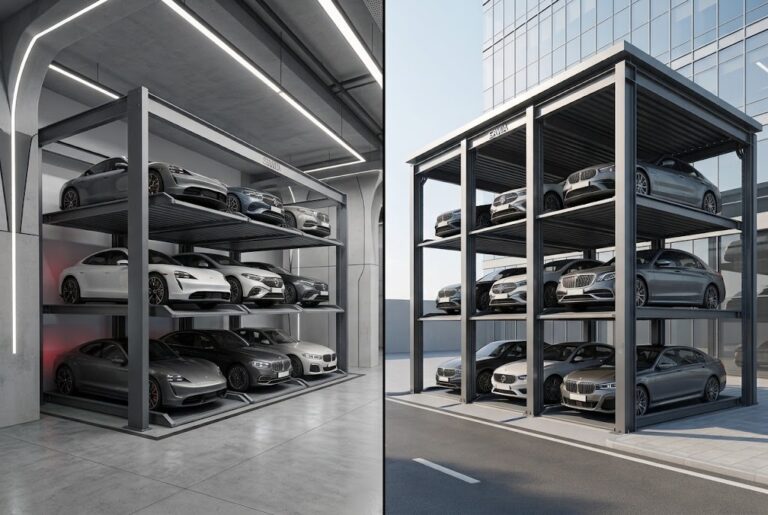
A mechanical parking system uses hydraulic, mechanical, or fully robotic movement to place and retrieve vehicles, instead of relying on the driver’s own maneuvering. The main categories are:
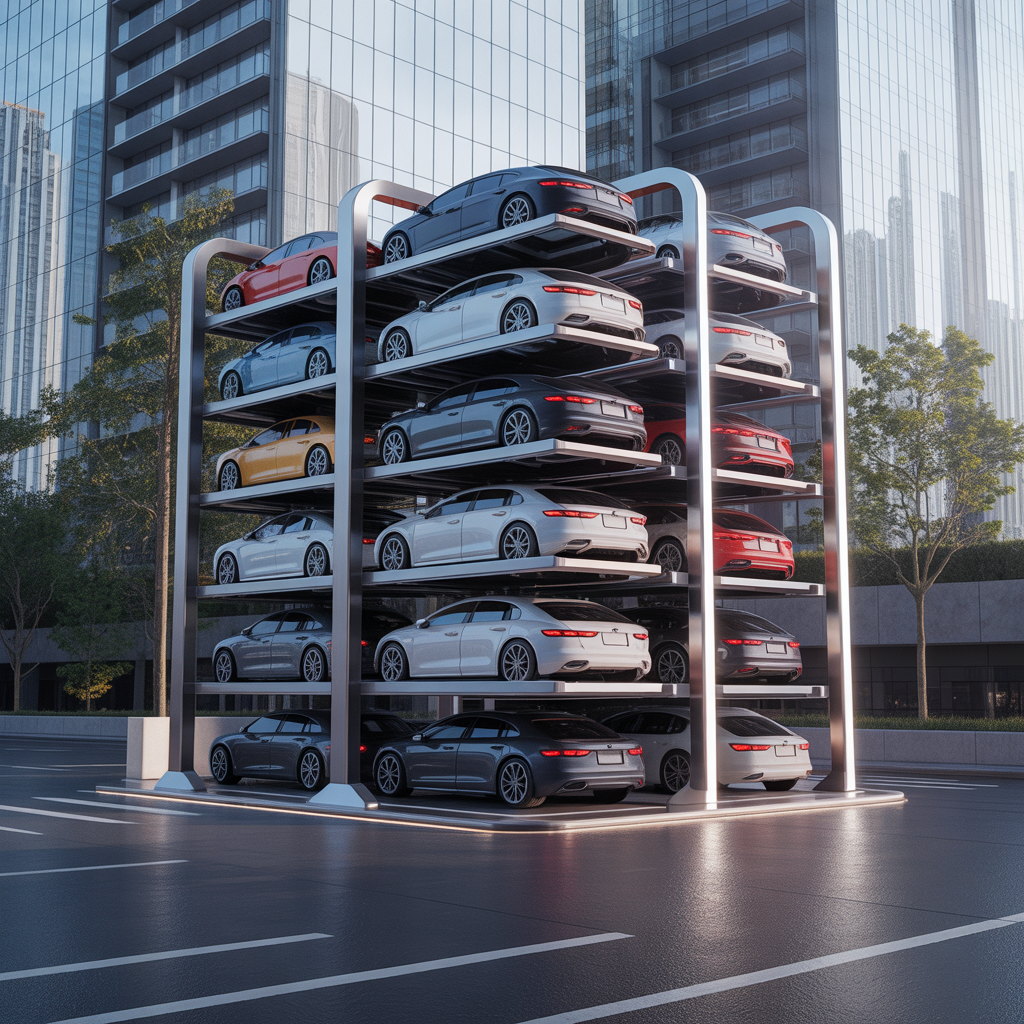
- Semi-automated systems, where the driver parks onto a platform that a mechanical or hydraulic mechanism then lifts or shifts to free additional space.
- Puzzle and shuttle systems, which move multiple vehicles both vertically and horizontally so any car can be retrieved without needing to move every other vehicle in sequence.
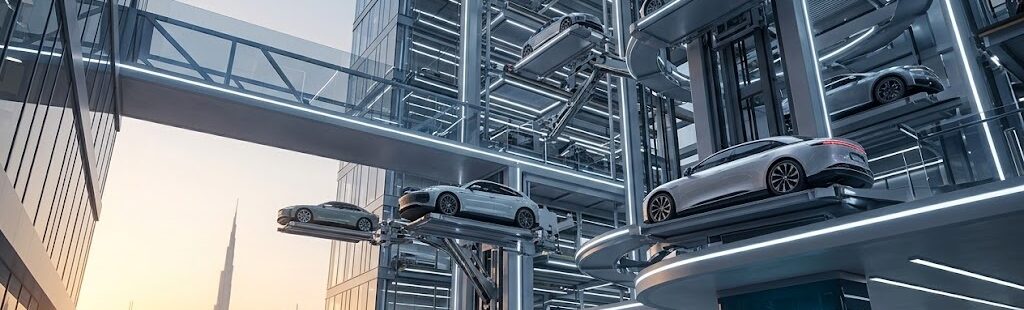
- Fully automated (robotic) systems, where the driver leaves the car at a transfer bay and a robotic shuttle stores it inside a tower or rack, with no further driver or public access to the storage area.
The Types of Systems Best Suited to Riyadh’s Market
Two-Post and Four-Post Lifts
A cost-effective entry point for villas, boutique commercial buildings, and smaller developments across Riyadh’s rapidly expanding residential districts, doubling capacity without heavy civil works.
Puzzle Parking Systems
A strong fit for mid-size office buildings, residential towers, and mixed-use developments across central Riyadh, where independent vehicle retrieval matters but a full robotic tower isn’t justified by the site or budget.
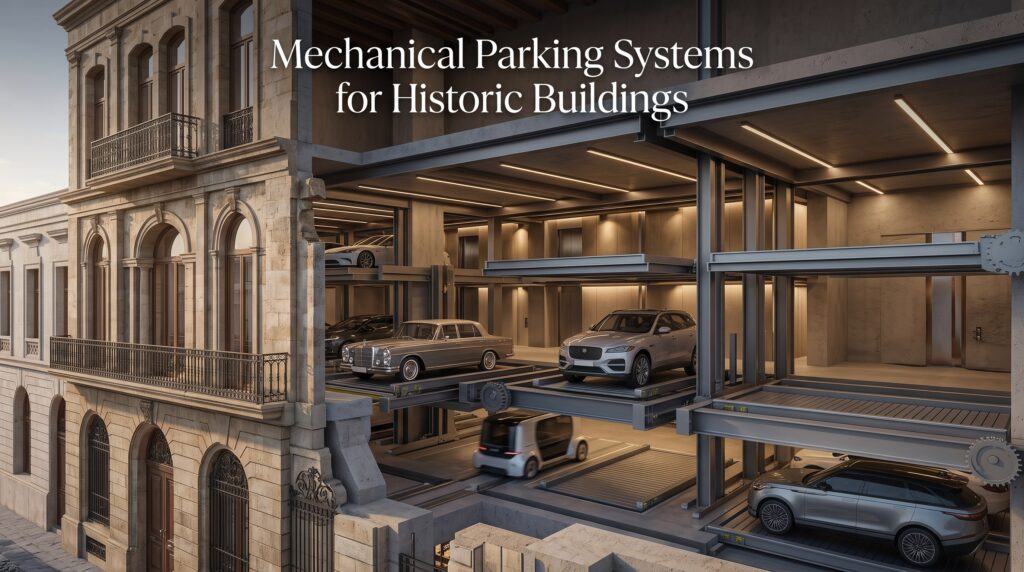
Fully Automated Robotic Towers
The format best suited to the scale of ambition at KAFD and comparable high-density developments — office towers, luxury residential buildings, and mixed-use districts where every square meter is reserved for revenue-generating or pedestrian-first space rather than ramps and driveways.
Metro-Adjacent Park-and-Ride Structures
A category Riyadh specifically needs more of as its metro network matures: compact, high-turnover mechanical parking structures positioned at or near metro stations, designed to handle the twice-daily surge of commuters parking briefly before switching to rail — a very different usage pattern from long-stay residential or office parking, and one that benefits from puzzle or rotary systems built for fast throughput.
Where Mechanical Parking Delivers the Most Value in Riyadh
KAFD and comparable financial or mixed-use districts. As the flagship district’s own masterplan demonstrates, delivering tens of thousands of parking spaces inside a dense, walkable district is only achievable through structured and mechanical formats built into the towers themselves.
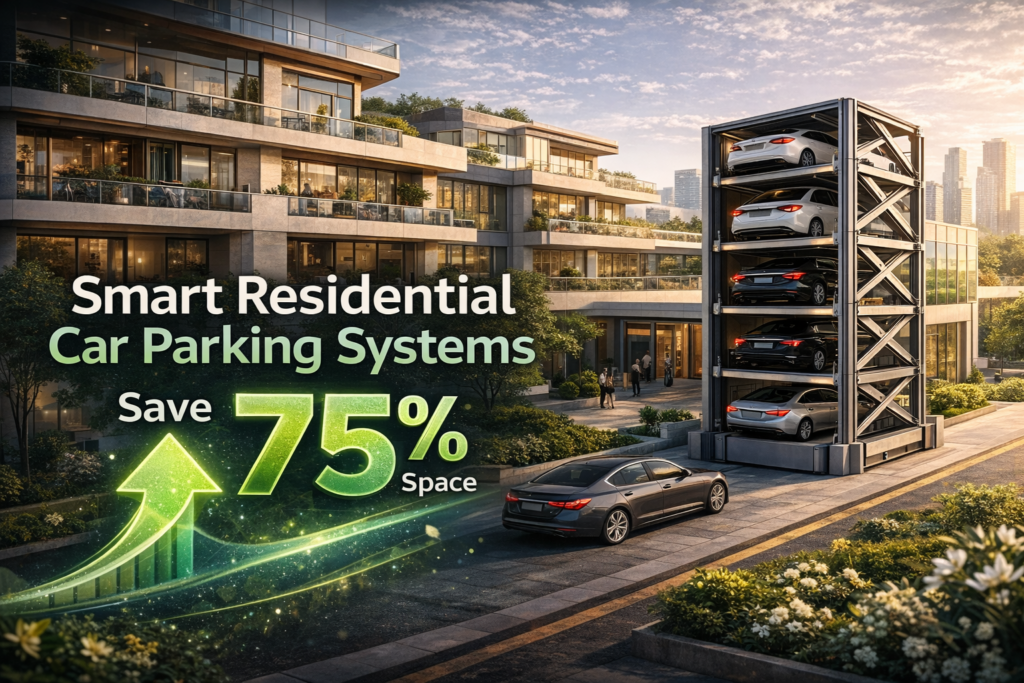
Residential towers across Riyadh’s growth corridors. With the city’s population expanding rapidly, new residential developments face the same land-value pressure seen in any fast-growing capital: every square meter recovered from a flat surface lot can instead become additional saleable or leasable residential space.
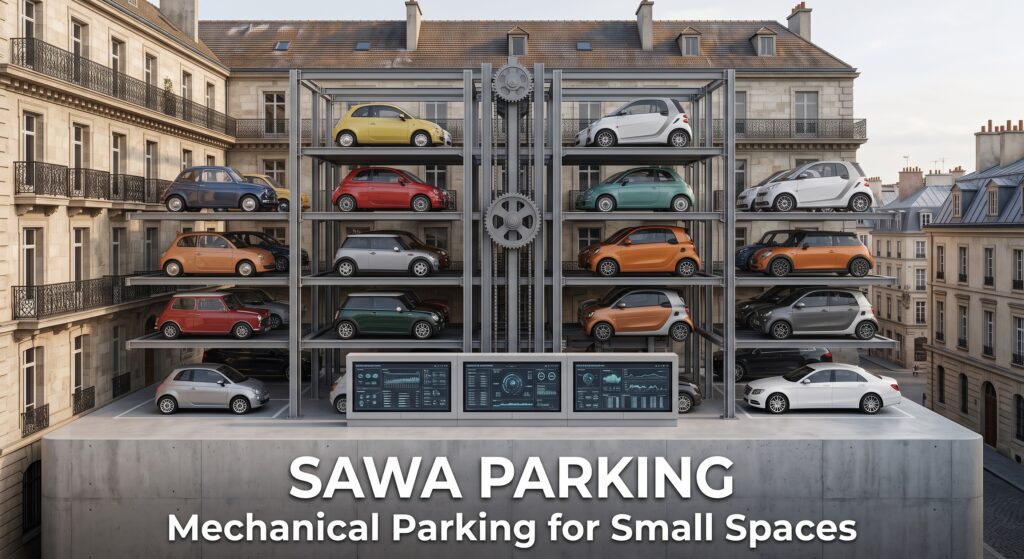
Metro station park-and-ride hubs. As the Riyadh Metro network matures and more residents shift toward transit for their primary commute, demand will grow for compact, high-throughput parking structures at key interchange stations — exactly the kind of short-stay, high-turnover use case mechanical systems are built for.
Shopping malls and retail destinations. Riyadh’s major malls and retail destinations manage some of the highest visitor volumes in the Kingdom, and higher-capacity mechanical systems reduce the congestion and circling that frustrate shoppers during peak hours.
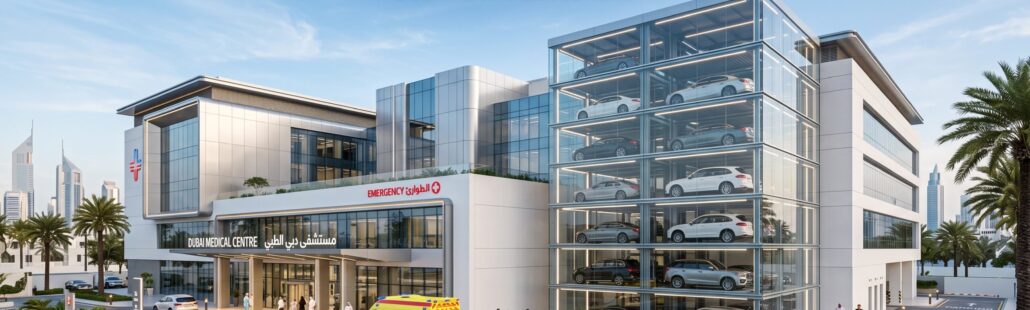
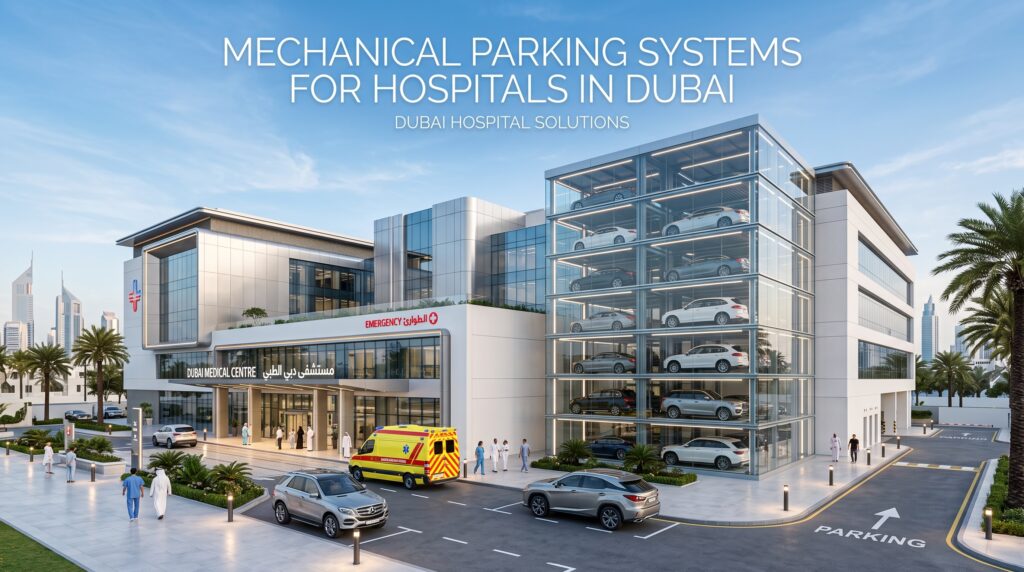
Hospitals and healthcare facilities. Predictable, secure, and rapidly retrievable parking matters for staff, patients, and visitors alike, letting healthcare facilities on constrained urban plots expand capacity without expanding their physical footprint.
Hospitality. Riyadh’s growing hotel sector, driven by both business travel tied to Vision 2030 investment and the Kingdom’s broader tourism ambitions, increasingly treats guaranteed, secure on-site parking as a baseline guest expectation on constrained downtown plots.
Government and institutional buildings. As the nation’s capital, Riyadh hosts a concentration of government facilities that require high security alongside efficient space utilization — a combination automated parking systems are well suited to deliver.
Cost, ROI, and What Affects Pricing in Riyadh
Pricing for mechanical parking systems in Riyadh depends on system type, vehicle capacity, site conditions, and the degree of custom engineering required:
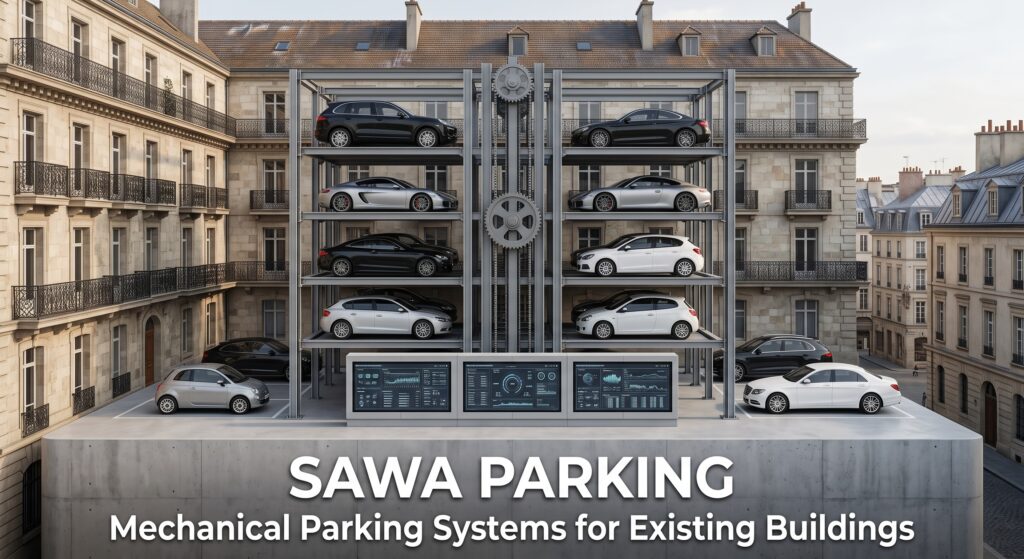
- Two-post and four-post lifts offer the lowest cost per additional space and the fastest installation timeline, a practical entry point for smaller developments.
- Puzzle and mid-size stacker systems sit in the mid-range, delivering a meaningful capacity jump relative to cost for residential towers and mixed-use developments.
- Fully automated robotic towers require the highest upfront investment but deliver the strongest ROI on Riyadh’s most valuable land, particularly in districts like KAFD where the entire masterplan’s density targets depend on maximizing built-in parking capacity rather than surface lots.
Ongoing preventive maintenance should be budgeted into any project, since hydraulic components, sensors, and control software require regular servicing to maintain reliability across a system’s typical 15-to-25-year lifespan — a particularly important consideration given Riyadh’s climate.
Climate and Site Considerations Specific to Riyadh
Extreme heat. Riyadh’s summer temperatures affect hydraulic fluids, lubricants, and electronic components, making thermal tolerance and adequate ventilation or cooling provisions essential specification details for any mechanical parking system operating in the city.
Dust and sandstorms. Riyadh sits in a dust storm–prone desert region, and airborne dust can degrade the accuracy of optical or laser-based vehicle detection sensors, requiring sealed enclosures and more frequent cleaning cycles than systems installed in less arid climates.
Air quality considerations. Given Riyadh’s documented air pollution challenges linked partly to high vehicle usage, any parking strategy that reduces unnecessary idling and circling — a direct benefit of both mechanical capacity and smart guidance systems — supports the city’s broader public health and sustainability goals under Vision 2030.
Foundation and site variability. Riyadh’s terrain and soil conditions vary across the city’s rapidly expanding growth corridors, meaning every installation should begin with a proper geotechnical survey rather than a standardized foundation design.
How to Choose the Right System for a Riyadh Project
- Available footprint and district design requirements — determines whether a tower, puzzle, or simple lift system is the right fit, particularly in masterplanned districts like KAFD with specific density and walkability targets.
- Proximity to Riyadh Metro stations — projects near transit interchanges should consider high-turnover, short-stay parking formats designed for park-and-ride demand.
- Expected vehicle volume and retrieval speed needs — malls, hospitals, and government buildings need faster throughput than long-stay residential parking.
- Budget and phasing — some developers start with a simpler lift or puzzle system and scale up capacity or automation level as later phases are delivered, similar to KAFD’s own phased tenant parking rollout.
- Climate-appropriate components — confirm the manufacturer specifies heat-tolerant hydraulics and sealed, dust-resistant sensor housings suited to Riyadh’s environment.
- After-sales support and maintenance response times — a system is only as reliable as the servicing behind it, so confirm local support availability before committing.
What to Look for in a Mechanical Parking Manufacturer
Riyadh’s market already includes strong players on the software and access-management side, such as Parkomax through its local partner Stebilex Systems, offering license-plate recognition, parking guidance, and visitor access management across Riyadh, Jeddah, and Dammam. For the physical, structural side of the equation — the mechanical hardware that actually creates new parking capacity — look for a partner that offers:
- In-house design and manufacturing, rather than pure resale of imported equipment, which typically means faster customization for irregular or constrained plots and more responsive after-sales support.
- A verifiable track record across comparable climates and project types, not just marketing renders.
- End-to-end turnkey service — site consultation, engineering design, manufacturing, installation, and long-term preventive maintenance under one accountable provider.
- Clear warranty terms on structural steel and mechanical components, with confirmed local spare parts availability.
- Regional experience with heat, dust, and desert site conditions, since a manufacturer accustomed only to temperate climates may not adequately account for Riyadh’s environment.
SAWA Parking was established as the first factory in Egypt, Africa, and the Middle East dedicated specifically to manufacturing mechanical and automated parking systems, and has already exported systems to markets including Italy and France. SAWA offers a complete turnkey process — planning and consultation, engineering design, in-house manufacturing, installation, and ongoing maintenance — giving Riyadh developers, hoteliers, and facility owners a single point of accountability from the first site assessment through years of operational support. For projects ranging from a residential tower in one of Riyadh’s growth corridors to a mixed-use development inside a masterplanned district, working with a manufacturer that controls its own production line — rather than reselling third-party hardware — typically means faster lead times, easier customization for constrained or irregular plots, and more responsive regional support after installation.
The Road Ahead
Riyadh is in the middle of a genuine structural shift: a driverless metro network reshaping how residents move through the city, a municipal parking initiative bringing hundreds of thousands of existing spaces under digital management, and a flagship vertical city at KAFD proving that dense, walkable, transit-connected development is achievable in the Saudi capital. Mechanical and automated parking systems sit at the intersection of all three trends — they are what makes it physically possible to deliver the parking capacity a growing, densifying capital needs, without undermining the walkability and land efficiency these new districts are explicitly designed around.
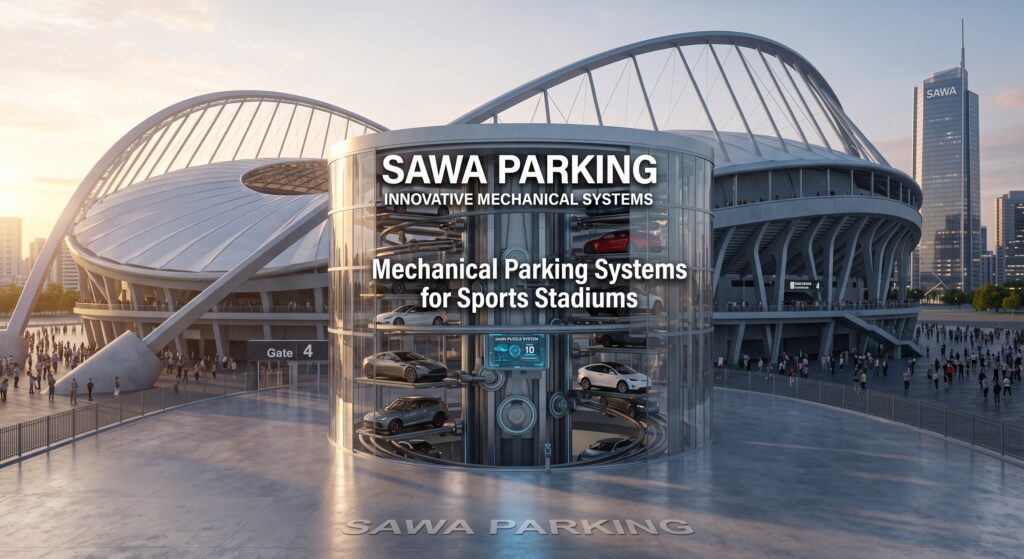
If you are planning a residential tower, commercial building, hospitality project, or mixed-use development anywhere in Riyadh and want to explore which mechanical parking solution fits your site, SAWA Parking’s team can review your project details and propose a tailored parking strategy from concept through long-term maintenance.
Sources
- KAFD (King Abdullah Financial District) — KAFD Introduces Smart City Parking Solutions. https://www.kafd.sa/en/media-centre/new-tenant-parking-facilities/
- BCG — King Abdullah Financial District: Masterplan and Construction Overview. https://www.bcg-uae.com/projects/king-abdullah-financial-district/
- Architectural Record — Zaha Hadid Architects’ King Abdullah Financial District Metro Station Opens in Riyadh. https://www.architecturalrecord.com/articles/17239-zaha-hadid-architects-king-abdullah-financial-district-metro-station-opens-in-riyadh
- Arab News — New Parking Management System for Riyadh Residential Areas. https://www.arabnews.com/node/2611121/saudi-arabia
- Stebilex Systems — Parkomax: Smart Parking & Access Solutions in Saudi Arabia. https://stebilexsaudi.com/brands/parkomax/