



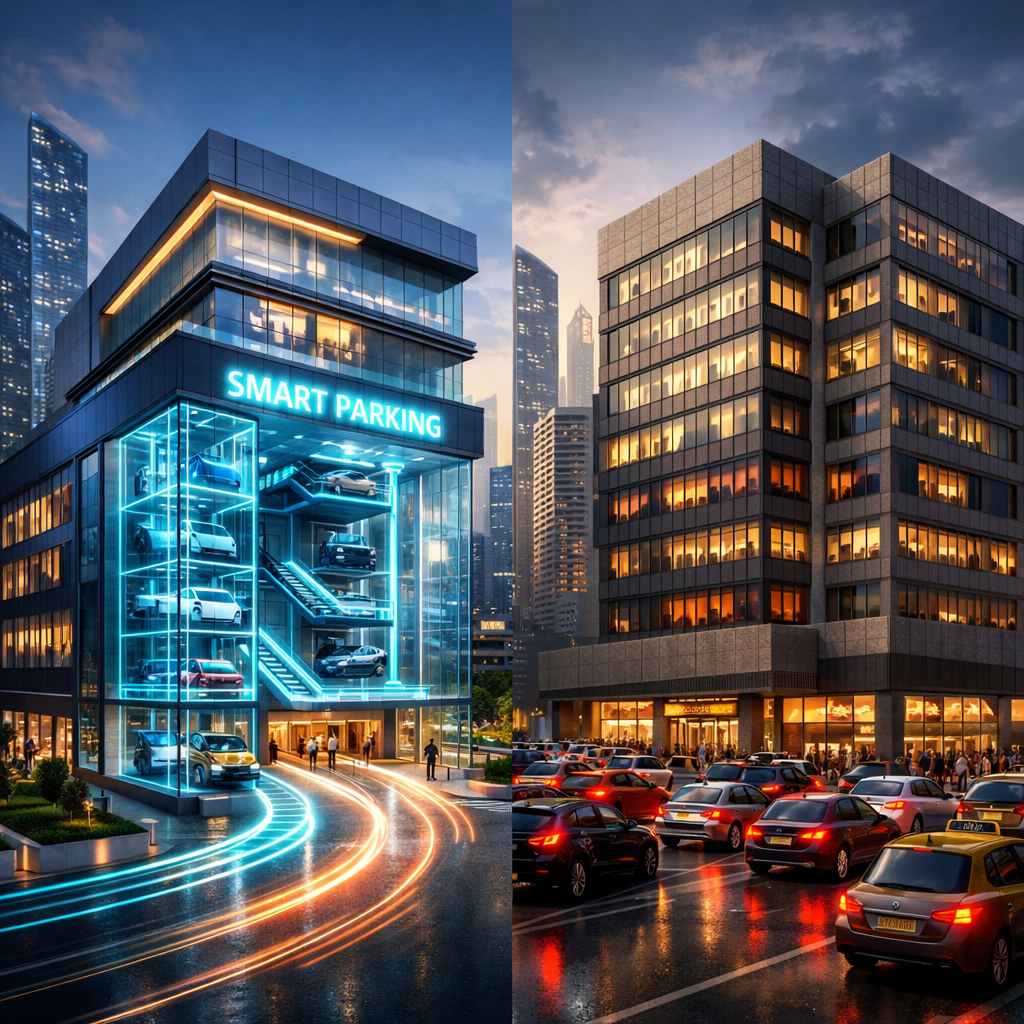
Smart Parking Systems Are Changing How Projects Compete
In today’s real estate market, projects rarely fail because of architecture. They fail because of friction. Buyers compare layouts, finishes, amenities, and pricing across multiple developments. What truly differentiates a project is how smoothly daily life functions inside it. Smart Parking Systems directly influence that daily experience. When parking is engineered, structured, and predictable, it removes one of the most common stress points in urban living.
Developers often treat parking as a technical requirement rather than a commercial asset. However, when parking feels uncertain or poorly organized, buyers hesitate. That hesitation affects pricing confidence and slows decision-making. Smart Parking Systems transform parking into a structured infrastructure promise. Instead of offering “available spaces,” developers offer engineered allocation backed by mechanical design and automated control systems that maximize land use and meet parking requirements even when space is limited.
Projects that integrate smart vertical parking early in the design phase gain measurable positioning advantages. Sales conversations become easier because the development presents a complete mobility solution rather than a compromise. This shifts buyer perception from risk to reliability.
Smart Parking Systems and Land Value Optimization
Land is the most expensive component in urban development. Traditional horizontal parking layouts consume premium square meters through ramps, turning lanes, and circulation areas. Smart Parking Systems reduce this inefficiency by shifting vehicle storage vertically using mechanical structures and automated systems. The footprint remains compact while parking capacity increases.
This vertical efficiency allows developers to reclaim valuable space. That reclaimed area can support additional residential units, retail frontage, storage, or upgraded amenities depending on the project model. In financial terms, parking becomes a lever for improving net sellable area ratios. Instead of allocating high-value land to static car storage, the developer monetizes space more intelligently.
Deep basement construction also carries structural and groundwater risks that increase timelines and cost uncertainty. Mechanical parking solutions redistribute cost toward controlled manufacturing and installation rather than unpredictable site excavation. Developers reviewing stacking systems, lifts, elevators, and automated configurations can explore the full range of Smart Parking Systems through SAWA’s product portfolio to evaluate capacity strategies aligned with their land economics.
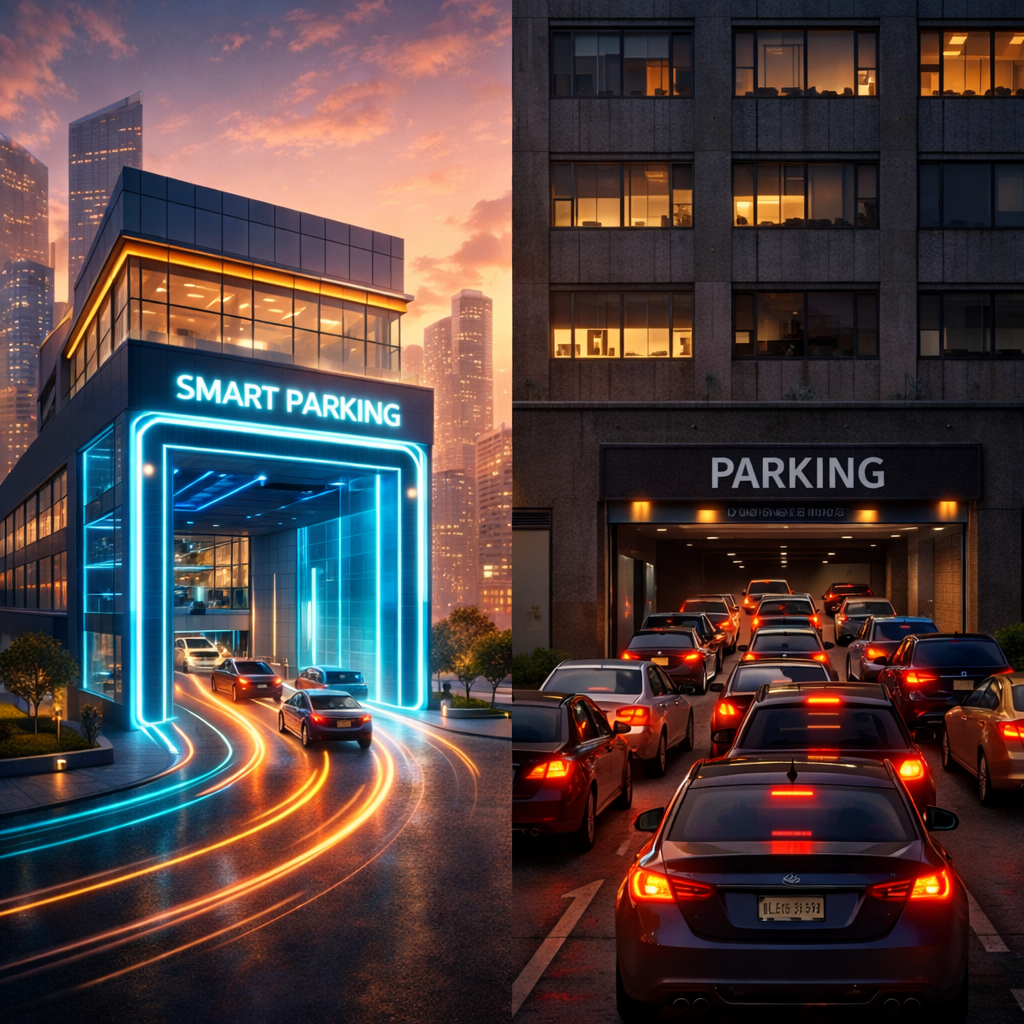
Smart Parking Systems as a Revenue Multiplier
Most feasibility studies treat parking as a compliance obligation. In reality, when optimized correctly, Smart Parking Systems strengthen pricing power. Buyers are willing to pay for predictability and guaranteed allocation. In luxury segments, structured vertical parking enhances exclusivity and perceived project sophistication.
Operational clarity also reduces post-handover disputes. Parking conflicts are among the most frequent causes of dissatisfaction in residential developments. Mechanical stacking and structured allocation reduce unauthorized use and simplify management processes. Developers seeking real-world examples of system integration across residential and commercial projects can review implementations through SAWA’s completed projects page.
When parking operates efficiently, overall asset performance improves. Fewer complaints mean stronger community satisfaction and better long-term resale value. Smart Parking Systems therefore influence both immediate sales performance and long-term project reputation.
Matching Smart Parking Systems to Project Type
Smart Parking Systems include multiple configurations designed to suit different building typologies. Compact stacking systems are suitable for villas and boutique buildings. Two-post and four-post lifts accommodate residential and commercial needs. Triple stackers increase density where vertical clearance allows. Tilting systems solve low ceiling constraints. Puzzle and rotary systems maximize capacity within minimal footprints. Car elevators enable vertical vehicle movement in multi-level structures.
This diversity allows developers to align parking infrastructure with target market expectations. Instead of forcing traditional layouts into constrained plots, mechanical solutions adapt to architectural limitations. In mixed-use developments, structured systems improve zoning between residential, retail, and office flows, reducing congestion during peak hours.
For developers in early planning stages, reviewing system options in detail supports better architectural coordination and financial forecasting. Product specifications and structural configurations can be examined through SAWA’s Smart Parking Systems page.

Local Manufacturing and Lifecycle Advantage
Execution reliability determines the success of any mechanical infrastructure. Locally manufactured Smart Parking Systems reduce shipping delays, customs exposure, and currency volatility. They improve lead-time predictability and simplify spare parts access.
Integrated service chains covering planning, design, manufacturing, installation, and maintenance ensure parking remains a controlled infrastructure asset rather than a long-term liability. This operational continuity is especially critical in hotels, commercial towers, and mixed-use properties where downtime affects revenue.
From a financial standpoint, lifecycle cost predictability strengthens investment stability. Developers who prioritize local production benefit from faster support response and simplified technical coordination. Early feasibility discussions significantly improve financial outcomes, and project teams can initiate direct technical consultation through SAWA’s contact page.
Long-Term Market Performance
Smart Parking Systems influence long-term competitiveness beyond initial sales. Projects known for organized and efficient parking maintain stronger resale value in secondary markets. Investors and buyers evaluate ease of access and allocation clarity as part of property quality.
When parking is engineered rather than improvised, it protects brand perception and operational efficiency for years after handover. Developers who treat parking as a core design strategy rather than an afterthought gain measurable advantage in both primary and secondary markets.
For continued insights into parking strategy, urban mobility integration, and developer-focused case studies, additional resources are available through the SAWA blog.
Conclusion
Smart Parking Systems are no longer optional enhancements. They are strategic infrastructure decisions that influence land optimization, regulatory compliance, buyer psychology, operational efficiency, and lifecycle value. By integrating vertical mechanical parking early in project planning, developers convert parking from a constraint into a competitive asset.
In markets where differentiation determines profitability, engineered parking solutions provide clarity, predictability, and measurable financial advantage. Developers who invest in structured Smart Parking Systems position their projects for faster sales, stronger pricing confidence, and long-term asset resilience.
References
- Donald Shoup, The High Cost of Free Parking, Routledge
https://www.routledge.com/The-High-Cost-of-Free-Parking/Shoup/p/book/9781932364965 - Todd Litman, Parking Management: Strategies, Evaluation and Planning, Victoria Transport Policy Institute
https://www.vtpi.org/park_man.pdf - Institute of Transportation Engineers (ITE), Parking Generation Manual
- Garber & Hoel, Traffic and Highway Engineering, Cengage Learning
cengage.com/…/traffic-and-highway-engineering-5e-garber - ISO 9001 Quality Management Systems Standards
iso.org/iso-9001-quality-management
- Bolton, W., Programmable Logic Controllers: An Introduction
https://www.elsevier.com/books/programmable-logic-controllers/bolton/978-0-08-096942-1