



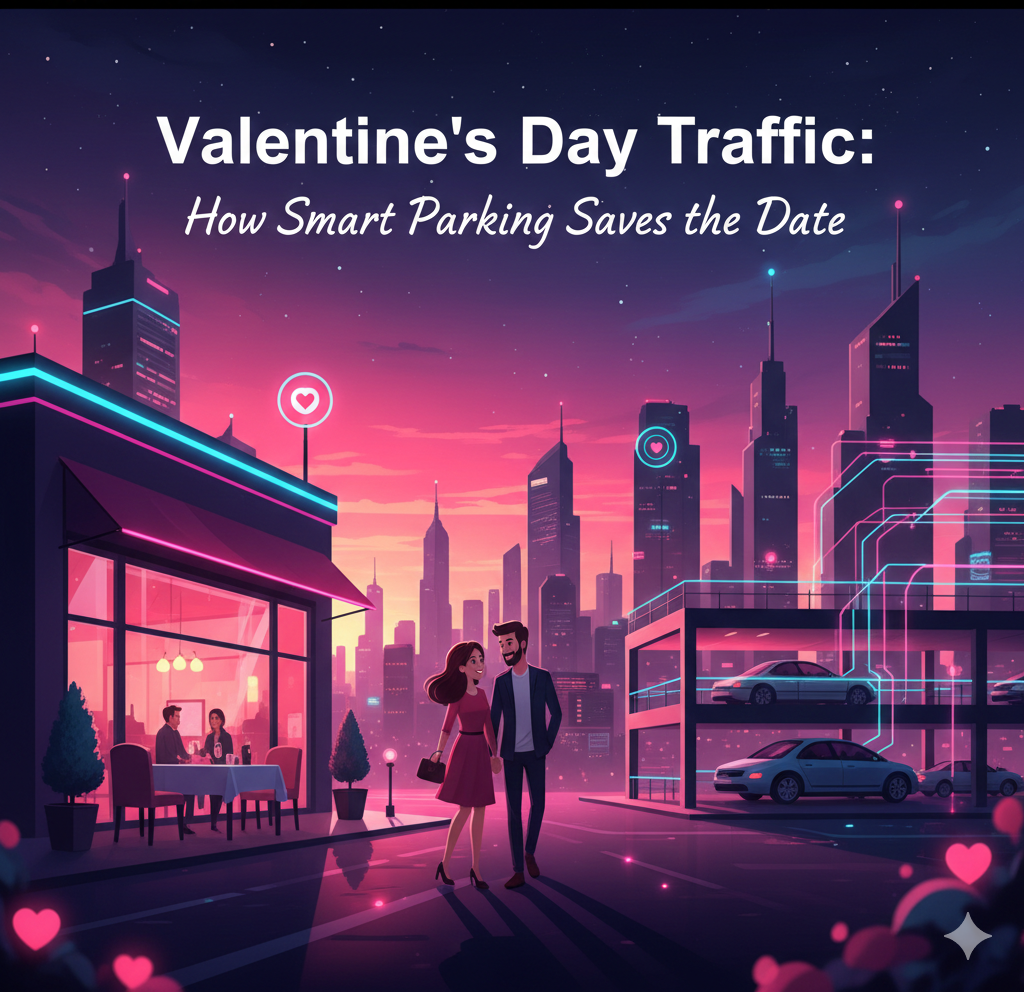
Smart Parking and Why Valentine’s Day Is a Traffic Trap
Valentine’s Day is not just a celebration of romance. In cities, it is also a predictable traffic event. Restaurants are fully booked, cinemas run back-to-back shows, hotels experience peak evening arrivals, and shopping malls turn into social destinations rather than retail spaces. In these moments, parking becomes the silent factor that can either protect the night or completely ruin it. Smart Parking proves its real value under this kind of pressure, where emotions are high and tolerance for stress is low. When parking fails on Valentine’s Day, the problem is not inconvenience, it is disappointment.
Smart Parking at Restaurants on Valentine’s Night
Restaurants are often the first stop of the evening, and the most sensitive one. Guests arrive already late, reservations are time-bound, and curbside congestion builds quickly. Traditional parking creates chaos as drivers circle blocks, stop illegally, or argue with valets over limited space. Smart Parking changes this experience by guiding vehicles directly to available spaces or automated systems without searching or hesitation. When arrival becomes smooth, the tone of the evening is protected. For restaurant districts that rely on repeat visitors, Smart Parking is not an upgrade, it is a reputation safeguard.
Smart Parking and the Cinema Experience
Cinema visits on Valentine’s Day are highly time-dependent. Missing the first minutes of a movie because of parking stress immediately breaks the mood. Smart Parking reduces this risk by shortening arrival time and eliminating uncertainty. Drivers know where to go, how long it will take, and where their car will be stored. This predictability matters more than speed. Studies in user behavior consistently show that certainty reduces stress more effectively than faster but unreliable systems. Smart Parking ensures that the experience begins at the entrance, not inside the screening room.
Smart Parking for Hotels and Romantic Getaways
Hotels play a central role on Valentine’s Day, whether for overnight stays or short romantic escapes. Arrival experience defines the guest’s emotional state far more than room details. Congested entrances, valet delays, and unclear parking instructions introduce friction before the guest even checks in. Smart Parking removes these pressure points by structuring arrival flow and separating vehicle handling from guest interaction. Hotels that integrate Smart Parking into their arrival sequence deliver calm, control, and confidence, qualities that align naturally with hospitality and romance. This is why many hospitality projects explore Smart Parking solutions early through
our products.
Smart Parking in Shopping Malls and Mixed Destinations
Shopping malls on Valentine’s Day transform into social hubs. Couples meet, dine, watch movies, and shop in a single destination. Parking demand spikes unevenly across short time windows. Traditional parking struggles with this variability, leading to congestion at entry points and frustration at exit ramps. Smart Parking systems manage flow dynamically, directing vehicles efficiently and reducing internal circulation. Malls that adopt Smart Parking benefit from smoother visitor movement and longer dwell time, directly supporting tenant performance. Developers often review real Smart Parking implementations via
project case studies
to understand how parking performance affects commercial success.
Smart Parking Is Not a Luxury on Sensitive Nights
Valentine’s Day exposes a critical truth about urban infrastructure. Parking is not neutral. It actively shapes emotional outcomes. On sensitive occasions, parking failure feels personal. Smart Parking reframes parking as a service rather than a constraint. It reduces conflict, protects schedules, and preserves mood. This is why Smart Parking should not be marketed as a premium feature, but as a reliability tool for high-impact moments. Cities and venues that understand this treat parking as part of experience design, not an afterthought.
Smart Parking, Local Intent, and Urban Behavior
From an SEO and urban behavior perspective, Valentine’s Day parking searches reveal strong local intent. People search for restaurants, cinemas, hotels, and malls near them, followed immediately by parking concerns. Smart Parking aligns perfectly with this behavior by addressing the last-mile problem. Locations that offer reliable parking gain visibility, trust, and repeat visits. Businesses that highlight Smart Parking availability during seasonal events benefit from both operational stability and digital discoverability. This is why Smart Parking content performs strongly as seasonal, event-based communication rather than evergreen technical explanation.
Smart Parking and the Emotional Economy of Cities
Urban experiences are increasingly judged by how they make people feel, not just what they offer. Valentine’s Day amplifies this reality. A smooth arrival supports connection. A stressful one disrupts it. Smart Parking operates quietly in the background, but its emotional impact is measurable. Less stress means more patience, better interactions, and stronger memories. In this sense, Smart Parking contributes to the emotional economy of cities, where infrastructure quality directly affects human relationships.
Conclusion: How Smart Parking Saves the Date
Valentine’s Day reveals the real purpose of Smart Parking. It is not about technology or automation. It is about protecting moments that matter. Restaurants, cinemas, hotels, and malls all depend on seamless arrival and departure to deliver positive experiences. Smart Parking succeeds where traditional parking fails by managing flow, reducing uncertainty, and respecting human emotion. On nights when timing and mood are everything, Smart Parking does not just support mobility, it saves the date.
Summary
Smart Parking proves its value during high-pressure occasions like Valentine’s Day, when parking stress can ruin carefully planned experiences. By improving arrival flow at restaurants, cinemas, hotels, and shopping malls, Smart Parking protects mood, timing, and overall satisfaction. It transforms parking from a source of frustration into a quiet support system that aligns with emotional and commercial goals. As cities continue to host event-driven demand, Smart Parking emerges not as a luxury, but as essential urban infrastructure.
References
-
SAWA Parking – Smart Parking Solutions
https://sawaparking.com/ -
Shoup, D. (2018). Parking and the City. Routledge.
https://www.routledge.com/Parking-and-the-City/Shoup/p/book/9781138825863 -
Gehl, J. (2011). Life Between Buildings. Island Press.
https://islandpress.org/books/life-between-buildings -
Transportation Research Part A: Policy and Practice. Elsevier.
https://www.sciencedirect.com/journal/transportation-research-part-a-policy-and-practice