



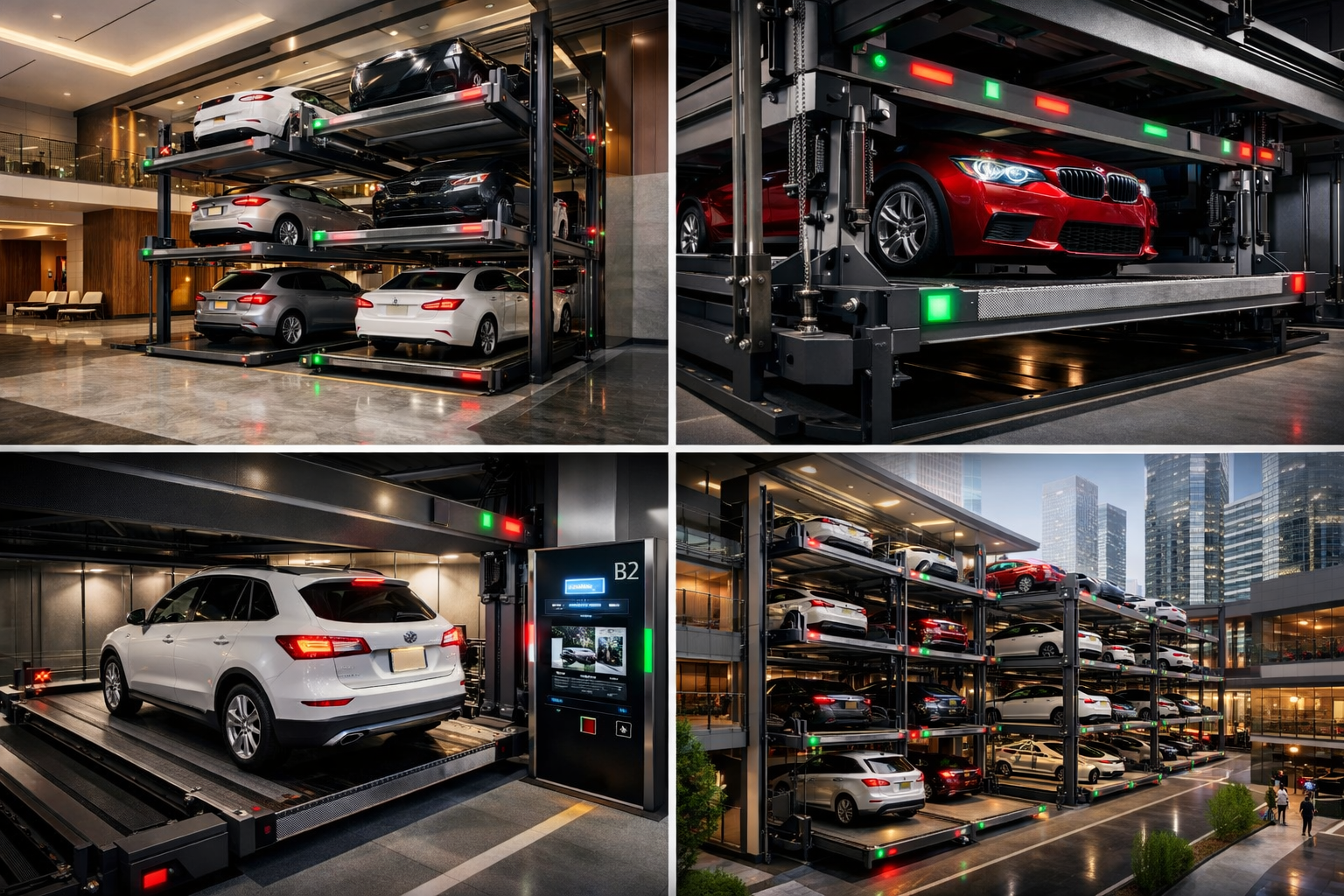
Residential Car Parking: The Strategic Infrastructure Behind Modern Real Estate Value
1) Residential Car Parking as a Core Economic Driver in Real Estate Development
Residential car parking is no longer a secondary architectural element appended at the end of project planning. In contemporary urban development economics, residential car parking functions as a strategic determinant of asset valuation, land-use optimization, and long-term return stability. As land prices rise and urban density intensifies, developers are compelled to maximize every square meter within a project boundary. Within this framework, residential car parking becomes a capital allocation decision rather than a compliance requirement.
When inefficiently designed, parking infrastructure consumes premium land without proportional financial return. Conversely, engineered residential car parking systems transform constrained footprints into high-efficiency assets. The difference between conventional ramp-based garages and space-optimized systems can reshape a project’s profitability margin. Developers who integrate mechanical or automated residential car parking systems from the conceptual stage secure better land efficiency ratios and higher unit sale attractiveness.
The growing sophistication of buyers further reinforces this shift. Residential communities today are evaluated not only by architectural aesthetics, but by daily operational convenience. Seamless vehicle access, reduced circulation congestion, and structured parking organization directly influence user satisfaction. Therefore, residential car parking is inseparable from modern real estate competitiveness.
2) How Residential Car Parking Defines Urban Living Quality
Residential car parking directly shapes the lived experience of residents. In dense urban environments, time spent searching for parking translates into stress, micro-congestion, and environmental inefficiency. Transportation research repeatedly highlights that a notable portion of internal urban traffic circulation stems from vehicles seeking available spaces. Within residential compounds, this dynamic becomes amplified when parking is poorly structured.
Smart residential car parking solutions reduce search time through systematic space allocation, structured layout engineering, and mechanical optimization. Beyond convenience, these systems enhance safety through improved lighting integration, organized vehicle positioning, and minimized pedestrian-vehicle conflict zones.
Moreover, parking infrastructure influences long-term maintenance costs. Conventional systems often require larger ramps, extended ventilation systems, and additional structural reinforcement. Optimized residential car parking systems reduce spatial redundancy and operational energy use, creating long-term cost efficiencies.
For developers, the quality of residential car parking signals project seriousness. It communicates foresight, engineering maturity, and strategic planning—qualities that strengthen buyer confidence and investor perception.
3) 7 Advanced Residential Car Parking Systems for Modern Developments
The diversity of residential typologies demands diversified parking strategies. The following engineered systems represent the most effective categories for optimizing residential car parking performance:
Hydraulic Puzzle Systems
Hydraulic puzzle systems allow vertical and horizontal vehicle shifting to maximize capacity within limited footprints. They are particularly effective for mid-scale residential developments and compounds seeking to multiply parking capacity without structural expansion. Developers can explore advanced configurations of the puzzle parking system engineered for efficient residential deployment.
Two-Post and Four-Post Stackers
Stackers are ideal for villas and low-rise residential projects. These systems double vertical capacity with minimal structural modification, making them a cost-efficient enhancement for private or semi-private developments.
Multi-Level Automated Systems
Fully automated residential car parking systems eliminate the need for internal vehicle circulation. Cars are transferred via robotic platforms to designated storage slots, significantly reducing spatial allocation per vehicle. A comprehensive portfolio of smart residential car parking systems demonstrates how automation elevates both efficiency and prestige.
Basement Smart Guidance Systems
Sensor-based parking guidance enhances slot detection and reduces idle circulation time within enclosed residential garages.
Vertical Rotary Systems
Designed for narrow plots, rotary systems provide high-density vertical stacking suitable for constrained urban land parcels. Each system aligns with specific residential densities, budget profiles, and architectural contexts, enabling developers to tailor parking strategy precisely to project demands.
4) Scientific Evidence: Residential Car Parking and Measurable ROI Impact
Academic literature substantiates the economic significance of residential car parking. Donald Shoup’s seminal work, The High Cost of Free Parking, articulates how inefficient parking allocation distorts land economics and inflates development costs indirectly. While primarily policy-oriented, its principles extend strongly to private residential development strategy.
The Urban Land Institute emphasizes that optimized structured parking improves land-use ratios and enhances capital productivity. The Institute of Transportation Engineers (ITE), through its Parking Generation Manual, illustrates how parking demand varies by density and land use mix—underscoring the importance of calibrated system selection.
Research published in the Journal of Transport and Land Use demonstrates that automated and mechanical residential car parking systems reduce space consumption per vehicle compared to traditional ramp-access garages. This reduction in spatial demand increases the percentage of land allocated to revenue-generating residential units.
Urban mobility analyses further indicate that minimizing internal vehicle circulation reduces localized emissions and operational inefficiency. These findings collectively confirm that residential car parking decisions have quantifiable financial, environmental, and operational consequences.
5) Residential Car Parking and the Strategic Shift Away from Import Dependency
Global trade fluctuations have reshaped the economics of importing mechanical systems. Variability in tariffs, logistics constraints, and supply chain disruptions introduce unpredictability into project budgeting and timelines. Developers reliant on imported residential car parking systems often face hidden costs related to shipping delays, spare part accessibility, and currency volatility.
While international manufacturing capabilities remain advanced, reliance on distant supply chains introduces strategic risk. Extended lead times can disrupt project delivery schedules and inflate capital expenditure unpredictably.
In contrast, locally engineered residential car parking solutions mitigate these vulnerabilities. Reduced logistics complexity, predictable pricing frameworks, and streamlined installation cycles provide measurable strategic stability. The shift toward domestic manufacturing reflects not isolationism—but resilience-oriented project planning.
6) Local Manufacturing in Egypt: A Competitive Advantage for Residential Car Parking
Egypt’s expanding industrial base has created an environment conducive to advanced mechanical system production. Residential car parking systems manufactured locally benefit from geographic proximity, rapid customization capability, and simplified after-sales support.
Localized production enhances cost predictability and reduces dependency on volatile international procurement channels. It also shortens implementation timelines—an essential factor in competitive real estate markets.
Solutions engineered by Sawa Parking exemplify how domestic manufacturing integrates engineering precision with financial efficiency. By consolidating design, fabrication, and installation under unified operational oversight, residential car parking systems become both economically and logistically optimized.
For developers seeking tailored system selection, the complete range of smart residential car parking systems provides scalable configurations adaptable to diverse project typologies.
7) Residential Car Parking and Sustainable Urban Development
Sustainability considerations increasingly shape development approvals and investor decisions. Residential car parking systems contribute directly to environmental performance when intelligently engineered.
Optimized vertical storage reduces surface land consumption, allowing greater green space allocation. Reduced internal circulation minimizes fuel consumption and improves enclosed air quality metrics. Structured layouts also support stormwater management efficiency by reducing unnecessary impervious expansion.
As emerging markets continue urban densification, sustainable residential car parking infrastructure ensures that mobility accommodation does not undermine environmental objectives.
8) Integrating Residential Car Parking into Master Planning Strategy
Forward-thinking developers integrate residential car parking into the earliest stages of master planning. Structural load considerations, ventilation planning, entry-exit flow, and future expansion potential must align with system selection.
Early integration prevents costly redesign and enhances architectural coherence. Whether selecting puzzle systems, stackers, or automated towers, alignment between civil engineering and mechanical design is critical.
To initiate a project-specific assessment and evaluate capacity optimization, developers can directly contact our engineering team for a structured consultation process.
9) The Future of Residential Car Parking in High-Density Cities
As land scarcity intensifies and buyer expectations evolve, residential car parking will increasingly define project competitiveness. Future-ready developments will prioritize mechanical efficiency, localized manufacturing resilience, digital integration, and structural sustainability.
Residential car parking is no longer a static concrete structure; it is an engineered system that influences capital productivity, environmental impact, and daily user experience. Developments that treat parking as strategic infrastructure rather than regulatory necessity will outperform peers in long-term value retention.
Conclusion
Residential car parking stands at the intersection of economics, engineering, and urban experience. It affects land utilization efficiency, project ROI, sustainability performance, and resident satisfaction. The global shift toward resilient supply chains further strengthens the case for localized, strategically engineered systems.
Developers who embrace advanced residential car parking solutions position their projects for operational stability, cost predictability, and long-term asset appreciation.
References
-
Shoup, D. (2011). The High Cost of Free Parking. APA Planners Press.
Available at:
https://www.routledge.com/The-High-Cost-of-Free-Parking-Updated-Edition/Shoup/p/book/9781932364965 -
Urban Land Institute (ULI). Parking and Urban Development Reports.
https://uli.org -
Institute of Transportation Engineers (ITE). Parking Generation Manual.
https://www.ite.org/technical-resources/topics/parking-generation/ -
Journal of Transport and Land Use.
https://www.jtlu.org -
Transportation Research Board (TRB). Parking and Urban Systems Studies.
https://www.trb.org -
McKinsey & Company. Urban Mobility Insights.
https://www.mckinsey.com/industries/automotive-and-assembly/our-insights