


- August 12, 2026
The United States is currently experiencing a historic renaissance in its industrial and manufacturing sectors. Driven by geopolitical shifts, supply chain vulnerabilities exposed during the global pandemic, and massive federal investments like the CHIPS Act and the Inflation Reduction Act, billions of dollars are being poured into reshoring and expanding domestic manufacturing. From the semiconductor foundries in Arizona to the massive electric vehicle (EV) battery gigafactories in the Midwest and the sprawling e-commerce logistics hubs in the Inland Empire of California, the American industrial landscape is transforming at breakneck speed. However, this industrial boom has collided with a severe, often overlooked logistical bottleneck: the allocation of space for workforce and fleet vehicles.
Modern industrial facilities are designed around a singular obsession—maximizing the efficiency of the manufacturing or logistics process. Every square foot of the facility is meticulously calculated to optimize the movement of raw materials and finished goods. Yet, traditional planning forces developers to sacrifice immense tracts of valuable industrial land to accommodate flat, sprawling parking lots or massive multi-level concrete ramp garages for employees and commercial fleets. In an era where industrial land prices are skyrocketing and zoning laws are becoming increasingly strict, this 20th-century paradigm is no longer economically viable. This is the exact juncture where mechanical parking systems for industrial facilities have emerged as a critical strategic necessity. Forward-thinking industrial developers and logistics architects are increasingly relying on innovations from Sawa Parking to solve this complex spatial equation.
The Spatial Crisis in US Industrial Parks and Mechanical Parking Systems for Industrial Facilities
To understand the urgency of automated parking in the American industrial sector, one must analyze the unforgiving math of modern logistics real estate. In prime industrial corridors—such as Dallas-Fort Worth, the I-95 corridor in New Jersey, or the ports of Long Beach and Savannah—land is an incredibly expensive premium.
When a developer builds a traditional parking structure for a 1,000-employee manufacturing plant or a massive logistics warehouse, the spatial requirements are staggering. A conventional parking space, factoring in the wide driving lanes required for heavy-duty pickup trucks, the turning radii for commercial fleet vehicles, pedestrian walkways, and structural supports, consumes an average of 32 to 38 square meters of footprint. Therefore, parking for 1,000 vehicles can swallow over 35,000 square meters (nearly 4 hectares) of land.

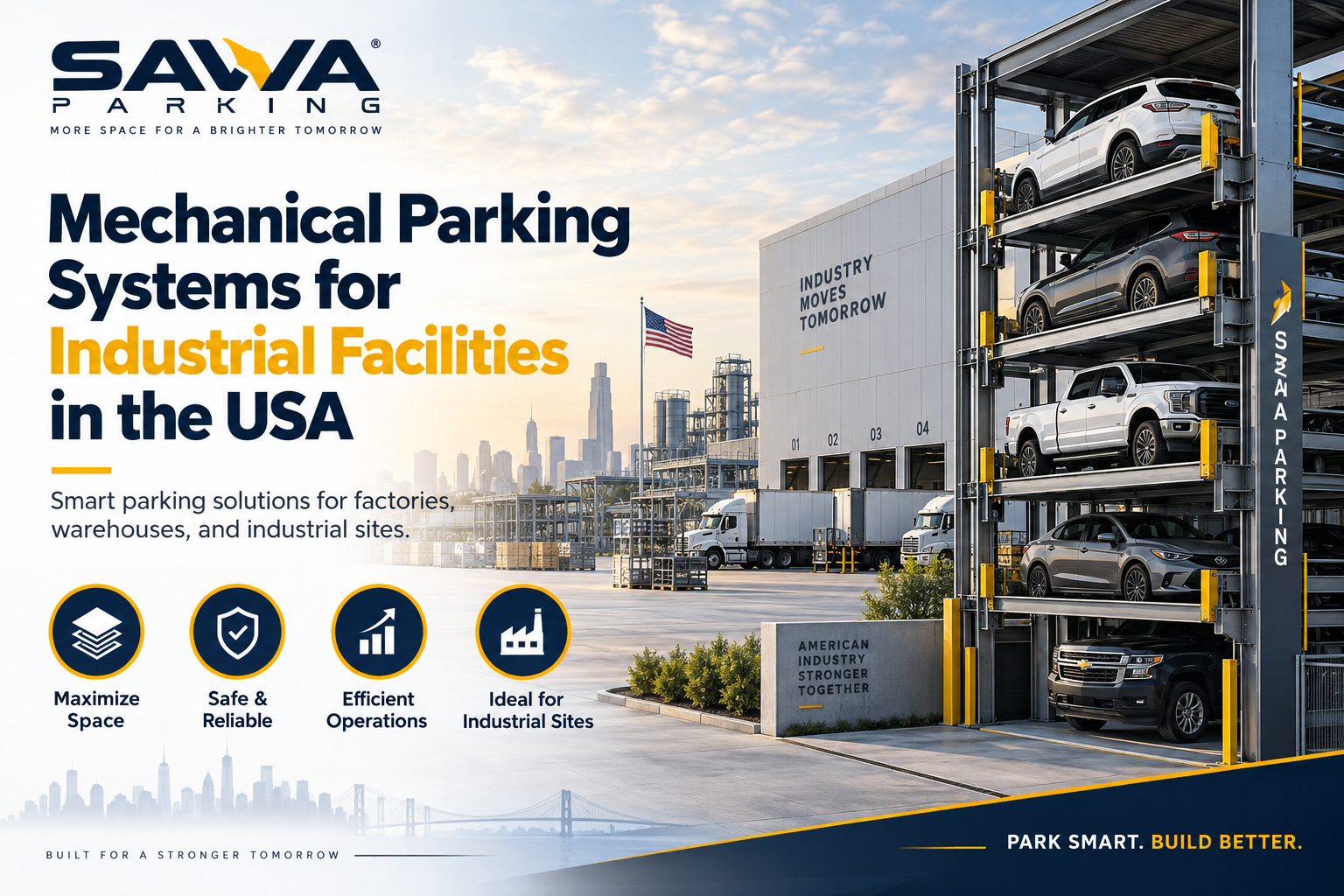
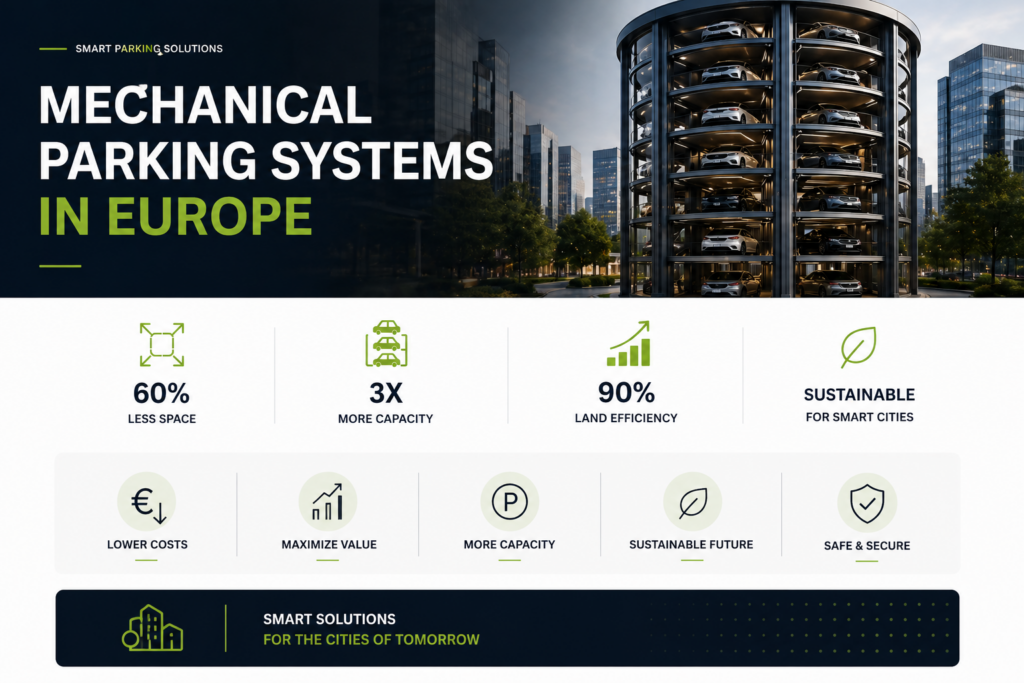
Mechanical parking systems for industrial facilities completely rewrite this mathematical paradigm. By utilizing automated platforms, lifts, or robotic shuttles, the human driver is removed from the parking equation. The system eliminates the need for driving lanes, pedestrian stairs, and oversized turning circles, compressing the spatial requirement per vehicle to as little as 15 to 18 square meters. For an American industrial developer, this represents a 50% to 60% reduction in the parking footprint. This spatial efficiency allows them to either reduce the overall land acquisition costs—a massive saving on a multi-million-dollar industrial plot—or reclaim the saved land to expand warehouse square footage, add more loading docks, or build auxiliary manufacturing facilities. To achieve this, developers can select from a highly specialized range of advanced parking products tailored to handle heavy industrial loads.
Workforce Logistics Optimization Through Mechanical Parking Systems for Industrial Facilities
An industrial facility is not an office building; it operates on rigid, high-volume shift schedules. Manufacturing plants and logistics hubs typically run on 24/7 cycles with major shift changes at 6:00 AM, 2:00 PM, and 10:00 PM. The transition between these shifts creates a massive, localized shockwave of traffic that traditional parking infrastructure is fundamentally ill-equipped to handle.
Eliminating the Shift-Change Bottleneck
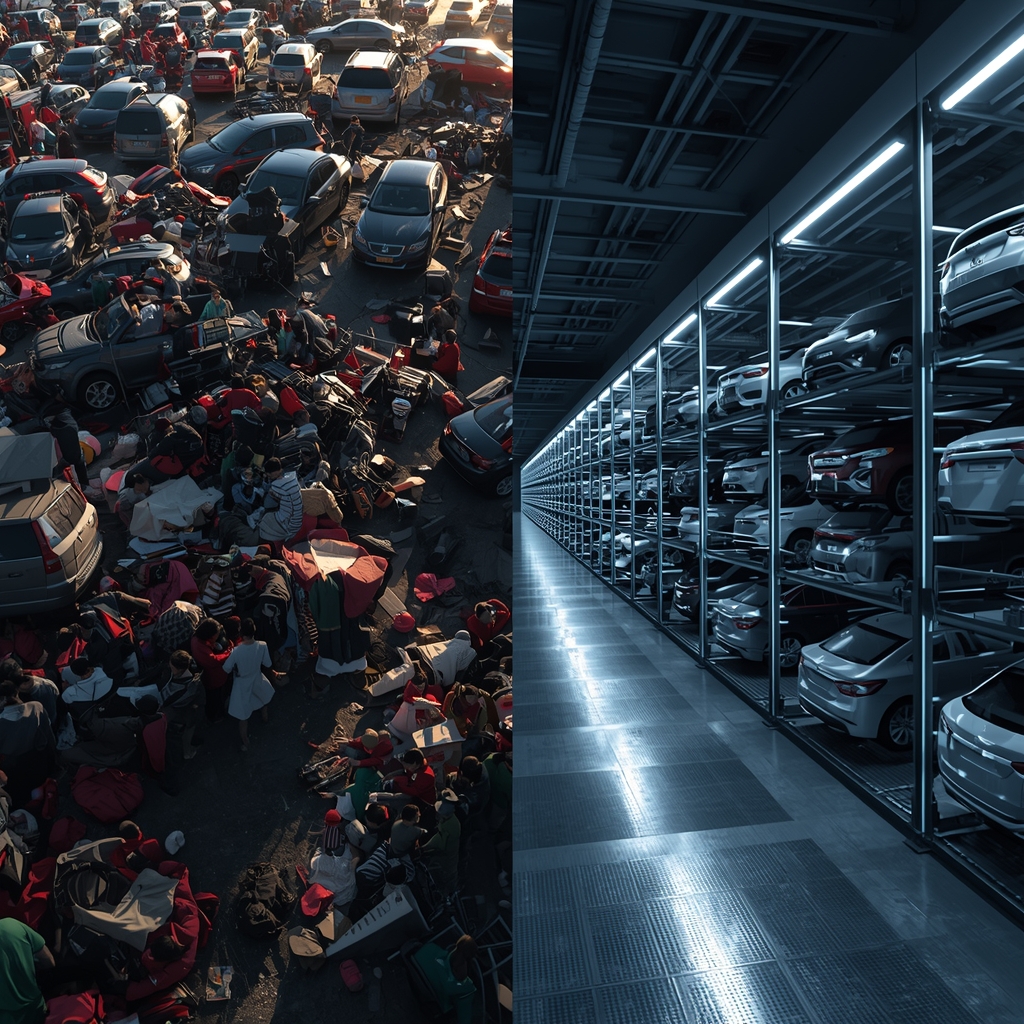
In a traditional industrial parking lot, the end of a shift results in hundreds of workers walking through rows of parked cars while hundreds of incoming workers are simultaneously driving through the same narrow aisles looking for spots. This creates severe traffic congestion at the facility gates, dangerous pedestrian-vehicle conflicts, and significant delays. Workers arriving for their shift may spend 15 to 20 minutes just navigating the parking lot, leading to lost productivity on the factory floor.
Mechanical parking systems for industrial facilities engineer this friction out of existence. The entry process is exponentially faster and strictly segregated. Workers pull into ground-level transfer cabins, exit their vehicles in under 60 seconds, and walk directly into the facility via secure pedestrian corridors. The automated machinery stores the cars simultaneously in the background. Because retrieval is also rapid—often under three minutes—the chaotic shift-change exodus is smoothed into a steady, controlled flow. Implementing these systems requires comprehensive end-to-end parking services to ensure the technology is perfectly synchronized with the facility’s complex shift schedules and HR management systems.
Fleet Security Enhancements Using Mechanical Parking Systems for Industrial Facilities
In the United States, cargo theft and the theft of commercial fleet vehicles have reached epidemic proportions, costing the logistics industry billions of dollars annually. Industrial facilities are prime targets. Traditional surface-level parking lots leave fleet vehicles—such as delivery vans, heavy-duty pickup trucks, and supervisor SUVs—highly exposed. They are vulnerable to catalytic converter theft, vandalism, break-ins for tools and equipment, and in some cases, outright vehicle theft.
Mechanical parking systems for industrial facilities transform fleet storage into a highly secure, impenetrable vault. Because the public and the workforce are entirely excluded from the parking grid, the vehicles are locked inside a human-free, structurally reinforced concrete or steel environment. The only way to access a specific vehicle is through the automated system’s software, which requires an authenticated credential (such as an RFID badge synced to the employee’s ID). This zero-human-contact environment virtually eliminates the risk of vandalism, parts theft, and unauthorized access. The global project portfolios of automated parking providers feature numerous industrial applications where this transition to high-security vaults has drastically reduced facility security liabilities and lowered insurance premiums.
Engineering Heavy-Duty Mechanical Parking Systems for Industrial Facilities
It is crucial to note that industrial parking is fundamentally different from retail or hospital parking. The vehicles stored at a manufacturing plant or logistics hub are not lightweight sedans; they are Ford F-250s, heavy-duty delivery vans, and commercial fleet trucks. These vehicles have significantly higher axle weights, longer wheelbases, and higher centers of gravity.
Robust Load-Bearing Engineering
Standard automated parking systems designed for passenger cars will fail under the continuous stress of industrial fleet weights. Therefore, mechanical parking systems for industrial facilities must be engineered with heavy-duty specifications. The steel pallets must be reinforced to handle gross vehicle weights exceeding 3,500 to 4,000 kilograms. The electric motors, chain drives, and hydraulic scissor lifts must be uprated to handle these massive loads thousands of times a day without mechanical fatigue.
Precision Manufacturing for Continuous Duty
An American manufacturing plant operates 24/7/365, often in harsh environmental conditions, including extreme heat in southern states or freeze-thaw cycles in the north. The duty cycle is relentless. This demands the absolute highest level of mechanical engineering and quality control. The precision manufacturing processes behind these heavy-duty automated systems ensure that high-tensile steel components, reinforced welds, and redundant safety sensors can withstand continuous, heavy-load operation. This guarantees that the parking machinery will not suffer from structural failure during critical production runs, matching the legendary reliability expected in American industrial engineering.
Environmental Compliance and Mechanical Parking Systems for Industrial Facilities
Industrial facilities in the United States operate under intense scrutiny from the Environmental Protection Agency (EPA) and local state environmental agencies. Obtaining permits for a new manufacturing plant or logistics hub often requires strict adherence to air quality, water runoff, and urban heat island mitigation standards. Traditional parking lots are a massive liability in the permitting process.
Mitigating the Urban Heat Island Effect
Acres of black asphalt traditional parking absorb immense amounts of solar radiation, creating “urban heat islands” that can raise the local temperature by several degrees. This not only affects the local microclimate but also increases the cooling load (and therefore the energy consumption) of the industrial facility itself. By condensing the parking footprint using mechanical parking systems for industrial facilities, developers can drastically reduce the amount of exposed asphalt, replacing it with permeable green spaces or building cover, making it significantly easier to secure environmental permits.
Eliminating Idling Emissions
In a sprawling traditional industrial lot, workers and delivery drivers routinely spend 10 to 15 minutes idling their heavy-duty engines while waiting for a parking spot or navigating the aisles. Diesel and gasoline exhaust from hundreds of vehicles concentrated in one area creates severe localized air quality issues. Automated parking eliminates this “cruising for parking” phenomenon. The heavy-duty truck or van is turned off the moment it enters the transfer cabin. Furthermore, because the automated parking grid is human-free, it does not require continuous high-intensity lighting or massive mechanical ventilation fans to extract exhaust fumes. Lights and fans only activate momentarily when a vehicle is being moved, resulting in massive electricity savings. Industrial architects looking to integrate these sustainable, permit-friendly infrastructure solutions can find valuable strategic insights by exploring a specialized parking technology blog.
Conclusion
The reshoring of American manufacturing and the exponential growth of e-commerce logistics represent a historic economic opportunity. However, realizing this potential requires abandoning outdated 20th-century infrastructure models. As industrial land becomes scarcer, environmental regulations tighten, and the need for fleet security intensifies, traditional parking paradigms are actively dragging down the efficiency and profitability of US industrial facilities. Mechanical parking systems for industrial facilities provide the definitive, engineered solution to this modern crisis. They maximize the utilization of high-value industrial land, eliminate the dangerous bottlenecks of shift changes, protect valuable commercial fleet assets in secure vaults, and ensure compliance with strict environmental mandates. By investing in heavy-duty automated parking infrastructure, American industrial developers are not just building a place to park trucks; they are optimizing their spatial capital to dominate in a highly competitive global market. To discover how these robust systems can be integrated into your next industrial facility master plan, we encourage you to contact our team for a specialized engineering consultation.
References & Scientific Sources
- Journal of Cleaner Production – Spatial optimization and land-use efficiency in modern manufacturing ecosystems: The role of automated vehicular storage in reducing industrial footprints. (Provides the academic foundation for calculating spatial footprint reductions and the opportunity cost of land used for traditional parking versus expanding production capacity).
- Accident Analysis & Prevention – Pedestrian-vehicle conflict analysis and occupational safety in heavy-traffic industrial shift-change environments. (Validates the safety argument regarding how traditional parking lots cause dangerous bottlenecks during shift changes and how automated segregation improves workforce logistics).
- Transportation Research Part D: Transport and Environment – Evaluating greenhouse gas emission reductions and heat island mitigation through automated parking infrastructure at logistics hubs. (Supports the environmental compliance claims, specifically regarding the elimination of heavy-duty idling emissions and the reduction in asphalt heat absorption).
- Security Journal – Asset protection and cargo theft prevention methodologies: A comparative study of traditional surface-level fleet parking versus human-excluded automated storage vaults. (Validates the security and liability reduction benefits of utilizing mechanical parking to protect high-value industrial and commercial fleet vehicles).